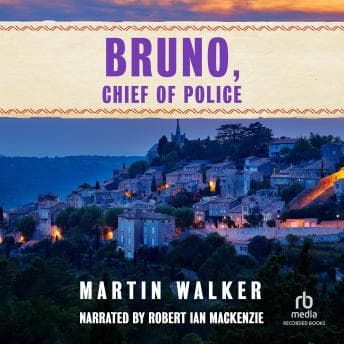

"Bruno made a mental note to buy more duck fat."
I don't remember the exact timestamp, but somewhere around hour three, our protagonist - the only cop in a small French village - is in the middle of a murder investigation and pauses to think about duck fat. And honestly? That's the whole vibe of this book. I was sitting in my driveway at 7:45 AM, engine off, night shift grime still on my scrubs, and I was genuinely more invested in whether Bruno's veal was going to turn out right than in catching the killer.
Let me explain why that's both a compliment and a warning.
A French Village Where Murder Is the B-Plot and Dinner Is the A-Plot
Martin Walker is a journalist, and you can feel it. The man knows his Périgord region the way I know the layout of a crash cart - intimately, obsessively, with the kind of detail that only comes from years of being there. Bruno CourrÈges isn't your typical mystery protagonist. He's a rugby-playing, market-shopping, wine-drinking chief of police who genuinely cares more about preserving his village's way of life than about solving crimes. The murder of an old Algerian immigrant sets things in motion, but Walker takes his sweet time getting there, layering in local politics, EU agricultural regulations (yes, really), and what felt like an entire chapter on how to properly prepare a truffle omelet.
And here's the thing - I didn't mind. Mostly. After twelve hours of trauma codes and ventilator alarms, listening to a man lovingly describe a French farmer's market was like someone handing me a warm blanket. The pacing is slow. Really slow. If you're coming into this expecting a Tess Gerritsen body-every-thirty-pages thriller, you will throw your phone out the window. This is not that book.
But when the story finally digs into the actual crime - the murder connects back to wartime North Africa, old racial tensions bubbling up in modern France, the kind of generational trauma that doesn't stay buried - it hits different. Walker deftly pulls the comfortable rug out from under you. I went from relaxed to genuinely unsettled in the last hour, and not because of gore. Because of how ordinary hatred can look when it's wearing a familiar face.
Mackenzie Gets the Quiet Parts Right
Robert Ian Mackenzie narrates this like he's telling you a story over a glass of Bergerac at a sidewalk café. His French pronunciations sound authentic - not the over-the-top "hon hon hon" parody stuff, but the casual way someone who actually lives in France would say place names and food terms. He gives Bruno this warm, grounded quality that makes you want to trust the guy immediately.
His character differentiation is subtle - tone shifts rather than full-on accent changes - which works for a story set almost entirely in one small community where everyone knows everyone. When Mackenzie reads the meal preparation scenes, there's genuine warmth there. You can almost smell the garlic.
But - and I have to be honest - the pacing issue that some listeners complain about? The narration doesn't help. Mackenzie's understated style is perfect for the cozy village stuff, but when the plot finally kicks into gear in the last fifteen minutes (I'm barely exaggerating), the shift feels abrupt. Like we've been simmering on low heat for eight hours and someone suddenly cranks the burner to high. I wanted more time with the climax. The resolution felt rushed compared to the hours I'd spent learning about local cheese production.
Also, there's one character - an American woman - whose accent felt off. Not terrible, just... noticeable in a way that pulled me out of the scene. Minor, but when everything else feels so authentically French, it sticks out.
This Is Not How Most Police Work Actually Works (But I'll Allow It)
As someone who's actually worked alongside law enforcement in an ER setting, Bruno's policing style is hilariously informal. The man solves crimes between tennis matches and dinner parties. There's no paperwork, no chain of custody concerns, no bureaucratic nonsense. It's fantasy policing, and I mean that affectionately. It's the cop equivalent of those medical shows where the doctor has one patient and unlimited time. We should all be so lucky.
The medical details that do pop up are minimal but not offensive. Nobody defibrillates a conscious patient. Small mercies.
Who Gets a Seat at Bruno's Table
If you love food, France, and mysteries that are more about atmosphere than body count - this is night shift approved. Perfect for that post-shift decompression when your brain needs something engaging but not aggressive. If you need constant action and plot twists, skip this and grab a Jack Reacher. Terminal List is what I reach for when my brain needs something with actual teeth - tighter pacing, higher stakes, and a narrator who doesn't pause to think about duck fat.
Carlos asked why I was Googling "truffle omelet recipes" at 8 AM. I blamed the audiobook. He blamed my entire personality.
The Discharge Orders
Solid start to a series. Not perfect - the pacing genuinely wobbles, and the climax deserved twice the page time it got. But Walker knows his setting like I know my unit, and that kind of authority is hard to fake. I'll be picking up book two on my next stretch of nights. Mostly because I need to know if Bruno ever gets his love life together, but also because I want more of that duck fat energy.