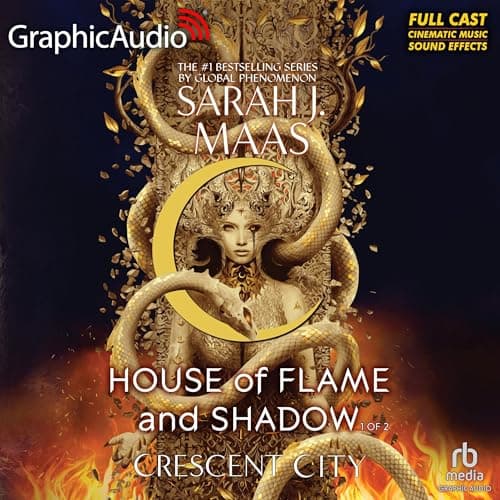
Everyone raves about Sarah J. Maas's dramatized adaptations like they're the second coming of audio entertainment, and honestly? They're mostly right this time. I went into House of Flame and Shadow's dramatized version expecting a gimmicky full-cast production that prioritizes spectacle over substance, but what I got was something that genuinely elevated a complex, multi-threaded narrative into something far more digestible and emotionally potent than the standard audiobook.
Let me back up. This is Part 1 of 2 of the third Crescent City novel, adapted for a full cast of what feels like half the voice actors in the industry — seriously, the credits list reads like a small town's phone book. And that massive ensemble actually works in the story's favor. Bryce is stranded in a world that isn't Midgard, Hunt is rotting in the Asteri's dungeons, and multiple storylines are unspooling simultaneously. With a single narrator, keeping track of who's where and doing what can feel like homework. With distinct voices for each character, sound effects grounding you in different environments, and cinematic scoring that shifts tone with each thread, the whole thing clicks into place like puzzle pieces.
Colleen Delany and the core cast carry the emotional weight well. The torture scenes, the moments of desperation, the quieter beats of characters grappling with impossible choices — they all land with more force when you hear genuine vocal performance rather than one narrator cycling through impressions. Kit Swann and Devon Lexington bring distinct energy to their roles, and Jonathan David Bullock handles Hunt's confined, desperate arc with real conviction. Not a single performance feels phoned in, which is impressive given the sheer number of actors involved.
Now here's where I have to be straight with you: there's a known audio issue around the two-hour mark where a separate narration track bleeds through faintly in the background. It's not catastrophic, but if you're the kind of listener who picks up on ambient irregularities — and I am — it'll pull you right out of the scene. It's the kind of production hiccup that shouldn't exist in a premium dramatized release, and it knocked my confidence in the technical polish for a stretch after I noticed it. The mix overall feels slightly rougher than what GraphicAudio typically delivers, though it's never bad enough to ruin the experience.
Maas's writing here is doing a lot — maybe too much for some readers. The overlapping storylines create a dense web, and even with the full cast making things easier to track, this isn't background listening material. I tried it during a run and found myself rewinding constantly because the plot demands your attention. The world-building is extensive, the political machinations are layered, and if you haven't read the first two books recently, you might feel lost. This adaptation assumes you're caught up and doesn't slow down to hold your hand.
What the dramatization does exceptionally well is pace the violent and intense sequences. Maas doesn't shy away from darkness — there's torture, confinement, war, death, and the weight of slavery woven throughout — and the sound design makes these moments visceral without being gratuitous. The cinematic music swells at the right moments and pulls back when the story needs to breathe. It's the difference between reading a screenplay and watching the movie. That same cinematic quality pulled me into Well of Ascension — Sanderson's layered siege sequences hit different when the sound of the world is fully realized in your imagination.
The sexual content is present but handled with appropriate cast dynamics, and the romantic tension between Bryce and Hunt carries genuine heat even when they're separated for most of this first part. That separation is actually one of the story's strongest choices — the longing and desperation feel earned rather than manufactured.
My main reservation is that this is explicitly Part 1 of 2, so you're committing to purchasing both halves for the complete story. At 13 hours, this first part covers substantial ground, but you will hit a stopping point that demands you continue. It's not quite a cliffhanger in the traditional sense, but it's close enough that you should budget for both parts before starting.
Who Should Listen (And Who Should Skip)
For Crescent City fans who struggled with the density of the standard audiobook, this dramatized version is the way to experience this story. The full cast transforms what could be a confusing juggling act of perspectives into something dynamic and immersive. If you haven't read the first two books, or you're hoping for something you can half-listen to on a commute — skip it. You'll be lost inside fifteen minutes. But if you're caught up and ready to lock in, grab decent headphones, give it your full attention, and maybe skip past that two-hour mark quickly if the background audio bleed bothers you.