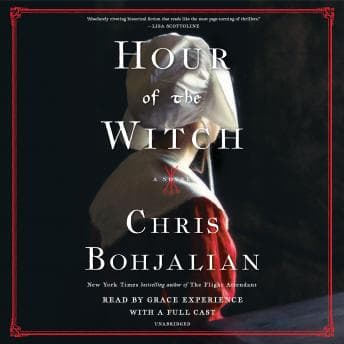

"I am Mary Deerfield, and I am not a witch."
That line hit me somewhere around hour three, and I had to pause my work because my hands were shaking. Not from the design project I was ignoring—from rage. Pure, hot, centuries-old rage at how little has changed for women trying to escape men who hurt them.
Look, I picked this up because Julia Whelan's name was on the narrator list. My queen. My comfort voice. And she IS here, but—and this is where I need to be honest with you—she's not the main narrator. Grace Experience carries the bulk of this story, and I have... feelings about that.
The Voice That Carries Mary's Pain
Grace Experience does something interesting here. Her delivery is measured, careful, almost restrained. At first? I was frustrated. Where's the fire? Where's the desperation of a woman whose husband just stabbed her hand with a fork? But then I realized—oh. OH. This is intentional. This is how Mary survives. She keeps herself small, controlled, because showing too much emotion in 1662 Boston gets you accused of being possessed by the devil.
The full cast narration for the court scenes and official documents is genuinely well done. When the other narrators step in—Julia, Saskia Maarleveld, Mark Bramhall—you feel the weight of the community pressing in on Mary. These aren't just voices; they're the walls closing in.
But I won't lie to you. There were moments, especially in the middle stretch, where I wished for more emotional variation from Experience. Some scenes that should have gutted me just... didn't land the way they could have. I kept thinking about how Julia Whelan would have delivered certain lines, and that's maybe not fair, but it's honest.
When History Becomes a Mirror
Here's the thing that wrecked me about this book—and I say this as someone who ugly-cried designing a logo for a pet grooming company, so take that as you will. The story isn't really about witches. It's about what happens when a woman says "he hurts me" and an entire community decides she must be the problem.
Mary goes to court to divorce her abusive husband. In 1662. The AUDACITY of this woman. And the men in power twist themselves into knots explaining why she should go back to him, why she's exaggerating, why maybe she did something to deserve it. That same gaslighting, that same institutional betrayal of women trying to escape violence—it's exactly what gutted me in It Ends With Us, just without the Puritan dress code.
I had to stop listening during my afternoon work session because I was getting tears on my tablet. Abuela would have been screaming at this book like it was a telenovela. "¡Déjalo, mija! Leave him!" She would have hated every single man in this colony and she would have been RIGHT.
Bohjalian did his homework—the period language is dense but never confusing, and you really feel the suffocating weight of Puritan society. Every neighbor watching. Every word analyzed for signs of the devil. It's a slow burn, and I mean SLOW. This is not a thriller despite what the marketing says. It's a courtroom drama wrapped in historical fiction wrapped in a meditation on how society punishes women for wanting freedom.
The Pacing Problem (And Why I Still Recommend It)
Okay, real talk. Around hour eight, I was getting antsy. The repetitive phrases—so many references to "the pestle" and "the devil's fork"—started to wear on me. I found myself zoning out during some of the testimony scenes, which is wild because I usually live for courtroom drama.
I think this is where the narration style hurt the story. A more dynamic delivery might have kept the tension tighter during the slower stretches. Experience gives the material reverence, absolutely. But reverence isn't always what a story needs. Sometimes it needs fire.
That said? The ending got me. I won't spoil it, but it's both unexpected and earned. I actually gasped out loud, which startled Diego off my lap (Frida was unbothered, as always).
Who Needs This Righteous Fury (And Who Should Skip)
If you love historical fiction that makes you want to throw things at the patriarchy, this is your book. If you connected with the domestic abuse themes in Colleen Hoover's work, Mary Deerfield's story will hit you just as hard—maybe harder. But if you need fast pacing or can't handle slow-burn courtroom tension, you might bounce off the middle section.
My Heart Is Still in 1662 Boston
Honestly? I'd probably read the physical book next time. The writing is beautiful and precise, and I think seeing those Puritan phrases on the page would hit differently than hearing them in Experience's measured tone.
But for a first experience—especially if you're commuting or doing something with your hands like I was—this audiobook works. Just know what you're getting into. It's not a page-turner in the traditional sense. It's a slow simmer of dread and hope and fury.
This book felt like sitting in a cold church pew, waiting for someone to believe you. It felt like every woman who's ever been told she's overreacting. It felt like history reaching across centuries to grab you by the throat.
My heart. MY HEART.
The vibes are immaculate if you're in the mood for righteous anger and historical pain. This is a rainy Sunday book, or a long road trip book, or a "I need to feel something real" book. Just maybe bump it up to 1.15x during the middle section. You'll thank me.