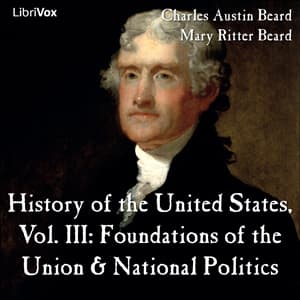

"The Civil War, however, was more than a528 528 528 sectional528 struggle..." — or something close to that. I'm paraphrasing from memory because the Beards had this way of dropping quiet bombs in the middle of what reads like a standard textbook paragraph. I caught that line somewhere around the ninety-minute mark while cleaning my Beretta at the kitchen table. Linda was already asleep. Ranger was sprawled across my feet. And Charles and Mary Beard were calmly dismantling every comfortable myth I'd absorbed in high school about American economic history.
Let me cut to the chase: this is a free LibriVox recording of a 1921 textbook. You need to calibrate your expectations accordingly. But if you do that — and I mean really do that — there's something genuinely valuable buried in here.
The Beards Had Receipts Before That Was Cool
Volume III covers roughly the post-Civil War era through the early twentieth century — Reconstruction, the Gilded Age, the rise of industrial monopolies, labor unrest, and America stumbling onto the world stage. What struck me is how the Beards approach history like an intelligence briefing rather than a timeline. They don't just tell you what happened. They tell you why the money moved the way it did, who benefited, and what political structures enabled it. The chapter on tariff politics and its relationship to industrial growth reads like a strategic assessment, not a lecture. For a book written over a hundred years ago, their analysis of how economic interests shape political coalitions feels uncomfortably current.
Mary Beard's influence shows up in the sections on labor and women's suffrage. There's a passage — I wish I could give you the exact timestamp but the chapter breaks aren't clean — where they lay out the economic argument for women's entry into the workforce during industrialization. It's not sentimental. It's structural. They treat it like a force multiplier for the economy, which honestly is how I'd brief it.
The writing itself is sharp for a textbook. Short sentences. Clear thesis statements at the top of sections. The Beards wrote for students but respected their intelligence, and you can feel that.
The LibriVox Problem (And It's a Real One)
Here's where it gets rough. The narration is handled by LibriVox volunteers, and the quality swings wildly. Some readers are genuinely good — clear diction, steady pace, comfortable with the material. Others sound like they're reading cold off a page they've never seen before. The real killer is the editing. There are audible cuts, inconsistent volume levels between chapters, and at least two spots where I heard what sounded like a re-take that wasn't trimmed properly. One chapter transition had a solid three seconds of dead air that made me check if my phone had disconnected.
At 1.25x speed, the stronger readers work fine. The weaker ones get a little muddled. I wouldn't go faster than that.
Look, it's free. The volunteers are donating their time to make century-old books accessible. I respect the mission. But I'd be lying if I said the production quality doesn't pull you out of the material at points. If you're used to polished Audible productions with professional narrators, this will test your patience. If you grew up listening to scratchy radio transmissions in a TOC at 0300, you'll manage.
Who This Is Actually For
This isn't for the casual listener who wants a breezy American history overview. At 3 hours and 26 minutes for just Volume III, you're getting a dense, analytical treatment of a specific era. It's dry in places — this was written as a college textbook, and it occasionally reads like one.
But if you're the type who reads primary sources for fun, or if you want to understand how historians thought about American development a hundred years ago, it's worth your time. There's real intellectual value in hearing how the Beards framed Reconstruction and industrialization before decades of revisionist scholarship reshaped the conversation. You're getting a period document as much as a history book. The same thing happened to me with Faithful Executioner — another book that works on two levels simultaneously, as history and as a window into how people of a particular era actually reasoned about justice, power, and accountability.
Corporate types I work with who want to understand the deep roots of American economic policy? I'd actually point them here. The Beards connect dots between tariffs, banking, railroad expansion, and political power in ways that still map onto modern debates.
Ranger slept through most of it. But Ranger also sleeps through thunderstorms, so that's not a reliable metric.
Worth Your Time? Here's the Debrief
Free audiobook of a genuinely important historical text, hampered by inconsistent volunteer narration and rough editing. The content earns a solid recommendation. The production earns a wince. If you can tolerate the audio rough edges — and honestly, for a free resource, you should try — the Beards' analytical approach to American history holds up better than most textbooks from any era. Just don't expect it to compete with a Ron Chernow production. Different mission entirely.






![Steve Jobs [unabridged audiobook] audiobook cover](/_next/image?url=https%3A%2F%2Fcovers.audiobooks.com%2Fimages%2Fcovers%2Ffull%2F9788499923406.jpg&w=1920&q=75)