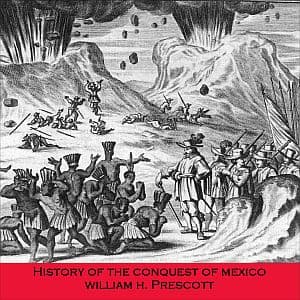

Let me cut to the chase: this is 24 hours of 19th-century prose about one of history's most audacious military campaigns, read by volunteers of varying skill levels. And somehow, against all odds, it works.
I finished this one over a two-week stretch of early morning runs with Ranger. There's something fitting about listening to Cortés march through hostile territory while you're huffing through pre-dawn Texas humidity. The conquistadors didn't have AC either.
The Original War Correspondent
Prescott wrote this in 1843, which means you're getting Victorian-era prose - formal, precise, and occasionally dense enough to stop a musket ball. But here's what surprised me: the man knew how to tell a war story. His descriptions of the siege of Tenochtitlan, the street-by-street fighting, the tactical decisions Cortés made with a force of maybe 500 Spaniards against an empire of millions - this reads like a staff college case study wrapped in literary language.
What Prescott understood, and what a lot of modern historians miss, is that military history isn't just about battles. It's about logistics, morale, and the thousand small decisions that determine whether your force survives the night. He tracks Cortés's supply problems, his alliance-building with tribes who hated the Aztecs, his handling of mutinous subordinates. I've seen this scenario play out in real life - small forces operating in hostile territory, dependent on local allies who have their own agendas. The parallels are uncomfortable and instructive.
The LibriVox Situation
Here's where I have to be honest. LibriVox is volunteer-driven, which means you're getting a rotating cast of readers with different accents, different skill levels, and different interpretations of Spanish and Náhuatl pronunciation. Some sections flow beautifully. Others - and I won't pretend otherwise - sound like someone reading aloud for the first time.
The project apparently had some missing and duplicate sections early on that got corrected, so if you're listening now, that's been fixed. But the variation in reader quality remains. One chapter you'll get someone who clearly understands the material and brings gravity to descriptions of Aztec religious ceremonies. Next chapter, you might get someone who stumbles over "Montezuma" like they've never seen the word before.
I listened at 1.25x, which helped smooth out some of the slower readers and kept the momentum going during Prescott's more elaborate passages. Recommend you do the same unless you've got unlimited patience.
What Prescott Got Right (And Wrong)
The author clearly did his homework for his era. He worked from primary sources - letters from Cortés, accounts from soldiers who were there. His military analysis is solid. His descriptions of Aztec society, their calendar systems, their architecture - he's genuinely trying to understand a civilization most Europeans of his time dismissed as savages. That same effort to understand indigenous perspectives on their own terms comes through powerfully in Geronimo's Story of His Life, though there you're getting the story directly from the source.
But - and this matters - he's still a 19th-century American writing about indigenous peoples. There's a paternalistic tone that creeps in, a sense that the conquest was somehow inevitable, maybe even necessary. Modern scholarship has complicated this picture considerably. You need to listen with that historical lens in mind. Prescott wasn't wrong about the facts as he understood them, but his interpretation reflects his time.
The violence is described matter-of-factly, which somehow makes it more affecting. Prescott doesn't sensationalize the massacres, the human sacrifice, the brutal reprisals. He just... reports them. I saw that same restraint in Dressmakers of Auschwitz - when you're dealing with historical atrocity, the facts carry their own weight. Like a man who's read enough battlefield accounts to know that horror doesn't need embellishment.
Who Should Saddle Up (And Who Should Stand Down)
This is for people who want to understand how empires fall. If you're interested in military history, colonial history, or just want to know what happened when two civilizations collided with catastrophic force, Prescott remains essential reading nearly two centuries later. Skip it if you need polished production values or can't handle older prose styles. This isn't a slick Audible original. It's a free recording of a classic text, with all the rough edges that implies.
SITREP
Worth your time? Here's the debrief: you're getting one of the foundational texts of American historical writing, free, with imperfect but serviceable narration. The content is excellent. The production is what it is. For 24 hours of genuine historical insight, the price is right - you're paying in patience rather than credits. Ranger approved this one, though he fell asleep during the chapters on Aztec mythology. Can't blame him. Those ran long.