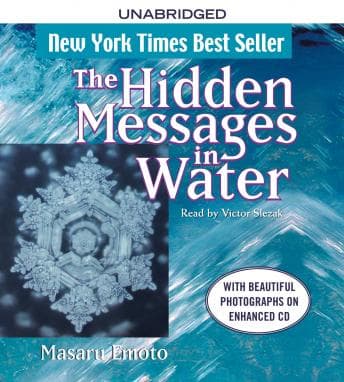

Jenny caught me at 1 AM in the kitchen, staring at a glass of water on the counter like it owed me money. "Are you... talking to the water?" she asked. I was not talking to the water. I was thinking at the water. There's a difference. Apparently. According to Dr. Masaru Emoto, anyway.
Look, I need to be upfront about something before we go any further.
My Parents' Dry Cleaning Business Did Not Run on Vibes
Bottom line: This book makes extraordinary claims - that human thoughts and words can physically alter the crystalline structure of frozen water - and provides essentially zero rigorous scientific evidence to back them up. Emoto's "high-speed photography" methodology wouldn't survive a first-year stats class. No control groups. No blinding. No peer review worth mentioning. He photographs ice crystals, picks the pretty ones that formed after exposure to "love" and the ugly ones that formed after exposure to "hate," and calls it science.
My parents spent 14-hour days pressing shirts. You know what they'd call this? They have a Korean word for it that I won't translate here, but it roughly means "nice story, now get back to work."
At 2 hours and 26 minutes, this is mercifully short. Even at 1.0x speed you're done before lunch. And I'll give Emoto this - the ideas are poetic. Water as a mirror of consciousness. The notion that gratitude has a physical shape. There's something almost beautiful about it as philosophy. But he doesn't sell it as philosophy. He sells it as science. And that's where I start checking my watch.
Victor Slezak Doing His Best With What He's Got
Victor Slezak narrates with a calm, measured tone that pairs well with the gentle background music running underneath. It's a nice production choice - gives the whole thing a meditative quality, like a guided reflection session. Slezak reads Emoto's words with genuine sincerity, and the pacing is steady without dragging.
Here's the problem nobody warned me about: the book constantly references photographs. Crystal images. Visual comparisons between water exposed to Mozart versus water exposed to heavy metal. And you're listening to an audiobook. You can't see any of it. It's like someone describing a sunset to you for two hours while you sit in a closet. Slezak will say something like "as you can see in this photograph" and you're sitting there in your car seeing nothing but brake lights. This is a fundamental format mismatch that should've been addressed in production - maybe with longer descriptive passages or a companion PDF. They did neither.
The music is genuinely pleasant, though. Gentle enough to complement without competing. If nothing else, this audiobook functions as a decent ambient listening experience.
The McKinsey in Me Is Screaming
I've sat in boardrooms where executives pitched ideas with less evidence than Emoto provides here, and those people got funded. So maybe I shouldn't be surprised this became a New York Times bestseller. But eight years of consulting trained me to ask one question: "Where's your data?"
Emoto's answer is essentially: look at these pretty crystals. The book starts with an interesting premise - water has memory, human intention shapes matter - and then instead of building a rigorous case, it spirals into claims about how words taped to water bottles change molecular structure. By the second half, we're deep into territory where he's assigning emotional meaning to crystal shapes with the confidence of a man who has never had a hypothesis rejected.
I've seen this pattern at three different companies: a charismatic founder with one interesting observation extrapolates it into a universal theory, skips the hard work of validation, and packages it as revolution. Sometimes they raise a Series A. Sometimes they write a bestseller. The outcome is the same - eventually someone asks for the receipts.
Who Gets Value Here (Honestly)
If you approach this as a spiritual meditation on gratitude and intentionality - not as science - there's something here. The idea that how we speak to ourselves and others matters? Sure. My mom knew that. She didn't need ice crystal photography to tell her that saying kind things was better than saying cruel ones. This is what my parents did instinctively. Now it has a TED talk.
If you're looking for evidence-based self-help, this ain't it. If you're a science-minded listener, you will spend 2 hours and 26 minutes arguing with your earbuds.
Jenny would say I'm being harsh. Jenny is right. But also - I'm not wrong.
The Consulting Fee
At 2.5 hours, the time investment is minimal, and the production quality with Slezak's steady narration and ambient scoring makes it a smooth listen. But spending a credit on something you could get the core idea of from a 5-minute YouTube video? That math doesn't work. The key takeaway - be intentional with your words and thoughts - is worth hearing. The pseudoscience scaffolding around it is not worth paying for. My review of Brewing covers a book that handles a similarly gentle, meditative premise with at least some intellectual honesty about what it is and what it isn't. Borrow it from the library. Think kind thoughts at it while you listen. Can't hurt.