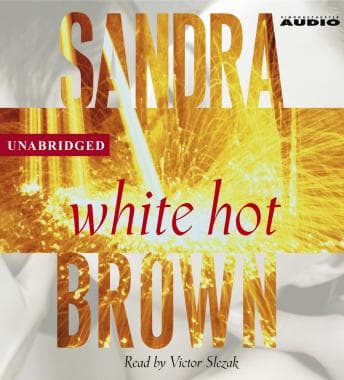

I was halfway through a stack of sophomore essays on The Great Gatsby — it was maybe 11:30 on a Tuesday night, Denise already asleep — when I realized I needed something to keep me from writing increasingly unhinged margin comments. So I queued up Sandra Brown's White Hot, figuring a Southern thriller would be the literary equivalent of a strong cup of coffee. What I got was more like bourbon. Smooth going down, a little messy by the end, but I don't regret a drop.
The Foundry Town That Swallows Its Own
Let me tell you what Sandra Brown does well here: she builds a town you can smell. Destiny, Louisiana, is one of those places where the single industry — in this case, an iron foundry — functions as both economic lifeline and moral stranglehold. The Lynch family owns the foundry, owns the town, and basically owns the oxygen. When Sayre Lynch returns after her younger brother Danny's apparent suicide, she's walking back into a family that operates less like relatives and more like a cartel with better table manners.
This reminds me of what Faulkner said about the past not being dead, not even being past. The Lynch patriarch, Huff, is a portrait of small-town tyranny so complete that you almost admire the architecture of his corruption. And Sayre's older brother is the kind of enabled sociopath who makes you realize the real horror of families isn't the violence — it's the complicity. When the suicide gets reclassified as homicide, the story cracks open into something genuinely tense. Brown knows how to lay dynamite under a dinner table and make you wait for someone to light a match.
The twist with Beck Merchant — the family's new lawyer who clearly has his own game running — is where the romantic suspense engine kicks in. And look, I teach Brontë and Austen. I know sexual tension on the page. Brown writes it with a directness that would make my AP Lit students blush and my colleague Mrs. Patterson clutch her lanyard. It's not subtle. But the power dynamics between Sayre and Beck — her suspicion of his motives, his genuinely murky loyalties — give the heat some actual stakes. That matters.
Victor Slezak and the Bourbon Voice Problem
Here's where I have to be honest, because the narrator situation is... complicated. Victor Slezak has a voice that's perfectly suited to Sandra Brown's world — deep, Southern-adjacent, with a kind of whiskey-soaked gravity. When he's locked in, particularly during the suspense sequences and the confrontations between Sayre and Huff, he's genuinely good. He shifts point of view between characters with enough distinction that you're never lost, and his pacing during the final act — that explosive ending several listeners mention — is well-handled.
But. There's a slurring issue that crops up, particularly in dialogue-heavy passages. Words run together. Diction gets muddy. I noticed it most during quieter conversational scenes, the ones where you need crisp delivery because the plot information matters. It's not constant, and honestly, after the first couple of hours my ear adjusted. But if you're someone who needs razor-sharp articulation — and I say this as a man who spends his days enunciating vocabulary words at teenagers who are secretly watching TikTok under their desks — it might grate on you.
I listened at 1.0x because the author chose those words and I choose to hear them properly. But I'll admit: at 1.0x, fourteen hours is a commitment, and Slezak's delivery occasionally drifts toward monotone during the middle stretch. The pacing of the book itself sags a bit around hours six through nine. Brown is setting up dominoes, and you can feel the arrangement happening, which isn't always thrilling to sit through.
Who Gets Burned and Who Should Walk Away
If you loved Brown's Envy or you're looking for romantic suspense that actually earns the "suspense" half of the label, this delivers. The family dynamics are nasty in a satisfying way, the setting has genuine texture, and that ending genuinely surprised me — I was grading a particularly painful essay on symbolism when the final revelation hit, and I actually put my red pen down. That doesn't happen often.
But if you need literary prose or a narrator who never stumbles, this isn't your book. Brown writes for momentum, not poetry. The prose deserves to be consumed, not savored. I noticed something similar in my time with Wild Sheep Chase — another book where the forward pull of the story is doing most of the heavy lifting, and you stop caring about the sentences because you need to know what happens next. And Slezak's performance is the kind that half the room loves and half the room tolerates. I landed somewhere in between — appreciative of his strengths, occasionally wincing at the diction.
My students would probably love this, actually. Which means I'll never tell them about it.
Worth Pausing the Red Pen For
Sandra Brown knows her craft the way a carpenter knows joinery — nothing fancy, everything functional, and the structure holds. White Hot isn't going to change your life, but it'll keep you company through a long drive or a late night of grading, and it'll land a couple of punches you don't see coming. For a genre that often settles for formula, that's worth something. Just give Slezak a few chapters to warm up. He gets there.