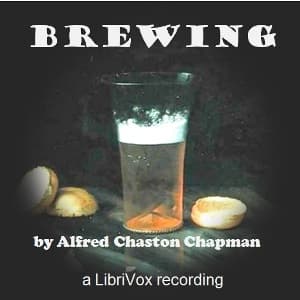

A 1912 Cambridge manual on brewing science is not what I expected to be listening to at 6 AM while reviewing a client's go-to-market strategy. And yet here we are.
Alfred Chaston Chapman's "Brewing" is a relic - and I mean that as genuine praise. This is a British chemist from over a century ago, absolutely convinced that brewing beer represents one of humanity's greatest contributions to scientific advancement. His argument? That the desire to understand fermentation drove discoveries in chemistry and biology that we still benefit from today. It's the kind of thesis my parents would have laughed at. "You're telling me beer made science?" my dad would say, shaking his head over the dry cleaning machines.
But Chapman makes his case. And at under three hours, he respects your time doing it.
When Yeast Was Still a Mystery
The historical context here is genuinely fascinating. Chapman writes from an era when the scientific understanding of fermentation was still being established. Pasteur's work on yeast was relatively recent history. The book treats brewing as a legitimate scientific discipline worthy of academic study - which, in 1912, was apparently a controversial position. Chapman explicitly states in his preface that he's fighting against the "widely spread impression" that brewing is just a "simple and more or less mechanical" operation.
This is business history, really. An industry fighting for legitimacy, investing in R&D before we called it R&D, and producing fundamental scientific breakthroughs as a byproduct of trying to make better beer. My McKinsey brain loves this. Innovation doesn't always come from the places you expect. Under the Black Hat makes a similar case for professional wrestling as a legitimate business discipline—another industry that had to fight for intellectual credibility.
The Narrator Situation
MaryAnnS delivers what I'd call a competent public domain audiobook reading. No dramatic flourishes. No distinct character voices - which, to be fair, this isn't that kind of book. It's a scientific manual. She reads it clearly, at a steady pace, without stumbling over the early 20th century technical terminology. That's the job, and she does it.
Is it going to win any Audie awards? No. Does it get the information from Chapman's brain into yours without friction? Yes. For a free or cheap LibriVox-style production, that's the correct bar to clear.
I listened at 1.75x (couldn't quite hit my usual 2.0x - the technical passages needed a beat to process) and it held up fine.
Who Should Listen (And Who Should Skip)
Here's where I have to be honest: this is a niche product. If you're in the craft brewing industry and want historical context for your craft, this is gold. If you're a business history nerd who gets excited about how industries professionalize themselves, there's real value here. If you're writing a paper on the history of applied science, Chapman is a primary source.
If you're looking for a fun audiobook about beer? Skip it. Chapman is writing for academics and serious industry professionals of his era. The prose is dense, formal, and assumes you care about the chemical composition of barley at a molecular level.
Jenny asked what I was listening to and I said "a 1912 brewing manual" and she just stared at me for a solid five seconds before walking away. Fair.
The ROI Calculation
At 2 hours 54 minutes, this is a quick listen. The key insight - that brewing drove fundamental scientific discovery and deserves respect as a knowledge-generating industry - lands in the first 30 minutes. The rest is supporting evidence and technical detail.
For the right listener, this is a satisfying deep-dive into a forgotten corner of industrial history. For everyone else, it's going to feel like homework.
Bottom line: Chapman was right that brewing deserves more intellectual respect than it gets. Whether his century-old argument for that respect deserves your three hours depends entirely on how much you care about the history of fermentation science. I found it oddly compelling - but I also read annual reports for fun, so calibrate accordingly.