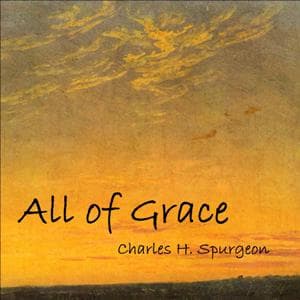

"Grace is the free, undeserved goodness and favor of God to the undeserving."
I hit pause on that line somewhere around the forty-minute mark, standing at the kitchen counter while Denise made coffee. She asked why I was staring at the toaster like it had insulted me. I wasn't staring at the toaster. I was thinking about how Spurgeon managed to distill Reformed theology into a sentence my freshman students could understand—and how that's actually harder than writing a dissertation.
The Prince of Preachers Speaks Plainly
Charles Spurgeon wrote this in 1894, and here's what strikes me: the man preached to crowds of thousands in Victorian London, yet All of Grace reads like he's sitting across from you at a pub, genuinely worried about your soul. There's no theological gatekeeping here. No Latin phrases to make you feel small. Spurgeon takes the doctrines of grace—election, justification, sanctification—and strips away every pretension until you're left with something almost embarrassingly direct.
This reminds me of what Hemingway said about writing true sentences. Spurgeon's doing the same thing with theology. Each chapter builds on the last: What is faith? How do you get it? What happens after? He's constructing an argument the way a good teacher would, checking for understanding before moving forward. My students would hate this. I love it.
The prose deserves to be savored, honestly. Spurgeon has this Victorian formality that never becomes stuffy—sentences that roll with genuine rhetorical power. "Come and welcome" becomes a refrain. "Believe and live" echoes through the chapters. The repetition isn't lazy; it's liturgical. The man understood that some truths need to be said multiple ways before they stick.
The Narration Problem (And Why You Might Push Through Anyway)
Here's where I have to be honest with you, because that's what we do here.
MaryAnn Spiegel reads this like she's transcribing a document rather than proclaiming good news. The pitch stays level. The tempo never shifts. Spurgeon wrote exclamation points—you can feel them on the page—but they don't translate into her delivery. It's the audio equivalent of reading a love letter in a monotone. The words are right. The music is missing.
At three and a half hours, this is a manageable commitment, but I found myself drifting during faculty meetings more than usual. (Principal Martinez, I definitely heard your thoughts on the new attendance policy. I did not.) The content kept pulling me back, but the performance kept letting me go.
I'll say this: LibriVox recordings are volunteer work, and there's something beautiful about people giving their time to make classic texts accessible. But if you're used to professional narration—the kind where a reader interprets rather than recites—this will test your patience. I bumped the speed to 1.15x and found it helped the pacing considerably.
Why We Still Read the Victorians
Here's what I kept thinking about on my lakefront walks this week: Spurgeon wrote this specifically for people who weren't going to church. He says so in the preface. He wanted something a factory worker could pick up, something a skeptic might stumble across. The whole project assumes that complicated ideas can be communicated simply without being dumbed down.
We've largely lost that confidence. Academic theology gets more specialized. Popular Christianity gets more shallow. Spurgeon was doing something in the middle—rigorous but accessible, serious but warm. The chapters on "How May Faith Be Illustrated?" and "Why Are We Saved by Faith?" could be taught in a seminary or handed to someone who's never cracked a Bible. That's rare.
The book is also surprisingly short on guilt. For a Victorian preacher, Spurgeon spends remarkably little time on hellfire and remarkably much time on invitation. "Come and welcome"—that phrase again. There's an urgency here, but it's the urgency of someone who genuinely believes he has good news, not someone trying to frighten you into compliance.
Who This Is For (And Who Should Skip It)
If you're interested in the history of Protestant thought, this is essential listening—Spurgeon influenced everyone from Billy Graham to your local Baptist church. If you're exploring faith or returning to it after years away, the directness might be exactly what you need. But if flat narration pulls you out of audiobooks entirely, consider finding a different recording first. The content is first-rate; the delivery is adequate.
If you loved Mere Christianity, this is its spiritual predecessor—less philosophical, more pastoral, but working the same territory. For something that explores faith through a completely different lens—messy, contemporary, and full of secrets—Two Truths and a Lie might surprise you. Lewis read Spurgeon. You can hear the echoes.
Late Nights and Stubborn Hope
I finished it while grading papers at 11 PM, which felt appropriate somehow. Spurgeon was a workaholic who burned himself out serving others. I'm a teacher who stays up too late trying to convince teenagers that words matter. Different centuries, same exhaustion, same stubborn hope that something we say might land.