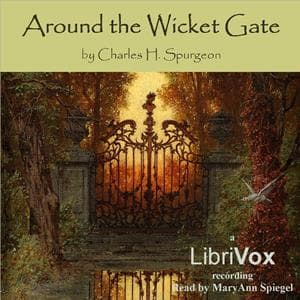

I was grading sophomore essays on The Great Gatsby at 11:30 PM - the kind where every student thinks green light symbolism is a hot take - when I decided I needed something to reset my brain. Something older. Something with actual conviction behind the words. So I put on Spurgeon's Around the Wicket Gate and let MaryAnn Spiegel's voice wash over me while I marked up margins with increasingly illegible notes.
Here's what struck me immediately: Spurgeon writes like he's grabbing you by the lapels. Not in an aggressive way, but with this urgent pastoral care that you don't really see anymore. The man was called the 'Prince of Preachers' for a reason, and even 130 years later, his prose has this directness that cuts through. He's not hedging. He's not being polite about eternal matters. He's saying: you're standing at the gate, why won't you walk through?
MaryAnn Spiegel's Measured Delivery
Spiegel has this warm, clear delivery that works surprisingly well for Victorian-era theological writing. I couldn't find much about her narration background online, but based on this performance, she understands something crucial: Spurgeon's words don't need dramatic embellishment. They need clarity. And she delivers that.
Her pacing is deliberate. Some listeners have called it slow, and honestly, they're not wrong. But here's my take as someone who teaches literature for a living - the pace matches the content. This isn't a thriller. It's a devotional work meant to be chewed on, not gulped down. Spurgeon himself would probably approve of the measured delivery. (My students would absolutely hate this take. They want everything at 2x speed.)
The enunciation is excellent throughout. At just over two hours, it's the kind of listen you can finish in a single evening walk along the lakefront, which is exactly what I did for the second half. Denise thought I was being unusually contemplative. I was. That's what good devotional writing does.
Spurgeon's Argument for the Hesitators
The central metaphor here - the wicket gate from Bunyan's Pilgrim's Progress - isn't subtle. Spurgeon takes that image and uses it to address people who are, as he puts it, "not far from the kingdom" but haven't stepped through. He's writing for the hesitators. The almost-believers. The ones who intellectually understand but haven't made the leap.
And look, regardless of where you stand on matters of faith, there's something worth studying in how Spurgeon constructs his arguments. The man was a rhetorical genius. His sentences have rhythm. His illustrations are concrete. He doesn't hide behind theological jargon - he writes like he's talking to actual people with actual doubts.
This is why we still read the classics, even the religious ones. Augustine's City of God operates on that same level—centuries-old conviction that still commands attention through sheer rhetorical force. Not because we necessarily agree with everything, but because the craft is there. The conviction is there. Spurgeon believed what he was writing with every fiber of his being, and that kind of authenticity translates across centuries.
Who This Is (and Isn't) For
Let me be straight with you: this is a niche audiobook. If you're looking for Christian devotional content, particularly from the Reformed tradition, this is excellent. Spurgeon's reputation is well-earned. The narration is clean, professional, and appropriately reverent without being stuffy. But if you're not already inclined toward theological reading? This probably isn't your entry point. It's dense. It's earnest in a way that modern audiences sometimes find uncomfortable. And the pacing, while appropriate for the material, will test listeners used to more dynamic delivery.
For my fellow literature nerds who appreciate 19th-century prose regardless of content - there's genuine pleasure here. Spurgeon's sentences are constructed with care. He knew how to land a phrase. The audio format actually helps with his more complex passages because Spiegel's pacing gives you time to absorb them.
I listened at 1.0x because - and I will die on this hill - the author chose those words. Spurgeon's cadence is part of the experience. Speeding it up would be like fast-forwarding through a hymn. Technically possible, but missing the point entirely.
Class Dismissed
Worth pausing the faculty meeting for? If you're the kind of person who finds comfort in theological certainty delivered with Victorian eloquence, absolutely. If that sentence made you cringe, this isn't for you. And that's fine. Not every book is for every listener.
The production is clean, the narration is competent, and Spurgeon remains Spurgeon - urgent, pastoral, and utterly convinced that what he's saying matters eternally. At two hours, it's a modest investment for a classic that's shaped Christian thought for over a century.