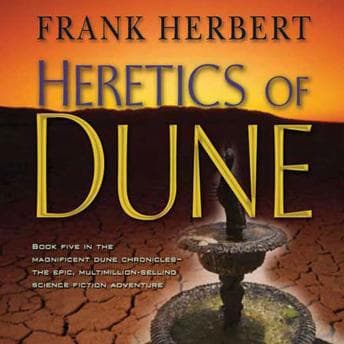

Look, I'm just gonna say it: Heretics of Dune is the book where Frank Herbert looked at everything he'd built and said "what if I made it weirder?" And honestly? I'm here for it.
I finished this at 2 AM on a Tuesday, supposedly working on my thesis (Dr. Patel, if you're reading this, I was definitely doing research on procedural narrative structures). But here's the thing - when you're 18 hours deep into Herbert's philosophical fever dream about post-scarcity religion and the nature of human evolution, your thesis on procedural generation starts to feel... small.
The 3,500-Year Time Skip That Actually Works
So we're now thousands of years past God Emperor. The Bene Gesserit are running things (sort of), the Tleilaxu are being creepy (definitely), and there's this ghola named Duncan Idaho who's been resurrected so many times at this point that it's basically a running joke. But Herbert doesn't just throw you into the deep end - he builds this new world piece by piece, and the way the factions have evolved is genuinely fascinating.
The Honored Matres are the real wildcard here. These are basically the Bene Gesserit's chaotic evil cousins who've come back from the Scattering with some... interesting techniques. Without spoiling too much, let's just say Herbert was exploring some territory that probably raised eyebrows in 1984. My D&D group would absolutely make a faction based on them. (We're not subtle people.)
What I love is how Herbert uses the massive time gap to examine how institutions calcify and adapt. The Bene Gesserit aren't the same organization from the first book - they've become something both more powerful and more vulnerable. It's the kind of world-building that rewards close attention, and the audiobook format is perfect for letting these ideas wash over you.
Simon Vance Knows When to Hold Back
Okay, so here's where I need to be honest. Simon Vance is a pro - his voice work is clean, his character differentiation is solid, and he handles Herbert's dense philosophical passages without making them sound like a college lecture. The man knows how to pace himself through an 18-hour philosophical treatise disguised as a sci-fi novel.
But.
There are moments where the narration feels almost too measured. Some of the more action-heavy sequences could use a bit more energy, and during the longer philosophical tangents (and there are many), I found myself reaching for the speed controls. I ended up listening at 1.25x for most of it, which felt like the sweet spot. Not a criticism of Vance specifically - more like Herbert's prose in this era just benefits from a slightly faster clip.
Vance's Bene Gesserit voices are particularly good though. There's this subtle control in how he voices the Reverend Mothers that perfectly captures their whole "we've been manipulating humanity for millennia" vibe. And his Duncan Idaho has this weary quality that makes sense for a guy who's been killed and resurrected more times than a D&D character with a generous DM.
Where It Drags (Because It Does)
I'm not gonna pretend this is a perfect book. Herbert was deep in his philosophical phase here, and there are stretches - particularly in the middle third - where the plot basically stops so characters can have long conversations about the nature of consciousness, the dangers of prescience, and the relationship between sex and power. (Herbert was... working through some things.)
If you're coming from the first three books expecting the political intrigue of Dune or the action of Children, you might find yourself frustrated. This is Herbert at his most contemplative, which means it's brilliant and exhausting in equal measure. I zoned out during a few of the longer Bene Gesserit council scenes, and I say that as someone who voluntarily reads 1,200-page fantasy epics.
But when it clicks? When all the philosophical threads start weaving together toward the end? Chef's kiss. This is Sanderson-level world-building, except instead of magic systems, Herbert is building systems of human evolution and institutional decay. The philosophical density here makes the original Dune look like a beach read by comparison. It's dense, it's weird, and it's absolutely worth the investment.
Who Should Queue This Up (And Who Should Skip)
If you've made it through God Emperor and you're hungry for more weird Herbert philosophy, this delivers. If you haven't read Dune yet, start there—trust me on this one. Skip this if you need plot momentum to stay engaged, or if Herbert's tangents about consciousness and power dynamics sound like homework rather than fun. But if you're the type who pauses audiobooks to think "wait, what did he just say about prescience?" - welcome home.
Roll for Initiative on Your TBR
Heretics of Dune is slower than the earlier books, more philosophical, and honestly more challenging. But the world-building is incredible, the new factions are fascinating, and Vance's narration - while occasionally too measured - serves the material well.
Just... maybe bump the speed up a bit. And don't listen to it when you're supposed to be writing your thesis. Not that I would know anything about that.