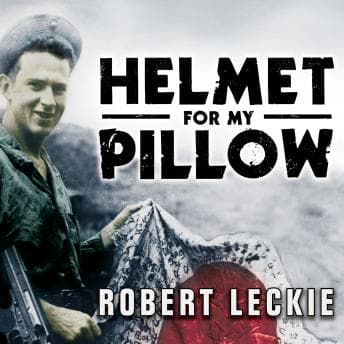

What does it actually sound like when a man tells you, plainly and without apology, about the worst thing he ever survived?
I was up past midnight — papers half-graded, red pen abandoned on the kitchen table, Denise already asleep — when I started Helmet for My Pillow. I figured I'd get through the first chapter, maybe two. I finished at 2 AM and sat there in the dark kitchen for a while afterward.
Leckie Writes Like a Man Who Learned Punctuation in a Foxhole
Here's what caught me off guard: Robert Leckie can write. I mean really write. This isn't the stilted, dutiful memoir of a veteran who felt obligated to get it down. The insider-journalist instinct — that compulsion to get the real story down before someone sanitizes it — is something I noticed just as strongly in Fire and Fury, though the theater there is considerably less heroic. Leckie was a journalist before and after the war, and you feel that training in every sentence. His prose is clipped and muscular when describing combat, then suddenly opens up into these meditative passages about what it means to be young and terrified and far from home. The short, declarative sentences hit like rifle shots — and then he'll give you a paragraph that's almost Fitzgerald in its lyricism about the Pacific moonlight or the sound of rain on a tent.
This reminds me of what Hemingway said about writing one true sentence and then going from there. Leckie does that, but he's less performatively stoic than Hemingway. There's genuine wonder mixed with the horror. He describes stealing communion wine and getting drunk with his buddies in Melbourne with the same honest attention he gives to the fighting on Guadalcanal. The rowdiness and the terror sit side by side, because that's how it actually was.
Nelson's Newsreel Voice and Why It Mostly Works
John Allen Nelson narrates with this directness that multiple reviewers have compared to a vintage newsreel announcer, and I think that's exactly right. There's a clipped authority to his delivery that suits Leckie's prose style — those short, punchy sentences land with proper weight. He doesn't over-dramatize the combat sequences, which is the right call. The material is dramatic enough.
Where things get interesting — and a little divisive — is the character voices. Nelson gives the sergeants a barking growl, the Australian girls a lilt, and Leckie's drunken friends a loose, sloppy warmth. I found these charming, almost theatrical. They inject some levity into a book that needs it. But I can see why some listeners felt the voices didn't always fit. There are moments where a character voice pulls you slightly out of the gravity of a scene. It's not a dealbreaker, but it's noticeable. Think of it as a narrator who's slightly more comfortable with the barracks humor than the battlefield solemnity — though he handles both competently.
At 10 hours and 37 minutes, this is a substantial listen but never a slog. Leckie's structure follows his war chronologically — Parris Island boot camp through Guadalcanal, New Britain, and Peleliu — and each section has its own rhythm. The prose deserves to be savored. I listened at 1.0x because the author chose those words, and Nelson's pacing honors them.
The Space Between Band of Brothers and the Mud
If you watched The Pacific on HBO and wondered what the source material felt like — it's rawer than you'd expect. The miniseries, for all its production value, necessarily smooths some edges. Leckie's book doesn't smooth anything. He writes about dysentery and fear and boredom and the particular madness of jungle warfare where you can't see the enemy until he's already shooting at you. He writes about the casual racism of the era without flinching from it. He writes about faith — he was Catholic, and it mattered to him — without being preachy.
What struck me most, sitting in my kitchen at 1 AM, is how literary this war memoir is. If you loved All Quiet on the Western Front, this is its spiritual successor from the American side — written by a man who survived and spent the rest of his life trying to make sense of it. My students would hate the pacing. I love it. There's no rushing the experience of being nineteen years old on a Pacific island wondering if you'll see twenty.
Who Gets the Assignment
This is for anyone who reads war memoirs not for the action but for the human being inside the uniform. History teachers, military history buffs, anyone who finished With the Old Breed by Eugene Sledge and wants the companion piece. Skip it if you need constant momentum — Leckie lingers where he lingers, and some of the Melbourne leave chapters meander. But that meandering is the point. War is long stretches of nothing punctuated by chaos, and Leckie captures both.
Worth Pausing the Faculty Meeting For
Leckie wrote over forty books, but this is the one that endures, and Nelson's narration — newsreel directness and all — serves it well. Not a perfect audiobook performance, but a deeply worthy one for a book that deserves to be heard aloud. The prose is too good to speed through. Take it at the pace Leckie wrote it. He earned that.








![Steve Jobs [unabridged audiobook] audiobook cover](/_next/image?url=https%3A%2F%2Fcovers.audiobooks.com%2Fimages%2Fcovers%2Ffull%2F9788499923406.jpg&w=1920&q=75)