
Ruby McTavish Callahan Woodward Miller Kenmore. That's not a character name, that's a body count disguised as a marriage record.
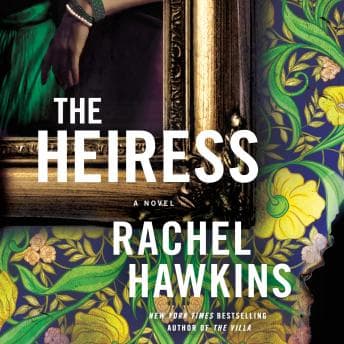
I was making dal makhani at 10 PM on a Tuesday — the kind of elaborate, multi-step cooking project I do when I'm avoiding revisions on my latest paper — and Heiress had me standing over the stove with a wooden spoon in one hand and absolutely zero intention of pausing. Rachel Hawkins understands something fundamental about human psychology: we are magnetically, pathologically drawn to women who might be monsters. Ruby is dead before the story really begins, but she haunts every single page like a case study in narcissistic control that extends beyond the grave. My therapist would have thoughts about this character. Many thoughts.
The Psychology of Inherited Dysfunction
What makes this book compelling isn't the mystery itself — though it's decent — it's the character architecture. Camden, Ruby's adopted son, exhibits classic avoidant attachment. He fled Ashby House, fled the money, fled the name, married Jules partly because she was also running from something. Two people bonded by mutual escape. The research actually shows that trauma survivors often find each other this way, forming relationships built on shared avoidance rather than shared connection. All Is Not Forgiven maps similar psychological territory — characters whose bond is basically a shared wound wearing a relationship's clothing. And Hawkins gets this right. When Cam and Jules return to Ashby House after his uncle's death, you can feel the regression happening in real time. The house doesn't just pull them back physically — it pulls them back developmentally.
But here's where it gets interesting: Jules. She's our way in, and she's unreliable in that specific way where you know she's lying to herself before she knows it. Patti Murin voices her with this chipper, slightly-too-bright tone that — and I found myself asking: why does Jules really want to stay at Ashby House? Because she does want to stay. That brightness in Murin's delivery reads as performance, and it's a smart choice. Jules is performing normalcy while being seduced by wealth and legacy. This is a fascinating case study in how easily people abandon their stated values when confronted with generational money.
Camden, meanwhile. Dan Bittner plays him as a walking stress response, and some listeners apparently found his narrative "no fun at all." I get it. But psychologically, this tracks perfectly. Cam is a man who spent a decade constructing a careful, small life — English teacher in Colorado, about as far from North Carolina old money as you can get — and now every wall he built is crumbling. Bittner ramps up the pace and volume during tense moments, and you can practically hear Cam's cortisol levels spiking. It's not comfortable listening. It's not supposed to be.
Ruby's Letters and the Ghost in the Machine
The structural trick here is Ruby herself — told partly through discovered letters to an unknown recipient. And this is where the multicast narration earns its paycheck. Four narrators, each handling different perspectives, and the transitions feel organic rather than jarring. John Pirhalla delivers these crisp, news-report-style segments that ground the more gothic elements in something that feels almost documentary. It creates this tension between the sensational and the factual that mirrors exactly how we consume true crime stories. We want the lurid details. We also want to feel like serious people while consuming them. That exact tension — between prurient fascination and intellectual respectability — is something I also sat with while reading Never, where the narrative structure practically dares you to admit what you're really enjoying.
The kidnapping backstory — Ruby was abducted as a child, the famous McTavish heiress gone missing — layers the psychology beautifully. Was the Ruby who came back actually Ruby? And does it matter, if she performed the role convincingly enough? The protagonist exhibits classic identity diffusion, or at least the book wants you to wonder about that. Hawkins plants doubt without overplaying her hand, and the slow-burn pacing works because each revelation from the different character perspectives genuinely shifts your understanding.
Now. The characters are largely unlikable. Every single one. I've seen complaints about this, and look — I study people for a living. People involved in inheritance disputes over old-money Southern estates are not generally likable. They're fascinating. There's a difference. If you need someone to root for, this might test your patience. If you're the kind of person who reads case files and thinks "oh, that's interesting," welcome home.
Who Gets an Invitation to Ashby House
This is for you if: you love gothic domestics where the house is basically a character, you're the person who watches true crime docs and analyzes the family dynamics instead of just the murder, or you've ever been curious about what happens when someone tries to reject an identity that money keeps forcing on them.
Skip it if: you need a protagonist to cheer for, you want fast-paced thriller mechanics from chapter one, or unreliable narrators make you impatient rather than curious. The slow burn is real — probably the first third is setup — and if you're not invested in the psychological machinery, the plot alone won't carry you.
At 8 hours and 21 minutes, it's a perfect length. Tight enough that nothing feels padded, long enough to let the dread accumulate properly.
Case File: Closed (For Now)
I finished the dal makhani. I finished the audiobook. Both were satisfying in that specific way where you sit with the aftertaste and think about what just happened. Hawkins wrote a book about how the dead control the living through money, through secrets, through the stories we tell about them. And the multicast production — Murin's performed cheerfulness, Bittner's escalating anxiety, Pirhalla's detached authority — turns it into something that feels less like fiction and more like eavesdropping on a family that desperately needs a therapist. Several therapists. A whole practice, probably.
The author understands human nature. Not perfectly — there's a late-stage twist that felt more mechanically convenient than psychologically inevitable — but well enough that I was annoyed at the right moments and unsettled at the right ones too.