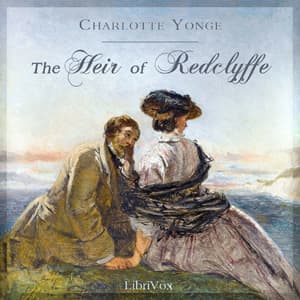

What makes a Victorian novel survive? Not the ones assigned in syllabi, kept alive by academic obligation—but the ones that genuinely meant something to readers for a century and then... faded. Charlotte Yonge's The Heir of Redclyffe sold more copies than Jane Eyre in its first decade. Pre-Raphaelite painters named their children after its hero. And yet my students have never heard of it. Neither had I, honestly, until I stumbled onto this LibriVox recording during a particularly brutal week of essay grading.
Twenty-five hours later, I understand both the devotion and the obscurity.
The Kind of Hero We Don't Write Anymore
Guy Morville is not your typical romantic lead. He's not brooding in the Byronic sense—he's genuinely trying to be good in a way that feels almost alien to modern sensibilities. His struggle isn't against society or circumstance but against his own volcanic temper, which he inherited along with the Redclyffe estate. The novel treats this internal battle with absolute seriousness. Guy prays. He reads theology. He genuinely believes in moral improvement as a life project. That same earnest commitment to moral struggle—though in a wildly different setting—drives All the Light We Cannot See, where characters wrestle with goodness amid impossible circumstances.
This is where Yonge's Oxford Movement influence becomes impossible to ignore. John Keble—the Keble of Keble College—supervised this manuscript, and you can feel his fingerprints everywhere. The religious content isn't decorative; it's structural. Guy's spiritual development is the plot. For modern listeners expecting romance-forward storytelling, this will feel like attending a particularly earnest sermon that occasionally pauses for drawing-room drama.
But here's what surprised me: it works. Not despite the moralizing—because of it. Yonge commits so fully to her vision that the novel achieves a kind of sincerity we've trained ourselves to distrust. When Guy forgives his cousin Philip—who has systematically destroyed his reputation and happiness—the moment lands because we've spent hours watching Guy wrestle with his anger. The forgiveness costs him something.
Twenty-Five Hours of Victorian Drawing Rooms
Let's address the elephant: this is a long listen. The pacing reflects Victorian serialization—Yonge wrote for readers who had time, who wanted to live inside a novel for weeks. There are extended passages about family dynamics, amateur music performances, and the proper management of parish responsibilities. My wife Denise, who tolerates my audiobook habit with saintly patience, asked me around hour twelve if "anything had happened yet."
The honest answer is: not in the way contemporary fiction trains us to expect. The drama is relational, incremental, domestic. Philip's jealousy of Guy builds through dozens of small moments—a dismissive comment here, a withheld piece of information there. The love story between Guy and Amy unfolds with such restraint that their eventual marriage feels earned rather than inevitable.
I found myself listening during faculty meetings (Principal Martinez, I promise I was taking mental notes on the budget) and during my lakefront walks with Denise, and the novel's rhythm suited both contexts. It doesn't demand constant attention, but it rewards it when given.
The LibriVox Reality
This is a volunteer production, and you need to know what that means. The narrators rotate by chapter, which creates tonal inconsistency—one reader's Guy sounds earnest and young, another's sounds middle-aged and weary. Some volunteers handle Victorian syntax with natural grace; others stumble through Yonge's longer sentences like students sight-reading aloud in class.
But there's something appropriate about this imperfection. The novel itself feels like a community project, a work of sincere amateur devotion. The LibriVox volunteers are giving their time to preserve a book most publishers have abandoned. I found myself forgiving audio inconsistencies I'd never tolerate in a commercial production.
That said: if you're particular about narration, this will test your patience. The quality varies chapter to chapter. Some sections I replayed because the reading was genuinely good; others I endured because I wanted to know what happened next.
Who Should Make the Twenty-Five Hour Commitment
If you love Trollope, if you've read all of Austen twice and want something adjacent but different, if you're curious about what Victorian readers actually chose to read rather than what we've canonized—this is worth your time. If you're interested in religious fiction that takes faith seriously without becoming preachy (a difficult needle to thread), Yonge threads it.
Skip this if you need plot momentum, if religious themes feel alienating, or if narrator inconsistency genuinely bothers you. Skip it if you want irony, moral ambiguity, or protagonists who question their own goodness.
My students would absolutely hate this. The sincerity would read as naïve, the pacing as punishment. But I'm not my students—I'm a middle-aged man who has spent twenty years watching teenagers pretend to read, and I've earned the right to love a novel about a young man who genuinely tries to be better than his worst impulses.
A Novel Worth the Slow Read
This is exactly the kind of book I started my podcast to discuss—a novel that mattered enormously, then disappeared, and deserves reconsideration. The prose deserves to be savored. The moral framework deserves to be taken seriously, even if you ultimately reject it. And the LibriVox volunteers deserve credit for making it accessible.
I'm not sure I'd recommend spending an Audible credit on this when the free version exists. But I'm glad I listened. And I'm adding Yonge to my mental list of Victorian authors worth teaching—right next to the Faulkner episodes my mom sleeps through.