
"I am alone. I am not lonely." Neil McCauley says that in the original film, and somewhere around hour three of this audiobook, Peter Giles delivers a variation of that sentiment in a voice so low it practically vibrates through your sternum. I was walking the lakefront with Denise on a Sunday morning, Lake Michigan doing its gray November thing, and I actually stopped mid-stride. She asked if I was okay. I was more than okay. I was back in Michael Mann's Los Angeles, and I didn't want to leave.
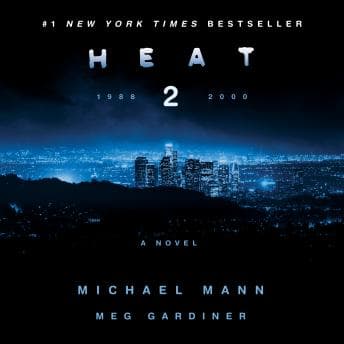
Let me be honest about something first: I teach Hemingway and Fitzgerald and Faulkner. I'm not the guy you'd expect to be evangelical about a novelization of a 1995 crime film. But Heat 2 isn't really a novelization. It's something stranger and more ambitious - a prequel and sequel wrapped around the skeleton of the original movie, and the result reads (well, listens) like Mann finally got to tell the story the way his brain always processed it. Not in two hours and fifty minutes. In eighteen and a half hours of sprawling, continent-hopping, morally compromised grandeur.
The Screenplay That Learned to Breathe
Mann's prose - co-written with Meg Gardiner, who deserves enormous credit for translating his visual grammar into sentences - reads like camera directions that grew a nervous system. You can feel the screenplay bones underneath. Short, clipped paragraphs. Tactical language for heist sequences that reads like operational planning documents. But then you get these long, almost meditative passages where McCauley or Hanna sits with their damage, and the writing opens up into something genuinely literary. The 1988 Chicago sections have this cold, industrial texture - Mann knows that city's particular brand of bleakness the way Chandler knew L.A.'s sunshine and rot. And then the post-Heat storyline drags Shiherlis through Ciudad del Este in Paraguay and eventually into Southeast Asia, and the whole thing takes on this fevered, desperate quality.
This reminds me of what Hemingway said about writing - that it's architecture, not interior decoration. Mann builds rooms you can walk through. The problem is that sometimes he builds too many rooms. There are stretches in the middle third - particularly the organized crime politics in South America - where the narrative threads multiply faster than you can track them. I rewound three times during one sequence involving competing Taiwanese and Chinese syndicates and I'm still not entirely sure I followed every connection. My students would hate this. I love it. Mostly.
Peter Giles Is Doing Something Insane (And It Works)
Let's talk about the narrator, because Peter Giles makes a choice that's either brilliant or unhinged, and I've decided it's both. I first heard Giles pull off this kind of vocal high-wire act in Crosshairs, and he brings the same fearless commitment here. He does impersonations. Not subtle vocal shadings or gentle suggestions of famous actors. Full-on Al Pacino for Hanna. De Niro's careful, flat delivery for McCauley. Val Kilmer's looser energy for Shiherlis. And here's the thing that shouldn't work but absolutely does - because Mann wrote these characters for those actors, hearing approximations of their voices actually anchors the audiobook in the film's reality. It's not mimicry for mimicry's sake. Giles understands that these characters ARE those performances in the cultural imagination, and fighting that would be foolish.
The narrator understands that pause is punctuation. Giles lets Hanna's monologues build with this manic Pacino energy, then drops into these quiet valleys where the character's exhaustion shows. His McCauley is all coiled restraint - sentences delivered like they cost something.
But - and this is real - his baseline narration voice sits so deep in the register that I had to bump my volume up about 20% compared to most audiobooks. During quiet descriptive passages, especially the late-night interior stuff, his voice drops into this subterranean growl that almost disappears. I hit the same wall with Scarecrow: Booktrack Edition—Giles' low register is a gift in a quiet room and a liability in traffic. Walking along Lake Shore Drive with traffic? I lost whole sentences. At my desk at 11PM grading sophomore essays on The Great Gatsby? Perfect. Every word landed. So your mileage will literally depend on your listening environment.
There's also the drama problem. Giles narrates descriptive passages - weather, room descriptions, a character walking down a hallway - with this movie-trailer intensity that occasionally feels like too much. Not always. But when someone's just ordering coffee and the narration sounds like a voiceover for the apocalypse, you notice.
Who Gets a Seat at This Table
If you've seen Heat - really seen it, not just the diner scene on YouTube - this is essential. Not suggested. Essential. Mann expands the mythology in ways that feel earned rather than exploitative. You get McCauley's backstory, Hanna's earlier career, Shiherlis's desperate afterlife. The 1988 timeline gives you a younger crew still sharpening their edges, and watching (hearing) them become the men we meet in 1995 is genuinely affecting.
If you haven't seen the film? Honestly, skip the audiobook for now. Go watch Heat first. The novel assumes familiarity with those characters the way a sequel assumes you saw the original. You could follow the plot cold, sure, but you'd miss all the weight.
And if you're someone who needs tight, linear storytelling - if you get frustrated when narratives jump between three timelines and two continents without warning - this will test your patience. The structure is deliberately fragmented, almost Faulknerian in its refusal to hold your hand through the chronology. (My students would absolutely hate me for that comparison. I stand by it.)
Worth Pausing the Faculty Meeting For
Eighteen and a half hours is a commitment. This isn't a beach read and it's not background listening. Heat 2 demands the kind of attention you give a film - which makes sense, because Mann thinks in cinema even when he's writing prose. The prose deserves to be savored. Peter Giles, for all his occasional over-the-top tendencies, understands that. He treats this material with the seriousness of a stage actor given a great script.
Is it perfect? No. The South American middle section bloats, some of the female characters still feel like they exist primarily to illuminate the men around them (a Mann trademark I wish Gardiner had pushed back on harder), and the dual-timeline structure occasionally sacrifices momentum for scope. But when it works - the heist sequences, Hanna's relentless pursuit logic, McCauley's philosophy of professional violence - it's the best crime fiction I've heard in years.
This is why we still read the classics. Sometimes a story gets told once on film and you think that's the definitive version. Then someone cracks it open and shows you everything that was underneath.