
What happens when a pharmacist gets the disease she's supposed to understand, and realizes the textbooks got it wrong?
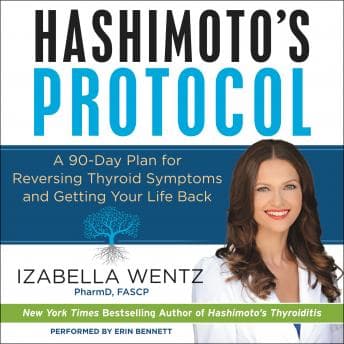
I was making dal tadka at 10 PM on a Tuesday — the kind of elaborate weeknight cooking that my mother would call unnecessary and my therapist would call "productive avoidance" — when Erin Bennett's warm, steady voice walked me through the mechanics of how your own immune system can decide your thyroid is the enemy. And I found myself doing something I almost never do with self-help books: actually paying attention for ten straight hours.
The Pharmacist Who Stopped Trusting the Pharmacy
Here's what makes Izabella Wentz interesting as a case study — not just as an author, but as a person. She exhibits classic cognitive dissonance resolution behavior. She spent years in pharmacy school learning to trust pharmaceutical interventions, got diagnosed with Hashimoto's at twenty-seven, and then systematically dismantled her own training when the medications didn't fix her. That's genuinely fascinating psychological territory. Most people double down on their professional identity when facing a health crisis. Wentz did the opposite.
The book is structured as a 90-day protocol: a two-week liver detox, followed by targeted interventions based on your specific triggers — gut infections, nutrient deficiencies, adrenal dysfunction, you name it. She includes self-assessment tests so you can figure out which root causes apply to you. It's practical in a way that a lot of health books aren't. She's not just saying "eat better and feel better." She's saying "here's exactly which inflammatory foods to remove, here are the specific supplements for liver support, and here's how to test whether your adrenals are shot."
But — and this is where my BS detector starts pinging — the research actually shows that autoimmune conditions are wildly individual. What works for one Hashimoto's patient can be irrelevant for another. Wentz acknowledges this to her credit, building in personalization through those self-tests. But listening to the audiobook format, you lose something critical: the charts, the food lists, the recipes. Several listeners have flagged this, and they're right. There are supplementary materials referenced throughout that you simply don't have access to while jogging or stirring dal. If you're serious about following the protocol, you need the print copy too. The audiobook alone is incomplete.
Erin Bennett Makes Science Sound Like a Conversation
Erin Bennett's narration is the reason this audiobook works at all. Health books in audio form can be absolute torture — imagine someone reading you a medical textbook for eleven hours. Bennett avoids that trap entirely. Her pacing is natural, almost conversational, like a knowledgeable friend explaining something over coffee rather than a lecturer working through slides. She handles the dense supplement and dosage information without sounding robotic, which is genuinely hard to do.
What I noticed specifically: Bennett modulates her tone when Wentz shifts from personal anecdote to clinical recommendation. There's a slight warmth that creeps in during Wentz's own health story, and a cleaner, more measured quality when she's walking through the protocol steps. It's subtle, but it helps your brain categorize the information — "this is her story" versus "this is what I should write down." For a single narrator handling a book that's part memoir, part medical manual, part cookbook, that's solid craft.
That said, there's no getting around the fact that this is a dense listen. At nearly eleven hours, there are stretches — particularly in the supplement recommendation sections — where even Bennett's engaging delivery can't prevent your attention from drifting. I found myself rewinding a few times during the adrenal protocol section, not because Bennett lost me, but because the material itself is granular enough that it resists passive listening.
The Psychology of Self-Rescue (And Its Limits)
I found myself asking: why does this book connect so strongly with its audience when plenty of other thyroid books exist? The research actually shows that patient-authored health books trigger a different psychological response than physician-authored ones. When Wentz says "I lost my hair, I couldn't think straight, I was exhausted for years" — that's not clinical authority. That's solidarity. And solidarity is psychologically powerful. People comply with health protocols at dramatically higher rates when they believe the person prescribing them has suffered the same way. It's the same mechanism I kept thinking about while reading Secreto (The Secret) — that book also sells itself almost entirely on the promise that the author has cracked something you haven't yet, and the audience compliance it generates is remarkable, even when the underlying claims don't hold up to scrutiny.
Psychologically, this tracks perfectly. Wentz isn't your doctor. She's you, but further along the path. That's her rhetorical superpower.
The limitation? Some of Wentz's recommendations are genuinely radical — major dietary overhauls, extensive supplementation, lifestyle changes that require significant time and money. She frames these as empowering choices, but I kept thinking about accessibility. Not everyone can afford organic everything and seventeen supplements. The book doesn't engage much with that tension, and it should.
Who Gets the Most Out of This
If you have Hashimoto's or suspect you do, this is pretty much required listening — with the caveat that you should buy the print version alongside it. The audiobook is excellent for understanding the why behind the protocol, for absorbing Wentz's framework, for motivation. But the actual doing requires reference materials you can flip through.
If you're a casual health-curious listener, you'll get maybe four hours of genuinely interesting content about autoimmune disease and the gut-thyroid connection before the specificity outpaces your interest.
Skip this if dense health information makes your eyes (ears?) glaze over, or if you're looking for entertainment rather than education.
My Prescription, Take It or Leave It
Wentz understands something most health authors don't: patients aren't stupid. They're desperate and undertreated. She writes — and Bennett narrates — accordingly. It's not a perfect audiobook. The format fights the content in places, and the missing supplementary materials are a real problem. But the combination of personal credibility, structured protocol, and genuinely accessible narration makes this worth your time if you're in the target audience. My therapist would have thoughts about how much of Wentz's authority comes from her own suffering — but that's a paper for another day.
The dal turned out great, by the way. Anti-inflammatory turmeric and all.