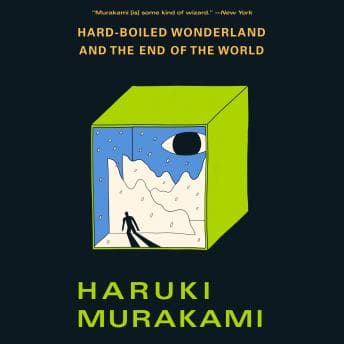

Murakami built a dual-world narrative structure that would make any D&D DM weep with envy, and I am not okay.
I was up way too late reorganizing my board game shelf - a task that somehow always happens at 1 AM when I should be working on my thesis - and I had this running through my earbuds. And look, I've read enough secondary-world fantasy to know when someone is doing something genuinely weird with world-building. This is genuinely weird. In the best way.
Two Campaigns Running Simultaneously, One DM
So here's the deal. You've got two alternating storylines. One is this cyberpunk-adjacent Tokyo where a guy called the Calcutec does data encryption using his own subconscious - basically his brain is a black box processor, which is a concept so wild I had to rewind twice to make sure I wasn't hallucinating. The other is this walled town called the End of the World where a newcomer has his shadow literally cut from his body and spends his days reading old dreams from unicorn skulls in a library. These two narratives trade off chapter by chapter, and for the first few hours you're just trusting Murakami that they connect. They do. But the payoff is slow.
The magic system - and yeah, I'm calling it a magic system because the subconscious-as-encryption-engine thing has rules - is chef's kiss. The Calcutec's brain was surgically altered to create a mental partition, and the way Murakami explains shuffling and laundering data through consciousness feels like someone designed a homebrew psionic subclass with actual internal logic. The End of the World sections operate on dreamlike rules: beasts carry memories in their skulls, the wall prevents escape not physically but existentially, and the protagonist slowly loses his mind (maybe literally his mind) as winter sets in. It's Sanderson-level world-building except Sanderson would've given you a glossary and Murakami just lets you drown.
Kirby Heyborne and the Art of Emotional Flatness
Here's where things get complicated. Kirby Heyborne has this pleasant, clear voice that genuinely fits Murakami's first-person narrator - who is, by design, emotionally detached and kind of oblivious. The guy encounters subterranean monsters called INKlings in a Tokyo sewer system and his internal monologue is basically "well, this is inconvenient." Heyborne nails that deadpan energy. His tone shifts subtly between the two worlds - slightly warmer and more bewildered in the Hard-Boiled sections, more muted and melancholy in the End of the World chapters - and those shifts help you track which timeline you're in.
But - and this is real - the character differentiation is almost nonexistent. The deranged scientist, his granddaughter who won't stop talking about her weight and eating habits (a whole thing), the mysterious organization operatives - they all kind of sound like the same guy with minor inflection changes. For a 14-hour listen, that can make your brain glaze over during the abstract philosophical stretches. I caught myself rewinding more than once during the consciousness theory dumps, and I'm someone who genuinely enjoys info-dumps. (If you don't like info-dumps, this isn't for you. But you're wrong.)
Steven Pacey walked so other narrators could run, and Heyborne is... walking at a nice pace. He's fine. He's good, even. But this material might've benefited from someone who could punch up the weirdness a little more. The granddaughter's scenes in particular feel like they needed more energy - she's supposed to be shockingly blunt and funny, and in audio she just blends into the same register as everyone else.
This Is Not Background Listening
Let me be extremely clear: if you put this on while grinding in a video game or doing dishes, you will understand approximately 12% of what's happening. The dual narrative requires you to actively track which world you're in, what's real, what's metaphor, and whether the unicorn skull dreams are literal memories or symbolic constructs. I tried listening while coding once and had to go back a full hour. This demands the kind of focus you'd give a complex campaign session where the DM is running two interconnected plots. The closest I've come to that same cognitive demand in audiobook form was actually Around The World in 80 Days, where the plotting requires you to hold multiple moving pieces in your head at once — though Murakami operates at a completely different altitude of weird.
That said, when you DO give it focus? The way the two worlds start rhyming with each other, the way you slowly realize what the End of the World actually is - it's the kind of revelation that restructures everything you've heard. My D&D group would love this as inspiration for a split-reality campaign.
Who Rolls Initiative on This One
If you love weird fiction, dual-timeline structures, and books that treat consciousness like a puzzle box - grab this. If you've read Murakami before and loved the dreamlike quality, Heyborne's narration preserves that. If you need distinct character voices and fast pacing, or if abstract philosophical tangents make you check your phone, this will frustrate you. And honestly? If you've never read Murakami, maybe start with the print version. Some listeners felt the audiobook format actually undercut the novel's effect, and I can see why - the prose rewards re-reading paragraphs, which is harder in audio.
I Read This Instead of Writing My Thesis (Worth It, Mostly)
This is a 14-hour commitment to a book that's half cyberpunk thriller, half existential dream journal, and fully Murakami being Murakami. Heyborne is a solid guide even if he doesn't always differentiate the cast. The world-building across both narratives is inventive and strange and rewards patience. But the pacing and flat character voices keep it from being the definitive way to experience this story. Worth a listen if you're the kind of person who gets excited about subconscious data encryption as a plot device. (I am that person. Dr. Patel would not be surprised.)