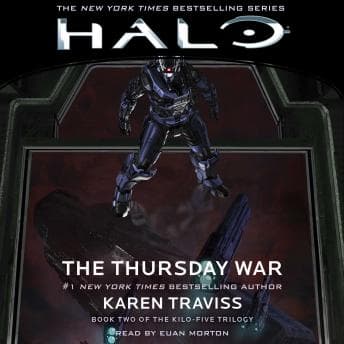

Karen Traviss writes military sci-fi the way my old D&D dungeon master ran campaigns - she makes you care about the logistics. Supply lines, political maneuvering, the moral grime of black-ops work. HALO: The Thursday War is not a bolter-porn shoot-em-up. It's a spy thriller wearing Mjolnir armor, and I was genuinely surprised how much I was into it.
I started this one during a late-night coding session - I was debugging a procedural terrain generator (yes, for my thesis, Dr. Patel, I promise) - and somewhere around hour three I realized I'd stopped typing entirely and was just sitting there with my headphones on, staring at a blinking cursor, completely absorbed in Sangheili civil war politics. That's either a compliment to the book or an indictment of my work ethic. Probably both.
ONI Runs a Dirty Campaign and I'm Here For It
The core premise is nasty in the best way: humanity's intelligence service, ONI, is actively destabilizing the Sangheili (the Elites, for my fellow Halo heads) by arming one faction against another. Kilo-Five is the team doing the dirty work, and Traviss doesn't let you forget that these are real people making ugly choices with real consequences. She's got that defense correspondent background and it shows - this reads like someone who's actually sat in briefing rooms and knows how institutional power grinds individuals down.
What got me was the Naomi-010 subplot. Her father is a colonial insurgent, and the tension between her Spartan conditioning and whatever's left of her humanity is the emotional spine of this book. Traviss doesn't resolve it neatly either. She lets it sit there, uncomfortable, which is way more honest than a tidy reconciliation scene would've been. My D&D group would love this kind of moral complexity in a character - it's the stuff that makes for great roleplay moments, where there's no clean answer and every choice costs something.
The Sangheili POV sections are where the world-building really sings. Traviss digs into their honor culture, their political structures, the way their society fractures when the Covenant religion collapses. This is Sanderson-level world-building in terms of how she treats an alien civilization as a real functioning society with economics and theology and factional disputes. The Sangheili aren't just "the bad guys" - they're people (well, aliens) trying to figure out what their civilization even means anymore. That's good sci-fi. Tower Lord does something similar with its conquered culture's POV chapters - that same sense of a civilization trying to reconstruct meaning from wreckage - though it lands with more fantasy pageantry and less political grime.
Euan Morton Leveled Up Between Books
Okay, so Euan Morton. He was apparently decent in Glasslands (the first Kilo-Five book), but listeners have noted he genuinely improved here, and I believe it. His differentiation between human characters, Sangheili, and the AI BBs is clean and consistent. The Sangheili voices have this weight to them - there's a gravelly authority that makes you buy these are seven-foot alien warriors debating the fate of their species. And his read on the ONI characters carries this great undercurrent of controlled tension, like everyone's always three seconds from saying what they really think but won't because the room is probably bugged.
He's not Steven Pacey. (Steven Pacey walked so other narrators could run, and that's just facts.) But Morton is doing solid, professional work that serves the material well. He finds the right register for Traviss's prose, which alternates between terse military efficiency and these longer reflective passages where characters actually think about what they're doing. That's a tricky balance and he handles it.
The Pacing Problem (And Why I Don't Entirely Agree)
Look, I've seen the complaints. "It's slow." "Too many details." And yeah - if you want wall-to-wall action, this book will frustrate you. There are stretches where Traviss is doing political setup, character work, world-building that won't pay off for chapters. At nearly 15 hours, you feel those stretches.
But here's the thing: if you don't like info-dumps, this isn't for you (but you're wrong). The detail work IS the point. Traviss is building a version of the Halo universe that feels lived-in and politically complex in a way the games never had time for. The "slow" parts are where she's laying pipe for payoffs that hit harder because you understand the stakes. When the extraction mission in the Sangheili civil war kicks off, it lands because you've spent hours understanding why every faction wants what they want.
That said - 1.25x speed is your friend for some of the middle sections. There are a few passages where the operational detail gets a bit circular, covering ground you've already internalized. Not a dealbreaker, but worth knowing.
Who's Rolling Initiative on This One
If you're a Halo lore junkie, this is essential. If you like military sci-fi that treats war as a political and moral problem rather than just a backdrop for cool explosions - Traviss is your person. If you liked the espionage vibes of The Expanse's Avasarala chapters, you'll find kindred energy here.
Skip it if you need your sci-fi fast and loud, or if you haven't read Glasslands first. This is book two of a trilogy and it does not hold your hand.
I read this instead of writing my thesis. The progression is satisfying, the world-building is dense in the right way, and Morton's narration makes 15 hours go down easier than it has any right to. Not a perfect book - the pacing dips are real - but a genuinely smart one.