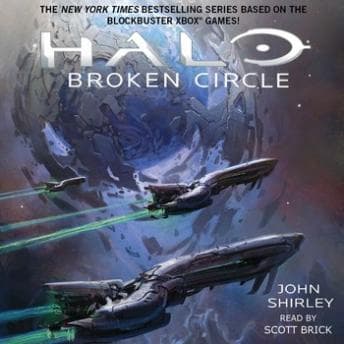

So here's the thing about 2AM insomnia after a week of on-call rotations: you make questionable decisions. Last Tuesday I finished debugging a cascading failure in our message queue, couldn't sleep, and thought "you know what, let me finally try a Halo novel." I haven't played the games since college — Kevin's the Halo guy, not me — but the premise of this one caught me off guard. This isn't a Master Chief story. It's not even a human story. It's the origin of the Covenant told entirely from the alien perspective, centuries before any Spartan ever suited up.
TL;DR: Worth your commute if you're into alien political drama and don't need humans in your sci-fi. Skip if you want action-heavy Halo combat.
The Covenant Gets a Prequel Nobody Asked For (But Maybe Should Have)
John Shirley does something genuinely weird here — he writes what is essentially a political thriller wrapped in religious schism, but with Elites and Prophets instead of, you know, humans. The story spans two timelines: the founding of the Covenant, when an Elite splinter group rebels against this fragile alliance, and then centuries later when the seeds of that original betrayal start bearing fruit. It's basically Foundation but for the Halo universe, and I mean that as a compliment. That kind of long-game political sprawl across centuries of fictional history is something To Green Angel Tower does with similar ambition — different genre entirely, but the same willingness to let consequences accumulate slowly until everything collapses under their own weight.
The San 'Shyuum (Prophets) are... hard to love. I'll be honest. There's a reason people bounce off this book early. The Elites have that warrior-honor thing going that's easy to latch onto, but the Prophet characters feel slippery and calculating in ways that kept me at arm's length for the first couple hours. It took maybe three commutes before I stopped trying to find the "good guys" and just accepted that Shirley was building something more complicated than that. The power dynamics between these two species — one with military strength, one with technological knowledge of the Forerunner artifacts — play out like a distributed systems problem. Two services that need each other but don't trust each other, forced into a consensus protocol that's fundamentally unstable. (Yes, I just compared alien politics to Paxos. I'm not sorry.)
Once I stopped looking for a human anchor point, the worldbuilding clicked. Shirley clearly did his homework on the lore. The Forerunner technology, the religious significance of the artifacts, the way the Covenant's caste system crystallizes out of pragmatic compromise — it's dense but rewarding if you're the kind of person who reads wiki pages about fictional civilizations. Which, let's be real, if you're picking up a Halo tie-in novel, you probably are.
Scott Brick Does the Heavy Lifting
Scott Brick is not Ray Porter — but he's solid. His delivery is precise, almost clipped in a way that actually works for alien characters who speak in formal, ritualistic patterns. There's a crispness to how he handles Elite dialogue versus Prophet dialogue that creates enough separation to track who's talking, even at 6AM when my brain is running at maybe 40% capacity. He doesn't do wildly different accents or anything dramatic, but the tonal shifts are consistent enough that I never had to rewind because I lost track of the speaker.
No sound effects, no music, just Brick and the text. Clean production. The 11h 46m runtime felt appropriate — this is a slow-burn political story, not a sprint, and the pacing reflects that. I ran it at 1.5x and it landed well. You could probably push to 1.75x during the more expository stretches in the first third without losing anything.
The one thing I'll flag: this is a focused-listening book. I tried it during a grocery run once and completely lost the thread of a Prophet political maneuver that turned out to be important three chapters later. On the train with my noise-canceling headphones? Fine. While multitasking? You'll miss the connective tissue that holds the two timelines together.
Who This Is Actually For (And Who Should Bail)
Perfect for: Halo lore completists, people who liked the Arbiter sections of Halo 2 more than the Chief sections (there are dozens of us), anyone who wants alien-perspective sci-fi that takes its own worldbuilding seriously. Also weirdly good for people who've never played the games — the research backs this up, and I agree. You don't need game knowledge; you just need patience.
Skip for: anyone wanting military action, anyone who needs a human POV character to care, anyone looking for something light. This is not background listening material.
The ROI Calculation
The ROI on this audiobook is... conditional. If you're already invested in the Halo universe and want to understand why the Covenant fractures the way it does, this pays dividends. It recontextualizes the entire Human-Covenant War as the final symptom of a disease that started centuries earlier. That's cool. That's worth the credit.
But if you're picking this up as your first sci-fi audiobook or expecting Bobiverse-level fun? Wrong tool for the job. This is the dense architecture doc, not the quick-start guide. I finished it across four commutes and a late-night session, and I'm glad I did — but I also immediately chased it with something lighter because my brain needed a break from alien theocracy.
Kevin, if you're reading this: yes, I'm now three Halo novels deep. This is your fault too.