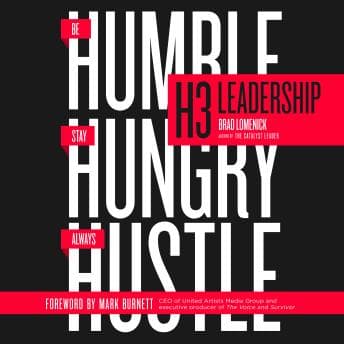

I was prepping a deck for a founder who keeps confusing "hustle culture" with "working yourself into a cardiac event" when I figured - okay, let me give Brad Lomenick's H3 Leadership a spin. Humble, Hungry, Hustle. Three words. Six hours. Former president of Catalyst, worked alongside Jim Collins and Malcolm Gladwell. Decent pedigree. Should be surgical.
Bottom line: It's not.
My Parents' Dry Cleaning Business Had Better Frameworks
Here's what frustrated me. Lomenick organizes everything around these three H's - Humble, Hungry, Hustle - and then unpacks 20 leadership habits nested under them. On paper, that's clean. In practice, it's a listicle stretched to audiobook length. Staying open. Owning convictions. Pursuing innovation. Demanding excellence. Fostering collaboration. Each one gets its own section, and each section follows roughly the same pattern: anecdote from Lomenick's Catalyst days, quote from a famous leader or thinker, practical application tip, move on.
The problem? Most of these habits overlap so heavily that by hour three I couldn't tell you whether "staying current" was filed under Hungry or Hustle. And honestly, it doesn't matter, because the framework is more organizational than intellectual. It's a filing cabinet, not an argument. My parents ran a dry cleaning business in Koreatown for 30 years. Awakening the Entrepreneur Within at least tries to build an actual argument for why entrepreneurial drive develops the way it does—though it lands at a similarly frustrating 3.5 for me. They were humble (no choice), hungry (survival), and they hustled (14-hour days, every day). They didn't need 20 sub-habits to explain this. They just did it. This is what my parents did instinctively. Now it has a TED talk.
What I will give Lomenick credit for: the humility piece. He's genuinely committed to servant leadership, and you can feel that it's not performative. His stories about leading Catalyst - a massive leadership conference that drew tens of thousands - carry weight because he's clearly someone who practiced what he preached in that specific arena. When he talks about sharing credit and staying teachable, it lands. It's the strongest third of the book by a wide margin.
The Catalyst Conference Isn't Your Company
Here's where my consulting brain starts twitching. Lomenick's experience is almost entirely in the faith-based leadership conference space. That's a very specific ecosystem with very specific dynamics - passionate volunteers, mission-driven culture, audiences who self-select for inspiration. When he extrapolates those lessons to general leadership, some of it transfers beautifully and some of it... doesn't survive contact with a Series B startup where three co-founders are fighting over equity splits and the runway is 11 months.
I've seen this fail at three different companies - taking leadership principles developed in high-alignment, mission-driven environments and dropping them into contexts where incentives are misaligned and people are scared. "Stay hungry" means something different when you're a conference president with a platform versus when you're a mid-level manager at a company that just laid off 20% of staff.
Also - and this matters for some listeners - there's a pretty strong faith undercurrent throughout. It's not a Christian leadership book per se, but the worldview is baked in. If that's your thing, you'll feel at home. If it's not, you might find yourself skipping sections. No judgment either way, but worth knowing before you spend a credit.
Stu Gray Does the Job, Nothing More
Stu Gray's narration is competent. Clear, professional, steady pace. He reads it like a guy who understands the material and respects it. But there's no electricity here - no moments where the delivery elevates a mediocre passage into something memorable. For a book that's already playing it safe with its ideas, a safe narration doesn't help. My 2.0x speed couldn't save this one. Not because it was slow, but because speeding up content that's already thin just makes you arrive at "meh" faster.
The production is clean. No weird audio artifacts, no background noise. Standard single-narrator business audiobook. It does exactly what it promises, which is also kind of its problem.
Who Gets ROI Here
If you're early in your leadership journey - like genuinely early, first management role, figuring out your philosophy - this is a solid primer. The 20 habits are real habits, and the practical tips are actually practical. Skip to chapter 5. Thank me later. That's where the Hungry section starts, and it's where Lomenick's energy picks up.
If you've read more than five leadership books, or if you've been managing people for more than three years, you're going to feel like you're reviewing flashcards you already memorized. Helpful tips but adds nothing new to the conversation - that's not just me saying it, that's a recurring theme in listener feedback, and I agree.
Jenny would say I'm being harsh. Jenny is right. But she'd also tell you to spend your six hours on something that challenges you rather than confirms what you already know. The key takeaway is worth the listen. The other 7 hours? Not so much. (Okay, 6 hours. But it felt like 7.)