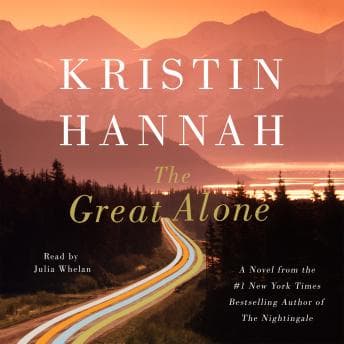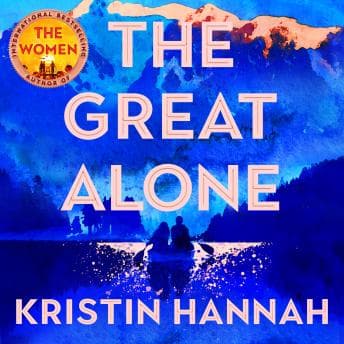

Kristin Hannah knows exactly what she's doing to you, and she doesn't care.
I started The Great Alone during a Saturday morning walk along the lakefront with Denise. By hour three, we'd looped the path twice because neither of us wanted to take out the earbuds. By hour eight — alone now, grading sophomore essays on The Crucible at the kitchen table — I'd stopped pretending to read about Abigail Williams and was fully absorbed in watching a thirteen-year-old girl try to survive a different kind of American wilderness.
Alaska as the Third Parent Leni Never Asked For
Let's talk about what Hannah is really doing here. On the surface, this is a domestic abuse story set against the backdrop of 1970s Alaska. But the thing that elevates it — the thing that kept me awake past midnight on a school night — is the way the landscape becomes inseparable from the family dysfunction. Ernt Allbright drags his wife Cora and daughter Leni to the Alaskan frontier because he's a Vietnam vet who can't function in civilization anymore, and Hannah uses the brutal winters and eighteen-hour darkness as a physical manifestation of the psychological prison Cora's trapped in. The wilderness doesn't care about your trauma. It'll kill you whether you're a good person or a bad one. That indifference is what makes the setting so effective — it's not metaphor, it's just true.
Now. Some readers have called this melodramatic, and I understand the complaint. Hannah stacks tragedy on tragedy with a relentlessness that occasionally feels like she's testing your threshold. There's a stretch in the second half where the plot pivots demand a lot of faith from the listener — convenient timing, coincidences that feel engineered. One reviewer called it "convenient when required," and yeah, I felt that. But here's the thing: the emotional foundation is so solid by that point that I forgave it. The way Leni's voice matures across the fifteen hours, the way her understanding of her mother's choices deepens — that's real character work. My students would hate this. I love it.
Julia Whelan Understands That Pause Is Punctuation
Julia Whelan. I've listened to her narrate probably a dozen books at this point, and she remains one of the few narrators who treats silence as a tool rather than dead air. Her young Leni is extraordinary — she captures that specific register of a kid who's seen too much, who's learned to read a room for danger before she learned to read for pleasure. There's a thinness to the voice, a watchfulness, that made my chest tight.
Her Ernt is genuinely frightening. Not because Whelan goes big — she doesn't scream or growl. She drops his voice into this flat, dead calm before the violence, and the contrast with the warmth she gives Cora and Leni makes those scenes land like a gut punch. The prose deserves to be savored, and Whelan gives it exactly the tempo it needs.
One fair criticism: a lifelong Alaskan listener reported cringing at mispronounced local words, and I believe it. I wouldn't know Kachemak Bay from Kalamazoo, but if someone mispronounced "Michigan Avenue" in an audiobook set in Chicago, I'd notice. It's a small thing, but it matters to the people who live there. Worth noting, not worth skipping the audiobook over.
Who This Is For (And Who Should Brace Themselves)
If you loved The Nightingale, this is its spiritual successor — same DNA, different war. As Bright as Heaven operates in that same territory — survival, family under impossible pressure, women holding everything together while the world comes apart around them. The war here is quieter and domestic, but Hannah writes survival with the same conviction. If you're someone who needs plot efficiency and tight structure above all else, the back half may test your patience. There are choices Hannah makes that feel more like a network TV movie than literary fiction, and I won't pretend otherwise.
But if you're willing to sit with a slow burn — fifteen hours of it — and you want a narrator who will make you forget you're listening to a performance? Worth pausing the faculty meeting for. Absolutely.
Content warning: this book deals directly with domestic violence, PTSD, and harm to a child. It's not gratuitous, but it's unflinching. Know that going in.
The Red Pen Says: A Minus
I'm giving this an A minus because Hannah earns every tear even when the architecture wobbles. The Alaskan setting isn't window dressing — it's load-bearing. Whelan's performance is the kind that makes you understand why audiobooks aren't cheating; they're interpretation. And Leni Allbright is going to stay with me for a while. She's one of those characters who grows up across the pages — across the hours — and you realize at some point that you've been holding your breath, hoping she makes it out.
She reminded me, honestly, of Scout Finch. Not in circumstance, but in that same quality of a child narrating a world she's only beginning to understand is broken.
Denise cried at the end. I didn't. (I did.)