
I was cleaning out my garage when I started this one, and within about fifteen minutes I had to stop what I was doing, sit down on an overturned bucket, and actually pay attention. That tells you something about the GraphicAudio dramatized format — it does not care about your to-do list.
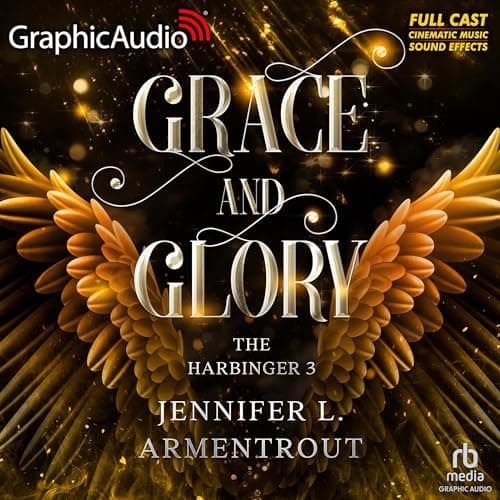
So here's where we are: Grace and Glory is the finale of Jennifer L. Armentrout's Harbinger series, and the premise is exactly as unhinged as you'd hope. Trinity Marrow has lost her Protector, the apocalypse is knocking, and the best plan anyone can come up with is summoning Lucifer to fight the Harbinger. Just — let's get the Devil involved. What could go wrong. The thing is, Armentrout actually makes this work because she never loses sight of the emotional throughline between Trin and Zayne. The world might be ending, but these two are trying to figure out a bond that's literally rewriting the rules of their existence, and that personal tension is what keeps the cosmic stakes from feeling abstract.
The cast here is massive — nearly thirty performers — and the production goes full theatrical: sound effects, score, overlapping dialogue. It's a lot. And I'll be straight with you: there's a moment early on where Trinity is trading barbs with Zayne, her voice dripping with that specific brand of terrified-but-cracking-jokes energy, and Zayne's actor responds with this low, steady warmth that grounds her completely. You can hear the dynamic of their relationship in that exchange more clearly than you'd get from reading the same dialogue on the page. Trinity's voice actress shifts from genuine grief — like, voice-cracking grief — to deadpan sarcasm within the span of a scene, and it never feels like whiplash. It feels like a person who uses humor as armor, which is exactly who Trinity is.
The Peanut scenes deserve their own paragraph. Peanut is a ghost, and whoever voices him plays the comedy with this earnest energy that makes his lines land harder. There's a bit where the production drops the background music and sound effects almost entirely for one of his moments, and the silence makes the joke hit like a punchline in a quiet room. Smart production choice.
Here's what I started realizing as I got deeper into it, though: this format is genuinely polarizing, and not just in a "some people prefer ebooks" kind of way. The dramatized adaptation trims Armentrout's prose to fit the script format. You lose internal monologue, descriptive passages, the stuff that lives between dialogue lines. This same trade-off came up when I reviewed The Crown of Gilded Bones (Part 1 of 2) (Dramatized Adaptation) — full cast productions have a way of making the emotional beats louder while quietly pocketing everything that lives in the white space of a page. If you've read the previous books and you love how Armentrout writes Trinity's inner world, you might feel like you're getting the highlight reel instead of the full experience. At least one listener ditched this version for the ebook to finish faster, and I get it — when you already know these characters, you might not want the production standing between you and the story.
There's also a criticism I found interesting: some listeners felt the whole thing played like a long advertisement for a show that doesn't exist. I can see it. There are moments where the music swells and the sound design gets so cinematic that it feels like it's selling you on the idea of a TV adaptation rather than serving the scene in front of you. It's a fine line, and this production occasionally trips over it.
But when it works — and it works more often than not — the fight sequences hit with real impact. There's a confrontation scene in the back half where you've got multiple characters shouting over each other, effects layered in, and the chaos actually maps to the chaos of the scene rather than just being noisy. That's hard to pull off with this many actors.
The ending surprised me. I won't spoil it, but Armentrout pulls off that rare trick of delivering twists that feel both unexpected and inevitable. Hearing those final scenes performed with full production gave them weight. The climactic moments land differently when you've got actors breathing real emotion into lines that on the page might read as standard genre fare.
Pacing-wise, the middle drags slightly. Armentrout likes to let her characters sit in their feelings — Trin and Zayne circling the same emotional territory for a stretch while the apocalypse is supposedly imminent. It's a feature of her style, and if you've made it through two books already, you know what you signed up for.
Who Should Listen (And Who Should Skip)
If you love full-cast drama and want a paranormal romance finale that sounds like someone built a D&D encounter with a full orchestra backing it — this is your jam. Skip it if you're protective of Armentrout's internal prose and don't want the production filtering your experience of these characters.
As a series closer, this does the job. Arcs resolve, stakes pay off, the forbidden-love thread carries genuine emotional weight through to the end. The previous book in the series, Rage and Ruin, did some of the heavier lifting to get us here, and it's worth knowing that one going in if you're new to Armentrout's pacing rhythms. The dramatized format amplifies the best parts and occasionally gets in its own way, but the cast — especially the leads — understood what this story needed from them and delivered it.