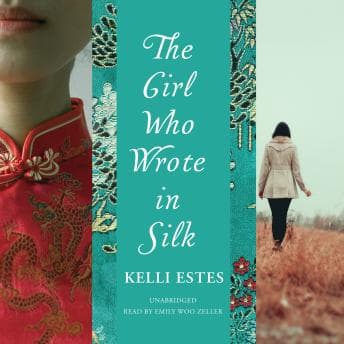

I was grading a stack of sophomore essays on The Great Gatsby - you know, the ones where they all discover symbolism for the first time and suddenly everything is a metaphor for the American Dream - when I started this audiobook. By hour three, the papers were abandoned on my kitchen table and I was walking the lakefront with Denise, both of us quiet, letting Mei Lein's story wash over us through my earbuds.
This is why we still read the classics. Or in this case, why we listen to historical fiction that earns its place alongside them.
History Stitched Into Fabric - Literally
Kelli Estes does something clever here that I wish more historical fiction attempted: she uses a physical object - an elaborately embroidered silk sleeve - as the narrative thread connecting past and present. Mei Lein, a young Chinese girl caught up in the 1886 forced expulsion of Chinese immigrants from the Pacific Northwest, literally embroiders her story into silk. Her descendant Inara discovers it a century later.
The concept could feel gimmicky. It doesn't. Estes clearly did her research on the Chinese Expulsion - a piece of American history that most of my students have never heard of, and frankly, neither had I until a few years ago. (This is why we still read, people. There's always more to learn.) The historical sections carry real weight, depicting racial violence and displacement with unflinching honesty while never feeling exploitative.
My students would hate the dual timeline structure. I love it.
Emily Woo Zeller's Delicate Balance
Here's where things get interesting. Zeller is a Golden Voice narrator - AudioFile has given her that honor, and she's earned it across dozens of performances. Her Mei Lein is remarkable: there's a worldliness to the voice, a weight of experience that makes sense for a character who witnesses such trauma. The Chinese phrases feel authentic rather than performed.
But - and this is worth mentioning - her Inara doesn't quite land the same way. The contemporary sections feel slightly less grounded. A siblings' reunion scene that should crackle with joy reads oddly, like the emotional register is slightly off. Some listeners found Mei Lein sounding older and more sophisticated than Inara, which creates a strange inversion where the historical character feels more real than the modern one.
Is it a dealbreaker? No. But it's noticeable. The narrator understands that pause is punctuation, and her pacing through the heavier historical material is genuinely riveting. She just connects more naturally with one timeline than the other.
What Estes Is Really Asking
Let's talk about what's actually happening beneath the surface here, because this isn't just a pretty story about embroidery and family secrets. Estes is asking uncomfortable questions about inherited guilt, about what we owe to history, about whether discovering your family's complicity in historical injustice obligates you to act.
Inara faces an impossible choice - one that will shake her family's legacy. And Estes doesn't give her an easy out. The prose deserves to be savored; there's a restraint to how she handles the moral complexity that reminded me of what Hemingway said about writing with the iceberg beneath the surface.
The content warnings are real: historical violence and racial discrimination are central to the narrative. This isn't cozy historical fiction. It's the kind that makes you uncomfortable in productive ways.
Who Should Clear Their Schedule - And Who Shouldn't
If you loved Hotel on the Corner of Bitter and Sweet, this is its spiritual successor - same Pacific Northwest setting, same exploration of Asian American history, same dual timeline structure. I found a similar emotional depth in Last One Home: A Novel, though it trades historical weight for contemporary family dynamics. If you're the kind of listener who appreciates historical fiction that teaches while it moves you, this is worth your time.
Skip it if you need constant action or if dual timelines frustrate you. The contemporary sections do drag slightly compared to Mei Lein's story, and if you're impatient with family drama, Inara's journey might test you.
This requires focus. I tried listening during a faculty meeting once (sorry, Principal Martinez) and had to restart an entire chapter. The historical details and emotional nuance demand your attention.
Worth Pausing the Faculty Meeting For
Twelve hours and twenty-four minutes is a commitment. But here's the thing: some stories earn their length. Estes has written a debut novel that grapples with forgotten American history, asks hard questions about legacy and responsibility, and does it through a genuinely inventive narrative structure.
Zeller's performance, despite its occasional imbalance between timelines, carries the emotional weight where it matters most - in Mei Lein's silk-stitched testimony. By the final hours, I'd forgotten about those sophomore essays entirely. (They got graded eventually. Symbolism was indeed discovered.)
This is historical fiction that does what the best of the genre should: it makes you Google something afterward, then sit quietly with what you've learned.