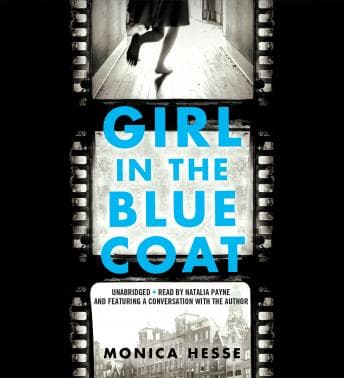

Linda was visiting her sister in San Antonio, so it was just me and Ranger in the house last Thursday night. I'd planned to do some contract review, but somewhere around hour two of this book, the paperwork stayed untouched and I was just sitting in the dark living room, Ranger's head on my knee, not moving.
That's the thing about Amsterdam 1943. Hesse doesn't ease you in.
"The Girl in the Blue Coat" opens with Hanneke - a Dutch teenager running black market goods through Nazi-occupied Amsterdam, telling herself it's resistance while mostly just trying to survive the grief of losing her boyfriend to the German invasion. The setup sounds familiar if you've read your share of WWII fiction. It isn't.
What Hesse Got Right That Most Authors Don't
I've read a lot of WWII books - fiction and history both - and the occupation chapters are usually where authors lose me. The moral complexity here reminded me of what Paul Tremblay does with unreliable perspectives in A Head Full of Ghosts - that same refusal to hand you a clean answer about who the real villains are. They write the Nazis as cartoons or they write the Dutch as uniformly heroic. Hesse doesn't do either. Hanneke's Amsterdam is full of ordinary people making ugly compromises, neighbors who look the other way, and a black market that exists because the occupiers created the conditions for it. That's accurate. That's how occupation actually works - I've seen versions of it. The moral ambiguity of who's collaborating and who's surviving and whether there's even a difference - Hesse earns that.
The mystery itself - a Jewish teenager named Miriam who vanishes from a hidden room in a client's house - is genuinely plotted. Not thriller-paced, but that's appropriate. This is a ten-hour book and it earns most of those hours. The web of resistance contacts Hanneke has to navigate, the paranoia of not knowing who to trust, the fact that one wrong conversation gets people killed - it's handled with real care. And Hanneke's grief for her boyfriend Bas is woven through everything, not used as decoration. It changes how she makes decisions. It changes what risks feel worth taking.
Hesse is a Washington Post journalist, and it shows in the research. The details of how the Dutch resistance actually operated, the geography of hidden rooms, the mechanics of the deportation system - none of it feels like Wikipedia padding. The author clearly did their homework.
The Narration - Honest Assessment
Natalia Payne is where this gets complicated. Let me be straight about what she does well: she nails Hanneke's emotional flatness - the dissociation of someone who's been grieving so long she's learned to function on autopilot. That's not easy to perform. It could read as boredom, but Payne keeps it in the right register.
But if you speak Dutch, or have spent any time in the Netherlands, buckle up. The Dutch place names and words are - rough. Not occasionally rough. Consistently rough in a way that pulled me out of the story more than once. I'm not a Dutch speaker, but even I could tell something was off. For a book set entirely in Amsterdam, that's a real problem. It's the equivalent of a book set in Fallujah where the narrator can't pronounce "Al Anbar." Distracting. Avoidable.
The emotional peaks land better than the baseline. When the horror escalates in the back third of this book - and it does escalate - Payne finds another gear. The flatness that occasionally feels like underperformance earlier starts to make sense as contrast. Still, at 1.25x this one felt right. The pacing needed a little help.
The Part That Stayed With Me
This is a YA book. I want to be clear about that because I almost didn't listen on that basis, and I would've been wrong. The YA label means the protagonist is seventeen. It doesn't mean the content is soft. There's a sequence toward the end involving what happens to people who get caught - what the deportation system actually was - that Hesse doesn't flinch on. She doesn't show you everything, but she shows you enough. Some books hit different when you've seen what organized violence does to civilians. This was one of those.
Ranger didn't move for the last two hours. Make of that what you will.
Who Should Listen, Who Should Pass
If you're coming off "The Nightingale" or "Salt to the Sea" and want more occupied-Europe WWII fiction with a female protagonist and real moral weight - this is your next listen. If you're Dutch or Dutch-fluent, get the print version and save yourself the pronunciation pain. If you need your WWII fiction to have military action and tactical detail, this isn't that book - it's a resistance story, not a combat story, and the stakes are personal, not strategic.
Mission accomplished, Hesse. Mostly accomplished, Payne.