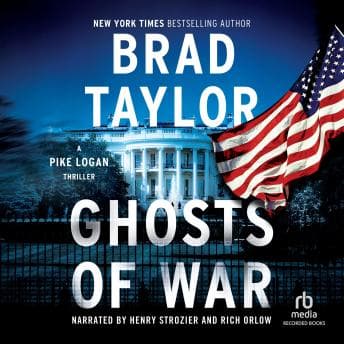

What happens when you hand the same character to two different narrators and hope nobody notices?
I was reorganizing the horror section at the library—yes, at 9 PM, yes, alone, yes, the fluorescent lights were flickering in that cliché way—when I started this one. Brad Taylor's geopolitical thrillers aren't my usual haunting ground, but sometimes you need a different kind of dread. The existential terror of watching NATO and Russia inch toward World War III while Pike Logan races against a ticking clock? That's horror adjacent enough for me.
The Two-Narrator Gamble
Here's the thing about dual narration that nobody warns you about: it can feel like watching a movie where they recast the lead actor halfway through and just... hope you don't notice. Henry Strozier and Rich Orlow both bring solid performances individually. Strozier has this gravelly authority that works beautifully for the military brass and Pike's internal tactical calculations. Orlow handles the political machinations and Jennifer's perspective with a different energy—sharper, maybe a bit more clipped.
But when they voice the same character in different chapters? Jarring doesn't quite cover it. Pike Logan sounds like Pike Logan with Strozier, and then suddenly he's... also Pike Logan but somehow a different person with Orlow. Your brain has to recalibrate each time. By hour six, I'd mostly adjusted. By hour ten, I'd stopped noticing entirely. Whether that's because the narrators found their rhythm or my brain just gave up—honestly couldn't tell you.
Nazi Gold Trains and Modern Paranoia
Taylor does something clever here that I genuinely appreciated. The Nazi gold train angle—Pike and Jennifer hired to verify artifacts from a fabled hidden cache in Poland—sounds like pure adventure pulp. And it is, partially. But Taylor uses it as a Trojan horse to explore how old wounds and old secrets become weapons in modern geopolitical chess. The past isn't dead; it's being actively weaponized.
The pacing runs hot. This isn't a slow-burn psychological thriller where you're meant to savor the dread. It's propulsive, sometimes breathlessly so. That same relentless momentum drives Devil's Hand: A Thriller, where the stakes feel just as immediate. The Taskforce is on stand-down (rogue operator problems, naturally), which means Pike and Jennifer are operating without their usual safety net. That vulnerability adds genuine stakes. When the Russian incursion into Belarus kicks off and the horrific attack against the United States lands, you're already invested enough to feel the whiplash.
Where It Haunts (And Where It Doesn't)
Look, I came to this from horror. I'm used to atmosphere being the point. Taylor's approach is different—the horror here is structural. It's the creeping realization that someone is engineering a world war, that the people who should be stopping it are the ones being manipulated into starting it. Kill Alex Cross plays with similar paranoia—the terror of systems failing when you need them most. That's genuinely unsettling if you let it sit with you.
What doesn't quite work is the narrative voice inconsistency some longtime series fans have mentioned. I'm a newcomer to Pike Logan's world, so I don't have the baseline comparison. But there are moments where the prose feels like it's rushing past character beats to get to the next explosion. Jennifer Cahill deserves more interiority than she gets. Pike's tactical brilliance is demonstrated constantly but his emotional landscape remains frustratingly surface-level.
The twelve-plus hours fly by, though. I'll give it that. I finished during a late shift at the library, shelving returns while the climax unfolded in my earbuds. Shirley (my cat, not Jackson) would have been unimpressed by the lack of supernatural elements. I was genuinely tense.
Who Needs This in Their Ears (And Who Should Skip)
If you're already invested in the Pike Logan series, you probably don't need my permission. This is apparently one of the stronger entries, and the geopolitical stakes feel uncomfortably prescient given... *gestures at everything*.
If you're new like me? It works as a standalone well enough. You'll miss some character history, but Taylor catches you up without drowning you in exposition. The dual narrator situation is a hurdle, not a dealbreaker. Give it until hour three before you decide if it's working for you.
Skip this one if narrator switching genuinely bothers you—that inconsistency never fully disappears. Maybe start with a single-narrator entry in the series first.
Back to the Stacks
This isn't horror. But the dread of watching powerful people make catastrophic decisions while the clock runs out? That's a different kind of nightmare. Taylor understands that the scariest monsters wear suits and make policy. The audiobook production has its quirks—that narrator switch never fully stops being noticeable—but both performers commit to the intensity the material demands.
Worth your time if geopolitical thrillers are your thing. Worth the adjustment period if you can push through the dual-narrator learning curve. Not perfect, but genuinely propulsive and unsettlingly relevant.
I'm going back to my ghost stories now. But I might return to Pike Logan's world. The man fights a different kind of haunting.