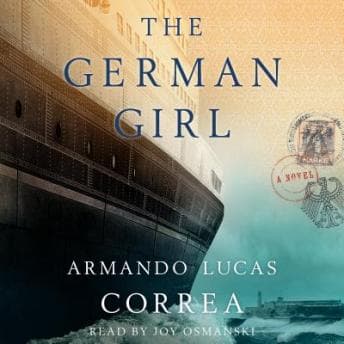

I'd heard the comparisons before I ever pressed play — The Nightingale, Lilac Girls, The Tattooist of Auschwitz. Every WWII novel with a female protagonist gets measured against that same shelf these days, and honestly, the comparison game had me bracing for something derivative. I was wrong. And I was right. Let me explain.
I started this one on a Saturday morning walk along the lakefront with Denise. She had her own podcast going, and I had Hannah Rosenthal's Berlin crumbling in my ears while joggers breezed past us like the world wasn't ending. Which, of course, it was — just not ours. That contrast between the sunny Chicago waterfront and a twelve-year-old girl watching Nazi flags replace the city she thought belonged to her? That stayed with me for days.
The Ship That Was Supposed to Save Them
Correa builds this novel around a real historical event — the voyage of the MS St. Louis in 1939, that doomed ship full of Jewish refugees who were turned away from Cuba, then the United States, then Canada, and sent back to Europe. If you know the history, you already know the gut punch is coming. If you don't, the novel earns it honestly. What Correa does well is slow the camera down during the early Berlin chapters — Hannah's family losing their possessions, their neighbors, their sense of self — before accelerating into the desperate hope of the ocean crossing. The St. Louis sections carry real dread because you're watching people convince themselves they're safe while you, the listener, know better.
But here's where I have to be honest. The dual timeline structure — Berlin 1939 and New York 2014 — creates an uneven experience. The historical chapters have genuine weight and specificity. Hannah's voice feels earned, particular, rooted in real loss. The modern timeline with Anna, her great-niece, searching for family history in Havana? It reads thinner. The 2014 chapters function more as a framing device than a fully realized story, and every time the narrative pulled me out of 1939, I felt the energy drop. My students would call it "the boring parts." I wouldn't go that far, but I understand the impulse.
Joy Osmanski and the Problem of Two Girls, One Voice
Here's where the audiobook-specific conversation gets interesting. Joy Osmanski narrates the whole thing solo, and her emotional tone is genuinely strong — she captures Hannah's mixture of childlike confusion and premature gravity in ways that feel right. The prose deserves to be savored, and Osmanski mostly lets it breathe.
But the dual timeline creates a real problem for single-narrator audiobooks. Hannah and Anna are both young girls telling their stories in first person. Without visual chapter breaks or any shift in vocal register between the two timelines, there were moments — particularly during those late-night grading sessions when my attention was split — where I genuinely couldn't tell which girl was talking. Which decade I was in. I'd surface from a paragraph about a paper and realize I'd been mentally placing Anna on a ship that sailed seventy-five years before she was born.
This isn't Osmanski's fault, exactly. She's doing solid work with what she has. But this is a book that probably needed either two narrators or a more dramatic vocal distinction between the timelines. The narrator understands that pause is punctuation — she uses silence well in the heavier scenes — but silence alone can't solve a structural problem.
What Correa Is Really Saying (And Whether It Lands)
Let's talk about what the author is really saying. This isn't just a Holocaust novel. It's a novel about exile — about people who survive the worst thing and then spend generations figuring out what survival cost them. The Cuba connection is what makes this book distinct from its comparisons. The Jewish refugees who actually made it to Havana, who built lives in a country that wasn't theirs, who watched that country change under Castro — that's a story I haven't encountered much in this genre. Correa, a Cuban-born journalist, clearly wrote from a place of personal understanding about displacement and cultural erasure.
The prose itself — translated from Spanish by Nick Caistor and Dolores M. Koch — has a formal, almost lyrical quality that works beautifully for Hannah's sections and sometimes feels stilted in Anna's modern voice. At 1.0x speed (yes, I'm that person), you can feel the translation at work in certain sentences. Not badly, just — you're aware of it. The language has a careful quality, like someone choosing each word from a slightly different shelf than the one you're used to.
If you loved The Book Thief for its child's-eye-view of historical horror, this is its spiritual successor — though quieter, less stylistically flashy, more concerned with aftermath than event.
Worth Pausing the Faculty Meeting For?
Close call. The historical core of this novel is genuinely affecting, and Correa's focus on the St. Louis and Cuba gives it an angle most WWII fiction doesn't attempt. But the modern timeline dilutes the impact, and the single-narrator approach creates genuine confusion in audio format. I'd say this is a strong read that's a slightly diminished listen. If you have the patience to lean in during the 2014 chapters and keep your mental timelines straight without visual cues, you'll find something real here. If you're the type who listens while multitasking — and honestly, that's most of us — you might want the print version instead.
My students would hate this. I mostly loved it. That mostly is doing honest work. The last time I felt this kind of qualified admiration — where the structural frustrations and the genuine emotional payoff were so thoroughly tangled up together — was with Second Foundation, another book where the framing device keeps threatening to undermine the thing you actually came for.