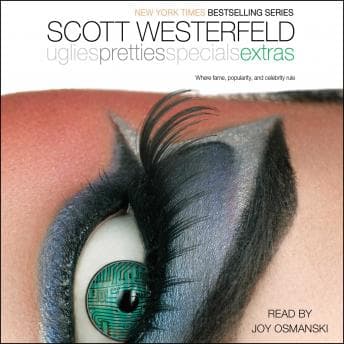

Scott Westerfeld wrote a whole book about social media clout-chasing in 2007. Let that sink in.
I was reorganizing my Audible library at midnight - Jenny calls this "reorganizing," I call it "admitting defeat against the backlog" - and I stumbled on Extras sitting there, unfinished from months ago. Restarted it. Finished it in two sittings. And I have thoughts.
A 15-Year-Old Influencer Before Instagram Existed
Here's what's wild about this book: Aya Fuse lives in a post-scarcity economy where the only currency is literally your face rank - a public popularity score that determines your social standing. She's a "kicker," which is basically a blogger/journalist hybrid, desperate to break a story big enough to boost her rank. Replace "face rank" with "follower count" and "kicking a story" with "going viral" and you've got a YA novel that accidentally predicted the next fifteen years of human behavior.
Westerfeld built this reputation economy where "tech-heads" mod their hover-gear for clout, "surge monkeys" get extreme plastic surgery for attention, and everyone's performing for an algorithmic audience. My parents spent 14-hour days at their dry cleaning shop earning actual money. This book's economy would've broken their brains. But here's the thing - Westerfeld isn't celebrating it. The whole narrative is a slow-burn critique of what happens when fame becomes the operating system of society. This is what every LinkedIn thought leader posts about now. Westerfeld just got there first. With better prose. The only other recent read that gave me that same 'someone figured this out decades early' feeling was Conjuring of Light, where the world-building does quiet thematic work that most contemporary authors are still catching up to.
The story kicks in when Aya discovers the Sly Girls - an underground crew that deliberately stays anonymous, pulling off dangerous stunts on mag-lev trains without any cameras rolling. In a world where everything is content, choosing invisibility is the most radical act possible. That tension between Aya's desperation to expose them and their commitment to staying hidden is genuinely interesting. It's the best stretch of the book.
Where the Consulting Brain Starts Twitching
Here's where I get honest. The first half is strong - tight world-building, a protagonist with clear motivation, real stakes within this bizarre economy. But around the midpoint, Westerfeld pulls Tally Youngblood back into the story, and you can feel the gears grind. It's like watching a startup pivot mid-pitch because the investors looked bored.
Tally showing up transforms the book from Aya's story into a legacy sequel problem. The alien threat that emerges in the back half feels rushed compared to the social commentary that was working perfectly fine on its own. I've seen this fail at three different companies - you've got a solid product, then someone in the room says "but what if we also did THIS" and suddenly you're chasing two strategies and executing neither well. The face-rank economy deserved a full book of exploration. Instead, we get a third act that pivots to action-adventure and loses the specificity that made chapters 3 through 8 so sharp.
At 9.5 hours, this is a book with about 6.5 hours of genuine insight into social currency, fame addiction, and post-scarcity economics. The other 3 hours? Not terrible, just... diluted.
Joy Osmanski Does the Heavy Lifting
Joy Osmanski's narration is solid work, not spectacular. She handles Aya's breathless, status-obsessed inner monologue well - you can hear the anxiety of someone checking their metrics every five minutes. Her voice for Hiro, Aya's older brother, carries this tired superiority that nails the "I was famous before you" sibling dynamic. Where it dips is the action sequences - some of the mag-lev train scenes felt flat when they needed adrenaline. A few stretches in the middle went slightly monotone, like she was pacing herself for the long haul instead of punching the moments that needed punching.
Clean production though. No audio issues. At 1.5x this moved well - I wouldn't go full 2.0x because Westerfeld's slang-heavy world ("kicking," "face rank," "eye-screen") needs a beat to process if you're new to the series.
Who Gets ROI on This
If you've read the Uglies trilogy, this is worth the listen for the world expansion alone. If you haven't - honestly, you could start here and mostly follow along, but you'll miss some context when Tally arrives. Best for: anyone who's ever doom-scrolled their own analytics, parents trying to understand why their kid cares about followers, or business folks who want a fictional case study in reputation economics that's more entertaining than any white paper.
Skip if: you want pure action, you're impatient with YA voice, or you need the original trilogy's intensity. This is a quieter, more cerebral entry.
The Engagement Metric
Bottom line: Westerfeld accidentally wrote a business book about the attention economy, disguised it as YA dystopia, and it holds up better than half the nonfiction on my shelf about the same topic. The back half loses focus, and the Tally fan service costs the story some momentum. But a 15-year-old girl gaming a reputation algorithm while uncovering an underground anti-fame movement? That's a premise most adult fiction authors would kill for. Jenny would say I'm being harsh about the ending. Jenny is right. But the first half earned the listen.