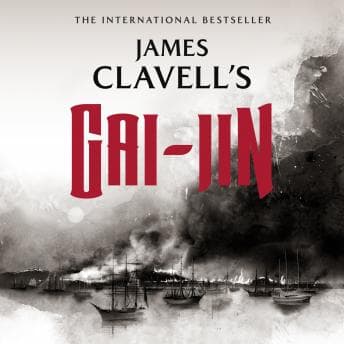

How many hours of your life are you willing to hand over to a single audiobook? Because fifty. Fifty hours and seventeen minutes. That's what Gai-Jin asks of you, and I need you to sit with that number for a second before we go any further.
I started this one during a stretch of night shifts where the unit was running hot - multiple traumas, back-to-back codes, the kind of week where you forget what daylight looks like. My 45-minute drive home wasn't cutting it, so Gai-Jin became my companion for nearly three weeks of commutes, meal prep sessions with my AirPods in, and those weird 2 AM lulls where I'd sneak in a chapter while charting. Carlos kept asking why I was muttering about samurai and opium traders while making pancit. Fair question.
Fifty Hours in Yokohama and I Have Feelings About It
Look, I love Clavell. Shōgun was the book that got me into historical fiction - I listened to it during my first year of night shifts and it rewired my brain. That same sense of being completely swallowed by an enormous, meticulously built world hit me again with Ben-Hur, which has no business being as immersive as it is for a book that old. Tai-Pan was nearly as good. So when I hit play on Gai-Jin, I expected that same electric feeling of being dropped into a world so fully realized you forget you're sitting in a Honda Civic in a hospital parking garage.
What I got was... different. Malcolm Struan, wounded on the Tōkaidō road, recuperating in Yokohama while political machinations swirl around him - there's a good story buried in here. The collision between Western traders and a Japan tearing itself apart from the inside, the Satsuma samurai who set everything in motion with that attack, Angelique Richaud navigating a world where she has no money, no real power, and every man around her is trying to use her for something. That stuff works. When Clavell zooms in on individual moments of cultural collision - the way the gai-jin (outsiders) fundamentally misread Japanese political structures, the way the Japanese characters strategize around Western ignorance - it's the kind of historical fiction that makes you smarter.
But fifty hours. Fifty. Hours. The diplomatic dialogue stretches and stretches. Clavell gives you every trading house negotiation, every political calculation from every angle, every internal monologue from characters you met fifteen hours ago and may not see again for another ten. I'm someone who does twelve-hour shifts. I have stamina. And there were moments during this listen where I thought, "This could've been thirty-five hours and lost nothing."
John Lee Running a Marathon at Sprint Speed
John Lee is an AudioFile Golden Voice narrator for a reason, and you can hear that pedigree here. The man is juggling dozens of characters across multiple nationalities - British traders, French socialites, Japanese samurai and politicians, Chinese merchants - and for the most part, he keeps them distinct. His voice acting genuinely does make stretches of this feel like a movie. You can hear the class differences between characters, the cultural friction built right into how they speak.
But here's the thing - and I say this as someone who listens to audiobooks in a semi-delirious post-shift state - Lee reads fast. Really fast. Almost no pauses between scenes, barely a breath between character switches. During my drive home at 7:30 AM after a twelve-hour shift, there were moments where I'd zone out for thirty seconds and suddenly we'd jumped from a Yokohama trading office to a samurai council and I'd have no idea whose head I was in. With a cast this large, you need those micro-pauses. You need the reader to give you a beat to reorient. Lee doesn't always give you that beat.
He's still good - I want to be clear about that. Keeping a fifty-hour narrative moving without it feeling like homework is a genuine skill. But if you've listened to the Tai-Pan audiobook with its different narrator, you might feel the difference. It's like comparing a solid travel nurse to the unit's best charge nurse. Both competent. One just knows the terrain better.
Who Should Commit to This (and Who Shouldn't)
If you've already devoured Shōgun and Tai-Pan and you're hungry for more of the Struan dynasty saga, this is your next stop. No question. The connections to those earlier books add layers that standalone listeners won't get, and there's genuine payoff in seeing how the family dynamics have evolved across generations.
If you're coming in cold? I wouldn't start here. This is not the entry point. The pacing assumes a level of investment in Clavell's world that new listeners haven't built yet, and the sprawling cast will overwhelm you without that foundation.
And if you're a casual listener who puts audiobooks on while doing dishes or scrolling your phone - this is not that book. I yelled at my dashboard during this one, but it was mostly "Wait, who is that? Go back!" This demands your focused attention, every hour of it.
Night Shift Prescription
Gai-Jin is like a patient with a complicated history - fascinating case, genuinely worth your time, but you need to commit to the full workup. It's not Clavell's best. The characters don't grab you the way Toranaga or Dirk Struan did. The plot meanders through diplomatic corridors when you want it sprinting through streets. But when it works - when the cultural tensions snap and the personal stakes collide with the political ones - you remember why Clavell built a whole saga around this world.
Fifty hours. I don't regret them. But I understand anyone who taps out at twenty.