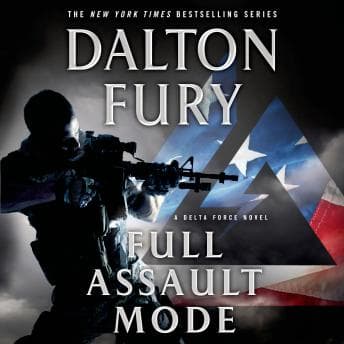

"Execute, execute, execute."
That line hit somewhere around hour three, during a particularly tense infiltration sequence, and I found myself nodding along in my truck like Ranger does when he's tracking a scent. Dalton Fury gets it. The man commanded Delta operators at Tora Bora, helped plan the bin Laden raid, and it shows in every tactical beat of this book.
Let me cut to the chase: Full Assault Mode delivers authentic special operations action that'll satisfy anyone who's ever wondered what deep-cover counterterrorism actually looks like. It's not perfect—there's some structural weirdness I'll get to—but when Fury's firing on all cylinders, this is the real deal.
When Your Cover's as Thin as Your Patience
Kolt Raynor's in trouble. Again. The guy can't seem to follow orders to save his career, which is exactly why he ends up getting recruited into Tungsten—an ultra-black program that makes Delta look like the public affairs office. His mission: infiltrate al-Qaeda and stop a nuclear power plant attack that would make 9/11 look like a training exercise.
Fury doesn't mess around with the stakes. The technical details on nuclear facility vulnerabilities? Uncomfortably plausible. The tradecraft for building a legend and working deep cover? This isn't Hollywood nonsense where the hero walks into a terrorist camp with perfect Arabic and a winning smile. Raynor struggles. He makes calls that don't quite work. He operates in that gray zone where every decision could blow your cover or get someone killed.
The dialogue has this authentic military cadence—though I'll admit, there's an excessive use of "Yes" and "No" in conversations that started grating after a while. Real operators don't talk like that. We use a lot more profanity and a lot fewer monosyllables.
Two Books Duct-Taped Together
Here's where it gets complicated. The first half of this book and the second half feel like they were written during different deployments. Part one sets up this intricate infiltration—Raynor building his cover, making contacts, the slow burn of deep-cover work. Then somewhere around the midpoint, it's like Fury got impatient and decided to fast-forward to the action sequences.
The transition is jarring. Plot threads that seemed important just... evaporate. Some of the tactical decisions in the back half require you to suspend disbelief in ways the front half never asked. There's a sequence involving the final assault that had me muttering "that's not how any of this works" even though I know Fury knows better.
I've seen this happen with guys who've been there—sometimes the authentic details in your head don't translate cleanly to narrative structure. The action is still intense when it hits. The stakes feel real. But the connective tissue between set pieces gets thin.
Fliakos Behind the Mic
Ari Fliakos handles the narration with steady professionalism. He's got the military cadence down—the clipped delivery during tactical sequences, the measured tension during planning phases. Nothing flashy, nothing that pulled me out of the story. For a book this dependent on operational authenticity, that's exactly what you need.
I listened at 1.25x as usual, and the pacing worked well. Fliakos doesn't rush the technical details but doesn't linger on them either. At just over twelve hours, it's a solid commitment but never felt like it was padding runtime.
Worth Your Time? Here's the Debrief
Look, I've read military thrillers where the author clearly got their research from Wikipedia and Call of Duty. This isn't that. The authenticity here reminds me of the meticulous historical detail in Outlander—different wars, different centuries, but that same commitment to getting the details right. Fury's credentials are unimpeachable, and the operational details reflect decades of real-world experience. When he describes the planning process for a high-risk infiltration, you can feel the weight of actual missions behind every word.
But credentials don't automatically make great fiction. The structural issues are real—that disconnect between the first and second halves will bother readers who care about tight plotting. Some of the later action sequences push into territory that feels more thriller-convenient than tactically sound.
If you've read the earlier Raynor books, this one's darker. More morally ambiguous. The counterterrorism stakes feel grimmer, which tracks with where the real-world fight was heading when this was written.
Who's This Op For?
Grab this if you want military fiction written by someone who actually did the job—readers who can forgive some narrative roughness for authentic tactical detail, and fans of the series who want to see Raynor pushed into uncomfortable territory. Pass if plot consistency matters more to you than operational authenticity, or if you need your military thrillers polished smooth.
Ranger approved this one—he perked up during every action sequence and only fell asleep during the romance subplot I didn't mention because it's barely there and honestly better for it.
A slightly off book from a guy who's been there is still better than most of what's on the shelf. Mission accomplished, with caveats.