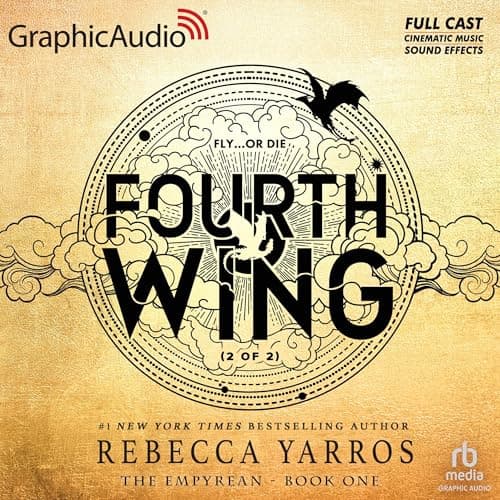

So here's the thing — I was supposed to be debugging my procedural generation code at 1 AM, had the dramatized Fourth Wing Part 2 running as "background noise," and by the time Liam's death scene hit, I was sitting in my desk chair with my hands over my mouth like I'd just watched a TPK unfold at the table. My code didn't get touched for another two hours.
Let me back up. Everyone online seems split into two camps: people who think this dramatized adaptation is the greatest thing since sliced bread, and people who think the original Rebecca Soler solo narration is superior. I went in expecting to side with the purists. I was wrong. Mostly.
When Your Audiobook Rolls a Nat 20 on Production
This thing sounds like a movie. Not in that vague "oh it's so cinematic" way people throw around — I mean the dragon roars have actual bass that rattled my cheap desk speakers, the ambient sounds during the Riders Quadrant scenes make you feel like you're standing on cold stone, and the score swells during combat in ways that genuinely elevated my heart rate. The fight choreography, which can feel flat on the page, suddenly has weight when you hear impacts and wingbeats layered under the dialogue. My D&D group would lose their minds over the sound design during the Threshing — it plays like a boss encounter with a full orchestral soundtrack.
Megan Poppy as Violet nails the internal monologue voice — that mix of "I'm terrified" and "I'll figure this out anyway" that makes Violet work as a protagonist. And whoever directed the Xaden scenes in those bonus chapters understood the assignment. The tension between Violet and Xaden doesn't just come through in the words; the pacing of delivery, the pauses, the slight shifts in tone — it's doing heavy lifting that a single narrator would have to work much harder to pull off.
The Pronunciation Problem Is Real (And Annoying)
But here's where I have to break from the hype train. With a cast this large — we're talking 30+ actors — consistency goes out the window in places. Dragon names and surnames get pronounced differently depending on which actor is speaking, and once you notice it, you can't un-notice it. During the library walk scene with Violet and Liam, it pulled me right out. This is a world-building issue for me specifically because Yarros built a naming system that signals political faction and family lineage. When actors can't agree on how to say "Riorson," it undercuts the world-building the story is trying so hard to establish. A pronunciation guide and a stricter director would've fixed this. It's not a dealbreaker, but it's the kind of thing that keeps this from being a perfect production.
And yeah — the background sounds during the spicy scenes. Look, I'm not a prude, but when you've got ambient bedroom audio layered under intimate dialogue, it lands somewhere between immersive and unintentionally funny. I actually laughed out loud at one point, which I'm fairly certain was not the intended reaction.
The Sanderson Comparison Nobody Asked For (But I'm Making Anyway)
Yarros doesn't build magic systems with Sanderson-level rigor — the signets and dragon bonding operate more on vibes and narrative convenience than hard rules. And that's fine. This isn't Stormlight. What Yarros does well is create a world where the stakes feel physical and immediate. The closest thing I've read to that kind of immediate, physical stakes in a completely different genre is Der Marsianer — every chapter a new problem to solve, every solution bought with something it cost to give. Basgiath War College works as a setting because it functions like a dungeon crawl — every chapter is another encounter, another check against survival. The progression is satisfying in that LitRPG way where Violet keeps leveling up through cleverness instead of raw power. The conspiracy elements in this second half land harder than Part 1 set them up to, and the final act twist genuinely caught me off guard. (I read this instead of writing my thesis. Dr. Patel would not approve.)
The dramatized format amplifies the emotional peaks in ways I didn't expect. Liam's death in particular — with the full cast reacting, the score dropping to near silence, and then that gutting final line — hit harder than it had any right to. I've listened to that scene twice now.
Who Gets a Seat at This Table (And Who Should Sit This One Out)
If you want the immersive, cinematic version of Fourth Wing and you're the type who listens with headphones in a quiet room, this is the way to experience this story. You get a movie-quality production with genuine emotional weight. The trade-off is some inconsistent pronunciations and a few moments where the dramatization overshoots into awkward territory.
Skip this version if you're a stickler for pronunciation consistency or you mostly listen while doing other things — the original Soler narration might serve you better. This production demands your attention. It's not a background listen.
The bonus Xaden chapters are genuinely good and not just marketing filler. Getting his POV on key scenes recontextualizes several moments from Part 1 in ways that made me want to go back and relisten.
Rolling Initiative on Part 2
Yes, it's 10+ hours on top of Part 1. Yes, it's worth it. The production team swung big on this dramatized version, and they connected on about 85% of it. The 15% they missed — pronunciations, a couple cheesy line reads, those bedroom sound effects — keeps it from being the definitive version. But when it works, especially during combat and the emotional climax, it's the best way I've experienced this story. Now if you'll excuse me, I have a thesis I should've been writing six hours ago.