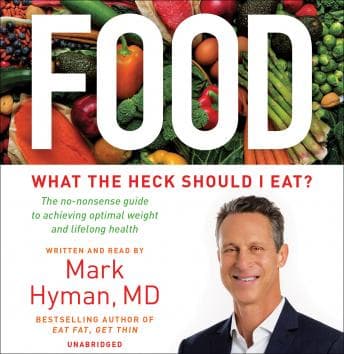

Dr. Mark Hyman is either going to make you feel incredibly validated or deeply uncomfortable about what's in your refrigerator. There's no middle ground here.
I started this one during a Sunday cooking session - ironic, given that halfway through I was questioning every ingredient I'd just bought. The protagonist exhibits classic functional medicine evangelism, which, if you're unfamiliar with Hyman's work, means he's going to challenge basically everything you thought you knew about nutrition. Eggs are fine. Oatmeal is suspect. Milk doesn't do what the commercials promised. And sugar? Sugar is the villain in this particular case study of American dietary dysfunction.
The Doctor Will See You Now (For Ten Hours)
What makes this audiobook compelling is Hyman's systematic demolition approach. He takes each food group - grains, legumes, meat, dairy, fats, sweeteners - and essentially puts them on trial. The research actually shows, according to Hyman anyway, that we've been fed decades of bad science mixed with food industry lobbying. It's a fascinating case study in how institutional guidance can go sideways.
Compared to other nutrition books I've encountered (and trust me, my mother has sent me approximately forty WhatsApp forwards about turmeric), Hyman is refreshingly specific. He's not just saying "eat better" - he's explaining the biochemistry of why certain fats aren't the enemy while seed oils might be. Whether you agree with his conclusions is another matter entirely. But the man builds his arguments.
The ten-hour runtime feels appropriate for the scope. This is comprehensive. Maybe too comprehensive? By hour six, I found myself asking: do I really need this much detail about legumes? The answer is probably no. But Hyman is thorough, and if you're someone who needs to understand the why behind every dietary choice, you'll appreciate it.
When the Author Is the Narrator
Hyman narrates his own work, which creates an interesting dynamic. His tone is friendly, accessible - like a doctor who actually has time for you during your appointment. (My therapist would have thoughts about why that feels so novel.) The clear explanation style works well for complex nutritional science. He doesn't talk down to you, but he also doesn't assume you have a biochemistry degree.
The downside of author-narration is that you're getting one energy level for ten hours. There's no vocal variety between characters or sections because - well, there are no characters. It's Hyman explaining, Hyman debunking, Hyman occasionally getting passionate about the failures of the USDA. If you're used to professional narrators who modulate their delivery, this might feel flat. I didn't mind it, but I also wasn't listening for entertainment. This was focused listening during meal prep, which felt appropriately meta.
The Psychology of Dietary Confusion
Here's what I found genuinely interesting from a behavioral perspective: Hyman addresses why we're so confused about food in the first place. The institutional failures, the conflicting studies, the way food companies have manipulated research - it's a case study in how external forces shape individual behavior. We think we're making autonomous choices at the grocery store. We're not. We're responding to decades of conditioning.
Psychologically, this tracks. Cognitive dissonance around food is real. We know vegetables are good. We eat the chips anyway. The gap between knowing and doing is exactly what So Long, Insecurity explores in the context of self-worth—different subject, same psychological pattern. Hyman's approach is to give you enough information that the "right" choice becomes obvious. Whether that actually changes behavior is... well, that's a different research paper.
The book also touches on food systems, environmental impact, social justice implications. It's ambitious. Maybe overly so. The holistic picture he's painting is compelling, but I occasionally wanted him to stay in his lane. The nutrition science is his strength. The policy commentary feels less essential.
Who Should Listen (And Who Should Skip)
This is for people who want to understand food science, not just follow a meal plan. If you want someone to tell you exactly what to eat for breakfast, you'll get frustrated - though there are recipes at the end. If you want to understand why certain foods affect your body the way they do, Hyman delivers.
Skip this if you're already deep into functional medicine or paleo/keto research. A lot of this will be review. Also skip if you're looking for a quick listen - ten hours is a commitment, and the information density is high.
The Prescription
Hyman has written what amounts to a nutritional manifesto disguised as a practical guide. It's well-researched (by his standards - nutrition science is notoriously contested), clearly explained, and genuinely useful if you're willing to sit with the information. The author-narration works better than expected, though I'd recommend 1.25x speed unless you really want to marinate in the details.
Is it going to change how you eat? Maybe. It changed how I think about what I buy, which is the first step. My mother would be proud. She'd also still send me those turmeric forwards.