
How many times can the American nutrition establishment completely reverse itself before we stop taking it seriously?
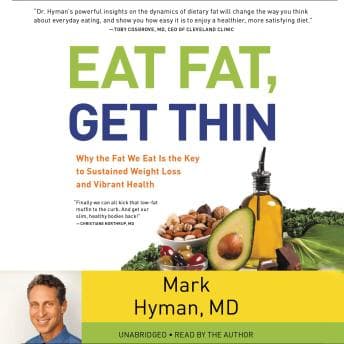
I was prepping a deck for a health-tech startup at midnight — the kind of startup that wants to "disrupt wellness" (their words, not mine) — when I figured I'd knock out Hyman's Eat Fat, Get Thin while cross-referencing their market research. Seemed fitting. And honestly, the first two hours had me nodding along. Hyman's core argument — that decades of low-fat dietary guidance were built on shaky science, industry lobbying, and one very flawed researcher named Ancel Keys — is genuinely important. If you've never heard the story of how the sugar industry funded studies to shift blame onto fat in the 1960s, Hyman lays it out cleanly. That section alone is worth your time.
But here's where my consulting brain kicks in: there's about 2.5 hours of solid, actionable content buried inside 8 hours of audio.
The Pitch Deck Is Solid, the Appendix Is the Whole Book
Hyman's framework boils down to: eat more healthy fats (avocados, nuts, olive oil, eggs, wild-caught fish), cut sugar and refined carbs, avoid industrial vegetable oils. That's the thesis. He supports it with studies on saturated fat, cholesterol myths, and the metabolic disaster of the Standard American Diet. Good stuff. Reminds me of Gary Taubes' Good Calories, Bad Calories but pitched at a broader audience — less academic, more prescriptive.
The problem? The book keeps re-selling you on the same idea from slightly different angles. By hour four, I'd heard the "fat doesn't make you fat, sugar makes you fat" argument restated in maybe six different ways. This is what my parents did instinctively — my mom cooked with sesame oil, pork belly, fermented everything — and nobody in Koreatown needed eight hours to explain why it worked. Now it has a TED talk.
Compare this to something like How Not to Die by Michael Greger, which at least covers wildly different disease categories to justify its runtime. Hyman's book has one big idea with a long tail of meal plans and recipes that, frankly, don't translate great to audio. Nobody's memorizing a shopping list at 2.0x speed on their commute.
Author-as-Narrator: The Functional Medicine Voice
Hyman reads his own book, and it's — fine. He's clear, authoritative, steady. He sounds like a doctor explaining test results: competent, unhurried, a little clinical. There's no dramatic flair, no storytelling instinct that makes you lean in. It's a lecture from a smart guy who believes deeply in what he's saying. I respect that. But after a few hours, the tone flatlines. No variation in energy between "here's how cholesterol actually works" and "here's my 21-day plan." Everything lands at the same emotional register.
Recorded live in New York City apparently, and the audio is clean — no weird room noise, no page-turning artifacts. Just Hyman and his convictions for eight straight hours.
Where the ROI Actually Lives
Skip to the sections on the science of fat metabolism and the history of the low-fat movement. That's where Hyman earns his keep. His breakdown of how different types of fat (omega-3s vs. omega-6s vs. trans fats) affect inflammation is practical and genuinely useful. The 21-day eating plan has value too, but grab the physical book or PDF companion for that — trying to absorb recipe ingredients through earbuds is a losing strategy.
What I kept wanting was more depth. More studies. More pushback on his own arguments. He mentions that not all saturated fats are equal, then kind of breezes past the complexity. A good McKinsey analyst would've stress-tested these claims harder. Feel Better in 5 has the same confident-doctor energy but at least keeps the scope narrow enough that the breezing-past doesn't cost you as much. Hyman's a believer, and believers sometimes skip the inconvenient footnotes.
Jenny, who actually does most of the cooking in our house, listened to about 30 minutes and said, "So... eat real food and stop buying margarine? Got it." She's not wrong. The core message is that simple. Whether you need 8 hours to internalize it depends on how deep your fat-phobia runs.
The Engagement Letter
Bottom line: If you're still operating on 1990s nutritional wisdom — egg whites only, skim milk, "heart-healthy" canola oil — this book will rewire how you think about food. The science sections are legitimately useful. But the audio format is the wrong delivery vehicle for about 40% of this content (the recipes, meal plans, shopping lists). And the repetition is real.
Who should listen: anyone starting their nutrition education or recovering from decades of low-fat dogma. Who should skip: anyone who's already read Taubes, listened to Peter Attia's podcast, or generally understands that avocados aren't the enemy. You already know this stuff.
My 2.0x speed couldn't save the middle hours, but the opening and the science chapters? The key takeaway is worth the listen. The other 7 hours? Not so much.