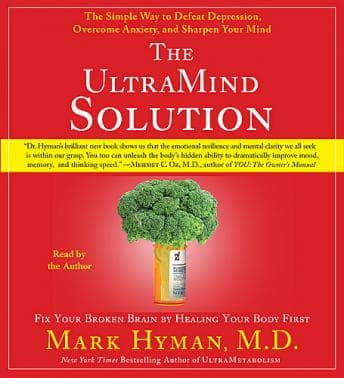

So I was half-awake on the 6:47 Caltrain, scrolling through my library trying to find something that wouldn't require actual cognition, and I landed on The UltraMind Solution. Six hours of a doctor explaining why my brain feels like it's running on a 2015 MacBook Air? Sure, let's go.
TL;DR: Worth your commute if you're new to the gut-brain-nutrition connection. If you've already read anything by Hyman or spent time in the functional medicine rabbit hole, the ROI drops fast.
Your Brain Is Basically a Distributed System With Bad Dependencies
Here's the core thesis: your brain doesn't operate in isolation. It's downstream of your gut, your nutrient levels, your toxic load, your hormones — basically every other system in your body. If you're foggy, anxious, depressed, or can't focus, Hyman argues you shouldn't just throw SSRIs at the problem. You should debug the underlying infrastructure first.
And honestly? As someone who debugs distributed systems for a living, this metaphor clicked hard for me. Your brain fog isn't the bug — it's the symptom. The actual root cause is three layers down in some dependency you forgot you even had. Hyman walks through seven "keys" to brain health: nutrition, hormones, inflammation, digestion, detoxification, energy metabolism, and what he calls the "calm mind." Each one gets its own section with questionnaires, supplement recommendations, and dietary changes.
The science actually holds up — mostly. He cites real studies on omega-3s, B vitamins, magnesium, and the microbiome. Some of the supplement stacking gets aggressive (like, how many pills does this man want me to take daily?), and a few of his claims about heavy metals and detox veer into territory where I'd want to see stronger evidence. But the foundational stuff — eat real food, fix your gut, reduce inflammation, get your vitamin D checked — is solid and increasingly mainstream.
The Repetition Problem (a.k.a. This Could've Been a Blog Post... Series)
Okay not quite a blog post. But this is a 6-hour-and-24-minute book that has maybe 3.5 hours of unique content. Hyman has this habit of restating his central premise — that the body affects the brain, that conventional medicine treats symptoms not causes — roughly every 15 minutes. By hour 3, I was muttering "yes, I know, the body is connected to the brain" while some poor guy in the quiet car gave me a look.
The six-week plan itself is buried under layers of context-setting. He spends a LOT of time on "why" before getting to "how," which is fine for a first-time reader but brutal on re-listen. I bumped this to 1.75x by the halfway mark and honestly wish I'd started there.
The questionnaire sections are also... not great in audio format. He reads through these self-assessment checklists — "Do you experience brain fog? Do you have digestive issues? Do you crave sugar?" — and they're clearly designed for a physical book where you'd check boxes. Listening to someone read a checklist at you on a train is a specific kind of tedium I do not recommend.
Hyman Narrating Hyman: The Doctor's Bedside Manner
He narrates his own book, and credit where it's due — he's clear, authoritative, and genuinely sounds like he cares about this stuff. No weird pronunciation issues, no stumbling over his own medical terminology. It's basically sitting across from a very passionate functional medicine doctor who really, really wants you to take your fish oil.
The downside of author-narrated nonfiction is that there's no performance craft to carry you through the slower sections. When a professional narrator hits a dry patch, they can modulate energy and keep you engaged. Hyman reads with consistent earnestness, which is fine but doesn't save the repetitive stretches. It's a lecture, not a performance. Clean audio though — no production complaints.
Who Gets the Prescription (And Who Doesn't)
Perfect for: You're new to functional medicine, you've been feeling like garbage and your doctor just shrugged, or you want a structured intro to the nutrition-brain connection. Also decent if you're the type who needs the "why" hammered in before you'll change behavior.
Skip for: Anyone who's already read The Blood Sugar Solution, listened to Huberman's nutrition episodes, or has a functional medicine practitioner. You'll recognize 70% of this. Also skip if you want something you can casually absorb at 6AM — the checklist sections demand more attention than zombie-mode allows.
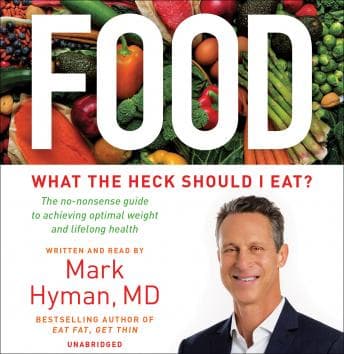
If you're looking for Hyman in a more actionable format without the six-hour lecture, Food: What the Heck Should I Eat? distills a lot of this nutritional philosophy into something you can actually skim at 6AM. Same narrator, same earnestness, half the runtime.The Commit Message
This is basically an intro-level systems architecture talk but for your body. Solid fundamentals, decent speaker, but the signal-to-noise ratio needed editing. I got enough out of it to actually go get my B12 and vitamin D levels tested (results pending, Kevin thinks I'm being dramatic), so it did its job. But I wouldn't spend a credit on it — grab it from the library or catch it on a streaming service. The information is too widely available now to pay premium for this particular packaging.