
Look, I'm going to be upfront about something: this is not my usual lane. Jenny handed me her Audible account last month and said 'just try it.' So here I am, a management consultant, reviewing a Christian self-help book about women's insecurity. My parents would be confused. I'm a little confused.
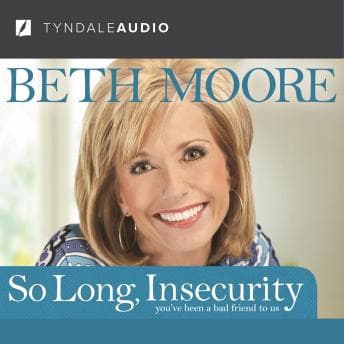
But here's the thing - I've sat in enough boardrooms watching brilliant women second-guess themselves while mediocre men steamroll through presentations. I've seen insecurity tank careers. So when Beth Moore says insecurity is 'a bad friend,' I get it. That framing? Actually pretty smart from a behavioral change perspective.
The ROI Question Nobody's Asking
Nine hours is a lot. I'm just going to say it. At 2.0x speed, that's still 4.5 hours of my life, and honestly? There's maybe 3 hours of genuinely useful content here. Moore has real insights about the psychology of comparison, about how we measure ourselves against impossible standards, about the exhausting performance of pretending we're fine. Good stuff. Stuff I've seen play out in every company culture I've ever consulted for.
But there's padding. Stories that meander. Anecdotes that could've been tightened. My 2.0x speed couldn't save this one - not entirely. If you're the type who needs to marinate in the message, fine. But if you're like me and you want the insight without the filler, prepare to do some mental fast-forwarding.
The key takeaway is worth the listen. The other 6 hours? Not so much.
When the Author Reads Her Own Work
Beth Moore narrating her own book is both the strength and the weakness here. She's warm. Conversational. There's this Southern charm that makes you feel like you're sitting across from her at a coffee shop. (Jenny would love her. They'd probably become best friends in twenty minutes.)
But - and this is a real but - her pacing drags. She lingers on certain passages like she's waiting for you to have an emotional breakthrough right there in your car. I was on a red-eye to Chicago when I started this, and I kept drifting. Not because the content was bad, but because the delivery wanted more space than I could give it at 6 AM with airport coffee.
Some reviewers mentioned her accent being distracting. I didn't find it distracting so much as... specific. It works if you're already in the Beth Moore ecosystem. If you're coming in cold like I did, it takes some adjustment.
What My Parents Did Instinctively
Here's what stuck with me: Moore's framework for understanding where insecurity comes from - culture, comparison, past wounds - is basically what every good therapist and organizational psychologist has been saying for decades. I've seen similar frameworks dressed up in corporate speak—7 Eternal Laws of Success tried this with business principles, though it landed flat for me. But she packages it in accessible language with a faith-based foundation that'll land with her audience.
My mom never read self-help books. She was too busy running a dry cleaning business and raising two kids. But she had this unshakeable sense of identity rooted in her faith and her work. No comparison trap. No performance anxiety. She just... was who she was.
Moore is essentially trying to teach what my mom embodied naturally. Now it has a TED talk. (Well, a 9-hour audiobook, but you get what I mean.)
The practical application is where things get thin. There are exercises and reflection points, but they're better suited for a small group study than someone listening during their commute. I kept thinking 'okay, but what do I DO with this?' and the answer was usually 'pray about it' or 'journal.' Fine for some people. Less actionable for others.
Who Should Listen (And Who Should Skip)
If you're a woman of faith struggling with insecurity - and let's be real, that's a huge demographic - this book will probably hit exactly right. Moore's vulnerability is genuine. Her message is solid. The audiobook format works because her voice adds authenticity you wouldn't get from a stranger reading her words. Skip it if you want a tight, efficient framework with clear action steps. This is more of a slow soak than a quick rinse.
Bottom Line
Jenny finished it before I did. She said it made her cry twice and laugh three times. I finished it feeling like I understood something about a conversation I'd been overhearing my whole career without really listening.
Worth the time? For the right listener, yes. For me? I'm glad I heard it. I'm not sure I needed all nine hours of it.
Jenny would say I'm being harsh. Jenny is right. But she'd also say I listened to the whole thing, which means something.