
"Nothing is for nothing."
That line hit me somewhere around hour three, and I had to stop walking. Just stood there on the lakefront path like a weirdo while joggers swerved around me and Denise kept going for another fifty yards before she realized I wasn't beside her anymore. She doubled back, saw my face, and said, "You okay?" And I was. I was more than okay. I was just... caught.
Let me be upfront about something. I'm not Beth Moore's typical audience. I'm a high school English teacher who spends most of his listening hours with Dickens and Dostoevsky and the occasional Toni Morrison reread that wrecks me for a week. My faith life is real but private, and I tend to approach Christian living books the way I approach faculty wellness seminars - with my arms crossed and one eyebrow up. So when I say this book surprised me, I need you to understand the size of that admission.
The Vine Metaphor Actually Earns Its Keep
Here's what I expected: a devotional-style book that takes one biblical image and stretches it thin across two hundred pages. What I got instead was Beth Moore doing something I try to teach my AP Lit students every single day - she traces a metaphor through its full ecosystem. Vinedresser, vine, branch, fruit, soil, pruning, even manure. She doesn't just mention these things and move on. She builds them out with the care of someone who actually went to Tuscan vineyards, stood in the dirt, touched the gnarled wood, and came back with something genuine to say about what growth costs.
The Tuscany sections are where the book comes alive in a way I didn't anticipate. Moore describes the majestic severity of those grape vineyards - the twisted, almost tortured-looking vines that produce extraordinary fruit - and she connects it to the spiritual pruning most of us spend our lives trying to avoid. This reminds me of what Hemingway said about writing - you have to kill your darlings. Moore is saying God does the same thing with our lives, and she's honest enough to admit it hurts.
The pruning passages are where she gets most vulnerable. She's not handing you platitudes from a stage. She's sharing from wounds that are still tender. You can hear it in her voice.
Why Author-Narrated Was the Only Way to Hear This
And that voice. Let's talk about it.
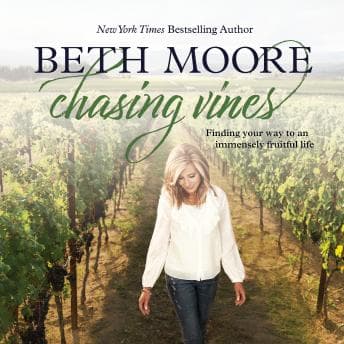
Beth Moore narrates her own book, and I'm going to say something I rarely say: this audiobook would lose at least a full star if someone else read it. Her Southern drawl isn't just accent - it's instrument. There's a warmth in how she lands on certain vowels that turns theological concepts into kitchen-table conversation. When she gets to the emotional passages, her voice doesn't perform grief or joy - it just carries them, the way a river carries whatever falls into it.
The narrator understands that pause is punctuation. Moore knows when to let silence do the work. There are moments where she stops mid-thought, and you can feel her gathering herself, and those pauses communicate more than the words around them. The Christian Book Award for Best Audio Book wasn't charity. She earned it.
At 6 hours and 43 minutes, this is a focused listen. No filler chapters, no padding. I got through it across three lakefront walks and one late-night grading session where the essays on The Great Gatsby were so bad I needed spiritual intervention. (Fitzgerald would have wept. Not the good kind.)
The Manure Chapter Is the One You'll Remember
I won't spoil the full arc, but there's a section where Moore talks about the manure that gets dumped on us - and she means the word literally in the agricultural sense and figuratively in every other sense. It's funny and raw and a little bit undignified, which is exactly right. Twenty years of teaching has taught me that the best lessons come from teachers willing to look foolish. Moore gets that.
My one reservation: if you're not coming to this from a Christian framework, some of the Scripture tracing will feel like it's written for insiders. Moore assumes a level of biblical familiarity that could leave secular listeners feeling like they walked into the middle of a conversation. I've found the Gospel of Matthew: Audio Course & Free Study Guide genuinely useful for filling in that context - it's the kind of thing that makes you a better-prepared listener for books like this one. That's not a flaw, exactly - she knows her audience - but it's worth noting.
Who This Is For (and Who Should Keep Walking)
If you loved Moore's other work, this is arguably her most personal and grounded book in audio form. If you're a person of faith going through a season where everything feels like pruning and nothing feels like fruit - this is the book. Listen at 1.0x. The prose deserves to be savored, and Moore's delivery demands you stay in real time.
If you're looking for academic theology or interfaith exploration, this isn't that. If Southern-inflected Christian memoir makes you squirm, you already know.
The Assignment I'd Give My Students
My students would hate this. I love it. Not because it changed my theology or revolutionized my prayer life - but because it reminded me that metaphor isn't just a literary device. It's how we understand being alive. Moore chases one vine through Scripture, through Tuscany, through her own scarred-up history, and she comes back with fruit in her hands.
Nothing is for nothing. Even the manure. Especially the manure.
Worth pausing the faculty meeting for.