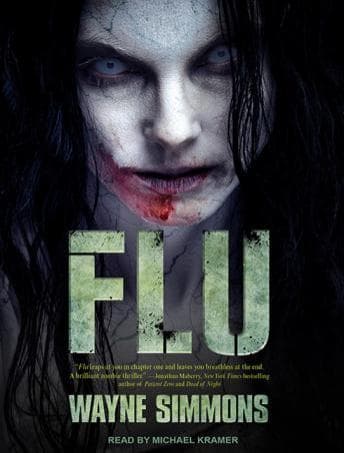

"Cover your mouth when you sneeze, and throw away the tissue." That's the government's public health advice in Wayne Simmons' Belfast-set zombie apocalypse. And honestly? That disconnect between institutional cheerfulness and absolute horror - that's the psychological hook that kept me listening through seven-plus hours of this thing while I was making my grandmother's dal makhani at 10 PM on a Tuesday. Something about stirring a pot for forty minutes while the world ends in your earbuds. Very grounding.
But let me be honest with you. This book and I had a complicated relationship.
The Narrator Is Doing Overtime to Save This Patient
Michael Kramer. You probably know him from Stormlight Archive, Wheel of Time, basically every fantasy audiobook your friend has been begging you to try. The man is an AudioFile Earphones Award winner and an Audie finalist for good reason. His voice here is low, weary, and genuinely unsettling - he sounds like a man who already knows civilization is over and is just going through the motions. That weariness? Perfect for this material. His deliberate pacing turns even mundane scenes into something that makes your skin prickle. He doesn't rush the horror. He lets it settle.
Now, there's a split opinion on his Irish accents - some listeners found them horrid, others didn't mention them at all. I noticed them, sure. Belfast dialogue filtered through an American narrator is always going to have some friction. But Kramer's overall tone is so locked into the creeping dread of this story that I could forgive the accent work. His performance is genuinely the reason to listen to this audiobook. I found myself thinking: if this were a different narrator, would I have finished? Probably not.
Psychologically, This Doesn't Track (And That's the Problem)
Here's where my researcher brain starts filing complaints. The premise is solid - a flu that kills you, then reanimates you, while armed police barricade the infected in their homes. That's a fascinating case study in institutional cruelty versus individual survival. The psychological territory is rich: What happens to social bonds when your government treats you like biohazard waste? How do people form trust when anyone could be infected? State of Terror wrestles with that same institutional-betrayal psychology, and honestly does more with the human cost of it.
Simmons sets this table beautifully. And then... the characters sitting at it are pretty thin.
The protagonist exhibits classic survival-mode behavior, but I kept waiting for deeper motivations to surface. Why does this particular person keep going? What are they protecting beyond their own pulse? The research actually shows that people in extreme crisis situations cling to identity anchors - relationships, beliefs, even routines. The characters here feel more like plot delivery systems than psychological beings. Their dialogue is functional at best, and at worst it reads like placeholder text waiting for a revision that never came.
I found myself asking: why does the author give us this incredibly specific, terrifying premise - the government posters, the armed lockdowns, the two-hour reanimation window - and then populate it with people I can't quite bring myself to care about? It's like building an elaborate haunted house and filling it with mannequins instead of actors.
Some listeners called the characters "trite and unlikable." I'd soften that to underdeveloped. There's a difference. Unlikable characters can be riveting (hello, every Patricia Highsmith protagonist ever). Underdeveloped characters are just... there. Taking up narrative space.
Belfast Burns and Nobody Notices (The Atmosphere Carries the Weight)
What Simmons does well - and Kramer amplifies - is atmosphere. The setting feels claustrophobic and real. Belfast under quarantine isn't glamorous post-apocalyptic territory. It's grim, wet, and ordinary in a way that makes the horror land harder. There's something about the mundanity of the setting that works psychologically. Your brain doesn't get the fantasy escape hatch. This feels like it could happen on your street, which is exactly the point.
The pacing is brisk at under eight hours. No bloat. The story moves, and Kramer's steady delivery keeps the tension from dropping even when the plot hits predictable beats. You know certain things are coming. You know who's going to get bitten. But the delivery makes you flinch anyway.
Who's Going to Catch This Flu
If you want a quick, atmospheric zombie listen and you're okay with characters being secondary to mood and momentum - this works. If you're a Kramer completist, his performance here is genuinely good and worth hearing. But if you need characters with real psychological depth, if you need to understand why people do what they do under pressure - you'll be frustrated. I was.
Apparently the sequel, Fever, is considered stronger. My therapist would have thoughts about me immediately queueing up more zombie content, but I might give it a shot.
The Case File, Closed
A strong premise and an excellent narrator carrying a story that needed one more draft. Simmons understands the horror of institutions failing. He understands atmosphere. He doesn't quite understand his own characters yet. I'm giving this a cautious recommendation with caveats, because that Kramer performance genuinely elevates the material. But the book beneath it? It's a B-minus student coasting on a good presentation.