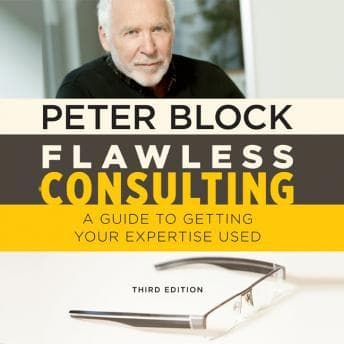

Everyone calls this the 'consultant's bible.' Three decades of editions, a devoted following, Peter Block's name basically synonymous with internal consulting frameworks. So when I queued this up expecting a solid business listen for my Monday morning Caltrain zombie shuffle, I was genuinely surprised by how much the narrator nearly torpedoed the whole experience.
Let me back up.
The Content Is Legitimately Useful (If You Can Get Past the Voice)
TL;DR: Worth your commute — but only if you read the print version or have superhuman patience with narration.
Block's core framework is actually pretty elegant for anyone doing any kind of advisory work, internal or external. He breaks consulting into phases — entry, discovery, feedback, decision to act, engagement, and implementation — and gives you specific language for each. Not hand-wavy "build trust" platitudes. Actual scripts. Like, here's how you contract with a client in the first meeting. Here's how you surface resistance when someone's nodding along but clearly not buying in. Here's the difference between a pair-of-hands consultant, an expert consultant, and a collaborative consultant, and why the third one is the only sustainable model.
The stuff on authentic behavior and naming difficult dynamics in real time? That's gold. It’s the same muscle you build in Crucial Conversations—learning to name the awkward tension instead of side-stepping it. Block has this framework where you literally say "I notice you seem hesitant about this" in client meetings, and he walks through why most consultants dodge that conversation and how it destroys the engagement downstream. As someone who spends half her day trying to get platform teams to actually adopt the tooling my team builds — which is basically internal consulting with extra YAML — this hit home.
The third edition adds sections on virtual communication and electronic distancing, plus two extended case studies in healthcare and education reform. The healthcare example is surprisingly detailed about how consulting skills translate when you're trying to change institutional culture rather than just deliver a recommendation deck. Block argues that the same patterns of resistance — deferring to authority, avoiding vulnerability, treating implementation as someone else's problem — show up whether you're consulting for a Fortune 500 or a school district. He's right.
Erik Synnestvedt and the Sentence-Ending Accent Problem
Okay. Here's where things go sideways.
Erik Synnestvedt has this... thing. He accents the ends of sentences in a way that's hard to describe but impossible to unhear. It's like every statement has a tiny upward lilt or emphasis on the final words that makes declarative sentences sound vaguely like questions? Or like he's reading to a child and checking if they're still following? At 6:15 AM on a packed Caltrain where I'm already fighting consciousness, this cadence became genuinely maddening.
I tried bumping to 1.75x — my usual move for business books that could've been blog posts — and it actually made it worse. The accenting got compressed into this staccato rhythm that was even more distracting. Settled on 1.5x which smoothed it slightly but didn't fix the fundamental issue.
Multiple listeners have described this narration as "plain bad" and "extremely irritating," and I don't think that's unfair. The voice itself isn't terrible — it's a clear, articulate delivery. But the prosody is off in a way that constantly pulls you out of the content. For a book about authentic communication, having a narrator whose delivery feels unnatural is... ironic? Painful? Both.
I actually switched to the Kindle version for two chapters midweek (late night after a deploy, couldn't sleep, figured I'd compare) and the content flowed so much better on the page. Which tells you everything about the audio production.
I ran into nearly the same narration quirk with Values Factor—the upward lilts were relentless there too, and I ended up giving that one 3.5 stars mostly on the strength of the ideas.Who This Is Actually For (And Who Should Run)
Perfect for: Anyone in a support function — internal tools teams, platform engineering, IT, HR, change management — who keeps delivering good work that nobody adopts. Block's framework for why that happens and how to fix it is genuinely practical. The ROI on this audiobook is high if you're in that situation.
Skip for: Anyone who's narrator-sensitive. Seriously. If a weird vocal pattern can ruin a book for you (and for me it almost did), get the print or ebook version instead. The content deserves better packaging.
Also skip if you want a modern, startup-flavored consulting book. This is rooted in organizational development tradition — Argyris, Schein, that whole lineage. It's less "move fast and break things" and more "slow down and name what's actually happening in this room." Which I'd argue is more useful, but it's a different energy.
The 9.5-hour runtime is about 3 hours too long. Block repeats his core concepts across multiple chapters with slightly different framing, which works great in a workshop (his background) but drags in audio. Chapters on implementation felt especially padded.
Save Your Credit, Borrow the Audio, Buy the Book
Here's my honest take: Peter Block wrote a genuinely useful consulting framework that's aged well across three editions. The core ideas about authentic behavior, surfacing resistance, and treating clients as partners rather than problems — that stuff is solid and practical. But this audiobook version is hamstrung by narration that fights the content instead of serving it. I finished it, I got value from it, and I immediately wished I'd just read the paperback.
If you're going to listen, borrow it through Libby. Don't spend a credit. And if Kevin ever asks why I seem annoyed on the train this week — babe, it's the sentence endings. It's always the sentence endings.