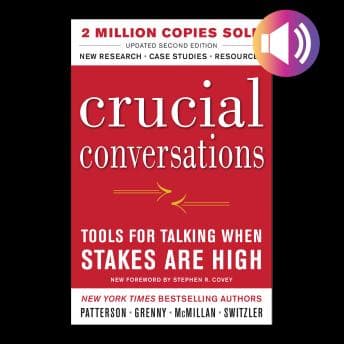

I have a confession. I've been avoiding a conversation with my department chair for three weeks. Three weeks of nodding politely in hallways, crafting elaborate excuses to skip meetings, and rehearsing speeches in the shower that I never deliver. So when I queued up this audiobook while making dal at 10 PM on a Tuesday, I was basically hate-listening. Prove me wrong, self-help book. Tell me something I don't already know about why humans are terrible at talking to each other.
And here's the thing—it actually did.
The Framework That Made Me Put Down My Wooden Spoon
The authors (four of them, which initially made me suspicious—too many cooks and all that) present what they call the "dual processing" model of crucial conversations. When stakes are high and emotions flare, we default to either silence or violence. Not physical violence, but verbal aggression—sarcasm, controlling behavior, labeling. The protagonist exhibits classic fight-or-flight responses, except the protagonist is... everyone. Including me. Especially me.
What makes this compelling is the specificity. They break down exactly how our "stories"—the narratives we construct about others' motivations—drive our emotional responses. You don't just feel angry because your colleague dismissed your idea. You feel angry because you told yourself a story: "She thinks I'm incompetent. She's always undermined me. She's threatened by my success." The research actually shows that separating facts from interpretation is neurologically distinct from simply "calming down." Your amygdala doesn't care about deep breaths if your prefrontal cortex is still spinning villain narratives.
I found myself asking: why do we assume the worst about people we claim to care about? The book's answer—that we judge ourselves by our intentions but others by their behaviors—isn't revolutionary. But hearing it framed as a cognitive pattern rather than a moral failing? That landed differently.
Anna Fields Does the Job (But Just the Job)
Here's where I have to be honest about the audio experience. Anna Fields delivers a competent, professional narration. Clear diction. Good pacing. She handles the business-speak without making it sound like a corporate training video—mostly. Anna Fields is technically capable, but I've heard her bring far more dimensionality to material—her work in Bel Canto genuinely moved me in ways this never approached. But there's no distinctive vocal personality here. No moments where her delivery elevated the material.
At over eight hours, this is not a quick listen. And that length becomes a problem. Some listeners found it outright tedious, and I understand why. The concepts are solid but repetitive—you'll hear the same frameworks applied to different scenarios until you could recite them in your sleep. The lack of chapter markers compounds the issue. I burned my onions because I couldn't find where I'd left off after answering a text. For a book about communication, the audiobook production could use a lesson in user experience.
When Psychology Meets Practicality
The six-minute mastery technique they mention is essentially a pre-conversation mental rehearsal: clarify what you really want, identify your stories, plan your opening. Psychologically, this tracks—it's structured cognitive reappraisal with a behavioral component. My therapist would have thoughts about this framework, and they'd probably be positive.
What I appreciated most was the concept of "mutual purpose." Before entering a difficult conversation, you need to establish—genuinely, not manipulatively—that you're working toward a shared goal. The same words delivered with "I'm here to win" energy versus "I'm here to understand" energy produce radically different neurological responses in your conversation partner. This is where the book earns its keep.
But—and this is a significant but—the examples lean heavily corporate. Performance reviews. Team conflicts. Salary negotiations. The emotional complexity of family dynamics deserves its own framework entirely—something I kept thinking about while reading Mother, which does the messier interior work this book largely sidesteps. The domestic applications feel tacked on, like the authors remembered at the last minute that humans also have families. If you're looking for help navigating conversations with aging parents or estranged siblings, you'll need to do some translation work.
Who This Is (and Isn't) For
This is for people who intellectualize their emotions. If you're the type who needs a framework before you can act—hello, fellow academics—this delivers. The structure gives you something to hold onto when your nervous system wants to either flee or attack.
Skip it if you're looking for warm, empathetic guidance. The tone is pragmatic to the point of clinical. And if you already know you avoid conflict? This book will confirm that, but it won't hold your hand through the emotional work of changing.
The eight-plus hour runtime is where this loses me as a full-price recommendation. The core concepts could easily fit in half that time. You're paying for repetition.
My Prescription
I'm going to talk to my department chair. Tomorrow. I've already identified my story ("She doesn't value qualitative research"), separated it from the facts ("She asked for more quantitative data in my last proposal"), and clarified my actual goal ("I want her to understand my methodology, not capitulate to my ego").
Will it work? I genuinely don't know. But for the first time in three weeks, I have a plan that isn't "avoid and hope it resolves itself."
The book won't transform you. But it might give you the cognitive scaffolding to transform yourself. Wait for a sale or grab it through your library app—the content is worth your time, just not necessarily a full credit.