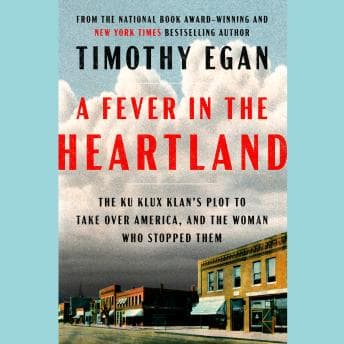

I was up past midnight cleaning my Beretta at the kitchen table - Linda was asleep, Ranger was sprawled across my feet - and I had this playing through my earbuds. Which is maybe the right way to encounter a book about institutional evil: alone, in the quiet, with nothing to distract you from how ugly the truth actually is.
Let me cut to the chase. Timothy Egan wrote something important here, and he narrates it himself with the kind of controlled intensity that makes you forget you're listening to nonfiction. This is the story of D.C. Stephenson, a con man who turned Indiana's KKK into a political machine in the 1920s, and Madge Oberholtzer, the woman whose deathbed testimony brought him down. Worth your time? Absolutely. But be prepared - this one leaves marks.
The Con Man Who Almost Won
Stephenson is one of those historical figures who seems almost impossible until you remember you've met versions of him. I've seen this scenario play out in real life - the charismatic leader who reinvents his biography every time he walks into a new room. Egan tracks how Stephenson arrived in Indiana with a past that changed depending on his audience and within two years became Grand Dragon of the state. The guy recruited through church picnics and family gatherings. Not burning crosses in some backwoods clearing - church picnics. Governors, senators, prosecutors, judges - all wearing the robes.
What Egan does brilliantly is refuse to let you think of this as some fringe movement. He hammers home that this was mainstream American politics. The Klan wasn't hiding in the 1920s. They were running things. Egan builds this picture methodically, layering political endorsements, municipal takeovers, and legislative victories until you realize the scope of what Stephenson assembled. It's not just a character study of one grifter - it's an autopsy of how an entire democratic system got compromised from the inside. Freezing Order documents the same rot in a different century and a different country - powerful men using institutional machinery to bury inconvenient truths - and the parallel is uncomfortable in exactly the right way.
Madge Oberholtzer Deserved Better Than History Gave Her
And then there's Madge. A young state education department employee who crossed paths with Stephenson and paid for it with her life. I won't sugarcoat it - the account of what Stephenson did to her is brutal. Sexual assault, kidnapping, sustained violence. Egan doesn't sensationalize it, but he doesn't flinch either. The right call.
Her deathbed testimony - and Egan reads this section with a restraint that somehow makes it hit harder - is the pivot point of the whole book. Here's a woman who knew she was dying and chose to make sure the truth survived her. That kind of courage isn't the loud, dramatic kind you see in movies. It's the quiet, deliberate kind. The hardest kind. I've known soldiers with that sort of resolve, and it's rare.
The author clearly did their homework. Egan's research into the legal proceedings, the political maneuvering to suppress Madge's testimony, the way powerful men circled wagons - it reads like a thriller but every word of it actually happened. That's what makes it so effective and so infuriating.
Egan Behind the Mic
Here's something I didn't expect: Egan narrating his own work actually works. A lot of authors shouldn't read their own books. They've got the knowledge but not the voice. Egan has both. His pacing through the darker passages is precise - he doesn't rush through the violence, doesn't linger on it either. He knows when to let a fact just sit there.
Is it a "performance" in the way a professional narrator would deliver? No. You won't get distinct character voices or dramatic vocal shifts. What you get is a journalist telling you exactly what happened with the authority of someone who spent years digging through the records. For this material, that's better. I listened at my usual 1.25x and it felt right - Egan's natural cadence is measured but not slow.
At 10 and a half hours, the length matches the scope. There's no padding here. Every chapter advances either the political machinery or Madge's story, and when those threads converge, you feel it.
Who Needs to Hear This
Anyone who thinks they understand American history but skipped the 1920s Klan. Anyone who assumes hate movements only thrive in the margins. History buffs, true crime listeners, people who liked Erik Larson's work - you'll find the same immersive research here but with sharper teeth.
Skip this if you need a palate cleanser right now. This is not comfort listening. Content warnings are real: sexual assault, racist violence, and the casual cruelty of institutional power.
Ranger and I Concur - Mission Accomplished
I sat at that kitchen table long after the book ended. Ranger eventually gave up waiting for me to move and went to his bed. Some books you finish and think "that was good." This one you finish and think "that was necessary." Egan took a chapter of American history that too many people don't know about and made it impossible to ignore. Madge Oberholtzer deserved to be remembered, and now she will be. Ranger approved this one.





![Steve Jobs [unabridged audiobook] audiobook cover](/_next/image?url=https%3A%2F%2Fcovers.audiobooks.com%2Fimages%2Fcovers%2Ffull%2F9788499923406.jpg&w=1920&q=75)