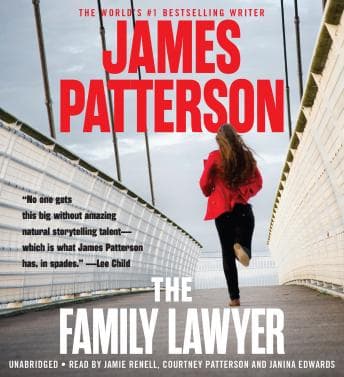

What happens when you take three stories, hand them to three different co-authors, but run them all through a single narrator who sounds like she's about to chew through drywall?
That's the question I kept asking myself somewhere on I-35 between Austin and San Antonio, Ranger riding shotgun, both of us trying to figure out why Jamie Renell was so angry. Not intense. Not urgent. Angry. Like someone cut her off in traffic before every recording session. It's a strange choice for material that actually calls for range - you've got a father defending his daughter against a bullying accusation, a troubled NYPD detective hunting a sniper, and a woman caught between loyalty to her sister and a murder investigation. Three distinct emotional registers. One tone throughout.
But I'm getting ahead of myself. Let me cut to the chase - this is a middling Patterson collection that could've been decent road listening if the narration hadn't fought the material so hard.
Three Stories Walk Into a Bar (Only One Buys a Round)
The title novella - "The Family Lawyer" co-written with Robert Rotstein - is actually the strongest of the three. Matthew Hovanes is a criminal defense attorney whose daughter gets accused of driving another kid to suicide through bullying. That premise grabbed me because I've sat across from parents dealing with impossible situations involving their kids, and the desperation Patterson and Rotstein capture here feels genuine. The legal maneuvering is competent enough, and the "something doesn't add up" thread keeps pulling you forward. For a short-form story, the characters have enough weight to them that you actually care what happens. It's not deep, but it works.
"Night Sniper" with Christopher Charles is where things go sideways. The setup - NYPD's best detective versus a random-pattern killer - is standard thriller fare, and in Patterson's hands you'd expect it to at least move fast. It does move fast. Problem is, the narration here goes from angry to aggressively angry, and the detective's "troubled" backstory feels more like a checklist than a person. Cheryl Mabern is supposed to be brilliant and damaged, but she reads more like a character sketch someone forgot to finish. And the narrator's approach to this particular story... look, I've listened to some rough performances, but this was the section where I genuinely considered switching to music. Multiple listeners have flagged this exact story as the weak link, and they're right. Face is a crime novel that actually gets the damaged-detective character right - the internal wreckage shows up in the work, not just in backstory bullet points, which makes the contrast here sting even more.
"The Good Sister" by Rachel Howzell Hall redeems the collection somewhat. The sister-loyalty-versus-justice dilemma has real teeth to it. Dani Lawrence discovering her brother-in-law is dead and watching her sister become the prime suspect - that's classic crime fiction territory, and Hall writes it with more personality than the middle entry. The question of how far you'd go to protect family is one that doesn't have a clean answer, and the story is smart enough not to give you one.
The Narration Problem You Can't Unhear
Here's my frustration with Renell's performance: she's not bad in the traditional sense. No mispronunciations that made me wince, no weird pacing issues, no audio artifacts. The production is clean. But tone is everything in audio fiction, and when your narrator delivers three distinct stories with three distinct emotional landscapes in essentially the same register - somewhere between irritated and furious - you lose the texture that makes audiobooks worth choosing over print.
First story? The anger almost works. You can read it as a father's barely contained rage at watching his daughter get accused. Third story? You can squint and see it as a sister's fury at an impossible situation. But the second story needed something different - calculation, dread, the clinical detachment of a detective who's seen too much. Instead you get more anger. It's like ordering three different meals and getting hot sauce on all of them.
I ran this at 1.25x as usual, and honestly the increased speed helped smooth some of the narration's rough edges. The stories are short enough that the pacing stays tight even when the writing gets thin.
Who Gets Value From This Mission
If you're a Patterson completist or you want something light enough for a commute that won't punish you for missing thirty seconds at a stoplight, the first and third stories deliver. If you're looking for substantial mystery-thriller work - the kind that keeps you up past midnight - this isn't it. And if narration tone matters to you (it should), know what you're walking into.
Worth your time? Here's the debrief: two out of three stories carry their weight, but one narrator handling all three with a single emotional setting drags the whole package down. At 10 hours, it's not a huge time commitment, but it's not one I'd spend a credit on either. Ranger slept through most of it, which tells you something.
File Under: Adequate But Not Mission-Critical
Patterson's brand is efficiency - get in, get the hook, get out. That works here in print terms. But the audiobook format demands a narrator who can shift gears, and this one's stuck in third. Borrow it, stream it, listen while you're doing something else. Don't pay full price.