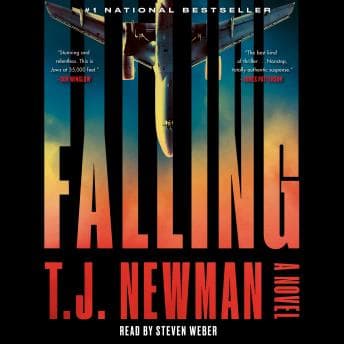

What would you actually do if the only way to save your family was to kill 143 strangers? Not as a trolley problem in a philosophy seminar. In real time, at 35,000 feet, with someone watching your every move.
I started Falling during a late-night cooking session - I was making my mother's dal makhani, which requires approximately forty minutes of stirring and zero mental bandwidth. By the time the lentils were ready, I had completely forgotten to eat them. I was standing in my kitchen, wooden spoon in hand, cold dal going to waste, entirely too invested in whether Captain Bill Hoffman was going to crash a plane.
That's the kind of book this is.
The Impossible Math of Loving People
Here's what T.J. Newman actually understands that a lot of thriller writers don't: the psychology of an impossible choice isn't about the choice. It's about the person making it. Bill Hoffman isn't an action hero. He's a pilot who coaches Little League and has a wife named Carrie and a son named Scott, and the kidnapper - a man named Rat who is doing this for reasons that are genuinely not cartoonish - has made the math very simple. Your family or the plane.
The protagonist exhibits what I'd call motivated moral paralysis - he's not frozen because he can't decide, he's frozen because every decision is wrong and his brain keeps running the calculations hoping the answer changes. The research actually shows that in genuine ethical dilemmas, the prefrontal cortex and the amygdala essentially fight each other, which is exactly what Newman dramatizes, even if she doesn't name it that way. Bill's internal logic is coherent. That's what makes it agonizing.
The structure cuts between the plane and the location where his family is being held, which in lesser hands would diffuse tension. Here it compounds it, because you're watching two clocks run simultaneously and neither outcome is acceptable.
I found myself asking: why does Rat, specifically, feel like a real antagonist rather than a plot device? And I think it's because Newman - former flight attendant, which explains the procedural accuracy that makes your stomach drop - gives him a comprehensible grievance. Not a sympathetic one. Comprehensible. There's a difference, and most thriller writers don't bother with it.
Steven Weber Is Doing Actual Work Here
Single narrator, 8.5 hours, no musical score, no sound design. Just Weber and the text. This is either going to work or it isn't.
It works.
What I noticed specifically: Weber doesn't exaggerate. When Hoffman receives the FaceTime call from the kidnapper - one of the scenes that will make you grip whatever you're holding - Weber plays it with this controlled, barely-contained quality that's more frightening than if he'd gone full panic. The authoritative pilot register he uses for Hoffman doesn't disappear when Hoffman is terrified. It cracks. Slowly. That's a performance choice, not just reading words.
The character differentiation is credible without being theatrical. You always know who's speaking. The pacing in the tension sequences is genuinely calibrated - he slows down exactly when you want him to speed up, which is the correct instinct.
No audio issues. Clean production. Nothing to complain about technically, which sounds like faint praise but isn't - a bad narrator could have made this book unlistenable.
I heard that same ability to crack slightly without breaking in Weber's narration of I Am Not Who You Think I Am, a thriller that also hinges on identity and trust.Psychologically, This Tracks (Mostly)
I'll be honest: the plot is not unpredictable. If you've watched enough action films - and I grew up on Bollywood, so I have watched a statistically improbable number of action films - you can see certain structural beats coming. My therapist would have thoughts about why I kept listening anyway. Something about the difference between knowing an outcome intellectually and experiencing it emotionally.
The book earns its tension not through surprise but through specificity. Newman knows what a cockpit actually looks like, what pilots actually say to each other, what the inside of a plane smells like during an emergency. That granular accuracy makes the impossible scenario feel possible, which is the only trick that matters in this genre. The same commitment to procedural truth is what makes Kiss the Girls work, though Patterson trades cockpit details for forensic profiling—and the result is equally gripping if you're in the mood for a different kind of countdown.
Is it Dostoevsky? No. Is it a debut thriller that kept me standing in my kitchen with a wooden spoon for an hour past when I should have eaten dinner? Yes. Those are different metrics and both are valid.
Who This Is For (And Who Should Skip)
If you want moral complexity with your adrenaline - read it. If you want aviation procedural detail that actually holds up - read it. If you want a narrator who understands that restraint is more frightening than histrionics - listen to it.
If you need your thrillers to be genuinely unpredictable, or if you're the kind of reader who gets frustrated when genre conventions are honored rather than subverted - this will test your patience. The ending is satisfying in the way that a well-executed formula is satisfying. That's not an insult. It's just accurate.
Eight and a half hours. One sitting if you're not careful. Don't start it if you have anything important to do afterward.