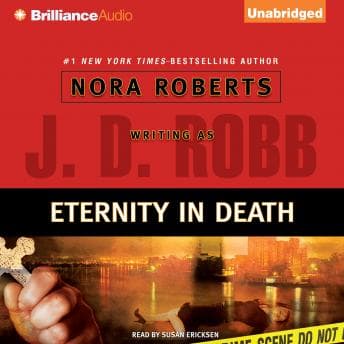

Everyone kept telling me the In Death series is comfort food — reliable, satisfying, don't think too hard. And look, I get it. Fifty-plus books in, you know what you're getting. But here's the thing: I came to Eternity in Death expecting popcorn and got a surprisingly sharp little character study wrapped in a vampire cape. Not a literal vampire cape. (Well. Sort of literal.)
I was chopping onions for a chana masala at 9 PM on a Tuesday — the kind of evening where you need something in your ears that won't demand your full attention but also won't insult your intelligence. At three and a half hours, this novella is basically a single cooking session. Perfect length.
The Psychology of a Wannabe Predator
So the setup: Tiara Kent, wealthy club kid, found dead with puncture wounds on her neck. The suspect calls himself a vampire. Eve Dallas, our lieutenant protagonist, is having absolutely none of it. What I found myself asking: why does Robb bother with the supernatural framing at all when she clearly has no intention of making this paranormal? And the answer hit me around the second hour — it's not about vampires. It's about the psychology of predatory charisma.
The killer in this story exhibits classic narcissistic personality patterns. He's constructed an entire identity — the Dark Prince persona — designed to seduce, isolate, and control. He targets wealthy young women who are bored enough to find danger romantic. The research actually shows that this kind of identity construction is textbook for certain types of serial offenders: they build mythologies around themselves because the mythology gives them permission. Robb gets this. The "vampire" angle isn't supernatural horror; it's a case study in how predators use mystique as a weapon.
And Eve's reaction is what sells it. She's annoyed. Not scared, not fascinated — annoyed. Because she sees through the performance immediately. Her cops are buying garlic, the media is losing its mind, and Eve is just... tired. That's psychologically honest. The best investigators I've read about in true crime literature share that quality: an almost aggressive pragmatism that cuts through the theater surrounding violent crime.
Ericksen Knows This Woman's Bones
Susan Ericksen has been voicing Eve Dallas for decades at this point, and you can tell. This isn't a narrator performing a character — this is someone who has internalized how Eve thinks. The irritation in Eve's voice when she's dealing with the vampire hysteria feels bone-deep and specific. When Eve shifts to speaking with Roarke (her billionaire husband, because of course), Ericksen drops into something warmer but still guarded, like Eve can't fully let go of the cop brain even in intimate moments.
The character differentiation is solid across the board — Eve's clipped delivery versus Peabody's slightly softer cadence, the oily smoothness Ericksen gives the suspect. I wouldn't say any single voice is a showstopper, but the consistency across what must be an enormous character library at this point? That's craft. My one mild complaint: at standard speed, the pacing in the middle investigation section felt a touch leisurely for a novella. I bumped to 1.25x and it tightened up nicely — gave it the urgency the story wanted.
What Makes This Character Compelling Is What She Won't Do
Eve Dallas is interesting to me as a psychologist because she's a protagonist defined by refusal. She refuses to be charmed. She refuses to entertain the supernatural explanation. She refuses to soften her approach for the victim's wealthy, connected family. In a lesser writer's hands, this would make her flat — just a tough-cop archetype. But Robb layers in these small moments where you see what the toughness costs. There's a brief exchange with Roarke where Eve's frustration with the case bleeds into something more personal, something about vulnerability and the people who exploit it. It lasted maybe thirty seconds. It was the best part of the book.
This is a fascinating case study in how a long-running series character can still surprise you in a novella-length story. You don't get the full emotional range of a novel, but you get a concentrated dose of who Eve is.
Who Gets the Most Out of This
If you're already in the In Death universe, this is a fun snack between meals. If you've never read the series — honestly, this isn't a bad entry point. It's short enough that you're not committing to a whole world, and it gives you a clean sense of Eve's psychology and her dynamic with Roarke. Skip it if you need complex plotting; this is character-driven all the way, and the mystery itself is more straightforward than twisty.
Anyone who's studied how cults and predatory figures construct personas will find the villain uncomfortably recognizable. My therapist would have thoughts about this character. Several thoughts. Whispers in the Dark goes to a similarly uncomfortable place with its central antagonist — that same constructed mystique, that same deliberate targeting — and I found it stuck with me for the same reasons this one did.
Case File: Closed, Satisfied
Three and a half hours, one good villain, one great protagonist, and a narrator who's been doing this long enough to make it look effortless. I finished right as my chana masala did. Both were exactly what I needed on a Tuesday night — sharp, warm, and over before I could overthink them.