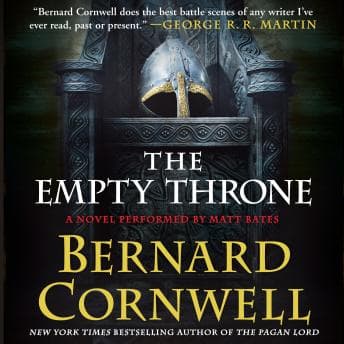

Look, I have a complaint. Eight books into the Saxon Tales and Cornwell still has me staying up way past when I should be working on my thesis. This is a problem. My advisor wants chapter drafts, and I'm over here listening to Uhtred scheme his way through tenth-century Mercia like it's somehow more important than my academic career. (It is. Don't tell Dr. Patel.)
So here's the deal with The Empty Throne - it's basically a succession crisis wrapped in shield walls and political maneuvering, and honestly? My D&D group would eat this up. Æthelred dies without a legitimate heir, everyone's scrambling for power, and Uhtred's backing Æthelflæd for the throne of Mercia. A woman ruler in Saxon England. The drama practically writes itself.
The Generational Shift That Actually Works
Cornwell does something interesting here that I've seen fantasy authors bungle a hundred times - he's aging up his cast. Uhtred's getting older. His kids are stepping into the story. And instead of feeling like a desperate grab to keep a series going, it actually works? The political landscape is shifting, new Vikings are raiding from Ireland, and there's this palpable sense that the old guard is making way for something new.
This is Sanderson-level world-building, except it's real history. A Short History of Nearly Everything gave me that same feeling of learning complex systems without realizing I was being taught. The magic system is chef's kiss - and by magic system I mean the web of Saxon politics, oaths, and the constant tension between Christian and pagan worldviews. Cornwell never info-dumps, but by book eight you understand exactly why a broken oath matters more than a lost battle.
Matt Bates Behind the Mic
Okay, so here's where I gotta be honest - I couldn't find a ton of background on Matt Bates online. What I can tell you is that his narration is solid. Really solid. He's got this smooth, engaging delivery that keeps the 11-hour runtime from ever feeling like a slog. Character differentiation is good - you can track who's speaking in dialogue-heavy scenes without getting lost, which matters when you've got Saxons, Danes, and various scheming nobles all talking over each other.
Some reviewers have mentioned his accent choices don't always land perfectly for the British and Irish characters. I get that. But honestly? It didn't pull me out of the story. The pacing is well-balanced - he knows when to let tense moments breathe and when to push through action sequences. Not Steven Pacey levels of narrator godhood, but Bates clearly understands the material and serves it well.
Where This Fits in the Saga
If you're jumping in at book eight - don't. Just don't. Start with The Last Kingdom and work your way here. The payoff of watching Uhtred's journey unfold, of seeing Æthelflæd grow from a political pawn into a genuine leader, that's earned through seven previous books of setup. This isn't a standalone.
But if you're already invested in the series? This is Cornwell doing what Cornwell does best. Shield walls. Political intrigue. Uhtred being simultaneously the smartest and dumbest man in any given room. The question of whether Saxon warriors can accept a woman ruler isn't treated as a simple yes-or-no - it's messy and complicated and feels historically grounded.
The TV adaptation (The Last Kingdom on Netflix) covers this territory too, so if you've watched the show, you'll recognize the broad strokes. But the books go deeper. Way deeper. The internal monologue, Uhtred's sardonic observations about Christian hypocrisy, the small character moments that get cut for runtime - it's all here.
Who's Rolling Initiative on This One
If you're into historical fiction that reads like epic fantasy, or you're a fantasy reader looking for something grounded in real history, this series delivers. Skip it if military fiction bores you or detailed battle tactics make your eyes glaze over - Cornwell loves his shield walls. Loves them.
But for me? I'll take Uhtred's sardonic narration over my thesis committee any day. The progression is satisfying in that way where you finish and immediately want more. Yes, it's 11 hours. Yes, it's worth it. I'm already eyeing book nine.
(I really need to graduate.)