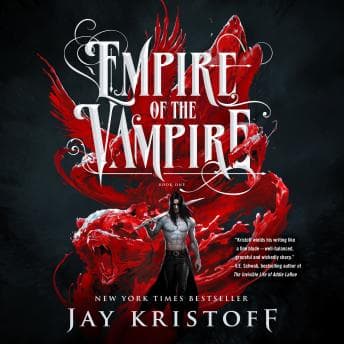

"The last sunrise was twenty-seven years ago."
That line hit me somewhere around hour two, packed into a 6:47 AM Caltrain, surrounded by fellow zombies clutching their coffees like holy relics. And I thought: yeah, that tracks. This is basically Interview with the Vampire meets The Witcher, except Gabriel de León makes Geralt look like a well-adjusted optimist.
27 Hours Is a Feature, Not a Bug
Let me be real with you: this audiobook is almost 28 hours long. That's roughly two weeks of my commute, or one particularly brutal on-call rotation. Jay Kristoff does not believe in brevity. The man wrote a 700-page vampire epic with a framing device where our protagonist is literally imprisoned and forced to tell his life story to his captors.
And somehow? It works.
The structure bounces between Gabriel's present-day interrogation and his past—training with the Silver Order, hunting vampires when the sun still existed, losing everything that mattered. Silverthorn uses a similar dual-timeline approach, though with considerably less existential dread. Kristoff layers these timelines like a distributed system with eventual consistency. You're getting fragments, building the picture, and by hour 15, the pieces start clicking together in ways that made me miss my stop. Twice.
But here's the thing nobody tells you: this is a slow burn. Glacially slow at points. If you're expecting non-stop action, you'll be frustrated. The ROI on this audiobook is backloaded—the first third is setup, worldbuilding, establishing Gabriel as the most bitter, broken vampire hunter you've ever met. The payoff comes later, and it's substantial, but you need patience.
Damian Lynch and the Art of Exhausted Rage
I've seen some listeners complain that Lynch's narration is "monotone." And I get it—if you're expecting the theatrical energy of a Tim Gerard Reynolds or Steven Pacey, you might be disappointed. But here's my take: Gabriel de León is a man who has watched humanity lose a 27-year war against vampires. He's imprisoned. He's probably going to die. The monotone IS the character.
Lynch nails the weary cynicism. His Gabriel sounds like a guy who's seen too much and stopped caring about impressing anyone. The moments where emotion breaks through—and they do happen—hit harder because of that baseline exhaustion.
What really impressed me: the sword. Gabriel's blade has... personality, let's say. Lynch's depiction of it is genuinely unsettling—there's this edge to his voice when the sword "speaks" that made me look up from my phone on the train, slightly creeped out. The research wasn't kidding about "especially creepy and compelling."
Character differentiation is solid but not showstopping. You can tell who's speaking, the accents are consistent, but this isn't a full-cast production. It's Lynch carrying 28 hours on his shoulders, and he does it with the kind of steady competence that keeps you engaged without ever becoming distracting.
The Vampire Problem (And Why It Works Anyway)
Look, we've all consumed approximately 47,000 vampire stories at this point. The genre should be exhausted. Kristoff knows this, and he leans into it hard—his vampires are genuinely monstrous, the religious iconography is cranked to eleven, and the world-building has this grimdark aesthetic that could easily tip into parody.
It doesn't. Mostly because Gabriel is such a compelling mess of a protagonist. I've seen that same kind of beautifully broken character work in Into the Forest, though in a completely different setting. He's arrogant, self-destructive, and makes terrible decisions for understandable reasons. The forbidden love subplot (you knew there'd be one) actually has stakes—pun absolutely intended—because Kristoff doesn't pull punches on consequences.
Content warning for the squeamish: this gets dark. Violence, sexual content, the whole grimdark package. Not a bedtime listen unless you want weird dreams.
Who Should Spend Their Commute Here (And Who Shouldn't)
Perfect for: Long commutes, road trips, anyone who loved The Name of the Wind but wished it had more vampires and less music theory. If you're a fan of dark fantasy that takes itself seriously without becoming self-important, this is your jam.
Skip if: You want something quick, you need constant action to stay engaged, or you prefer theatrical narrators. Also maybe skip if you're burned out on chosen-one narratives—Gabriel is special in the way fantasy protagonists always are, though Kristoff at least makes him earn his suffering.
The opening musical score is a nice touch—sets the mood without overstaying its welcome. Production quality is clean throughout, no weird audio artifacts or jarring transitions.
Final Commit: Worth the Runtime
I finished this over three weeks of commutes, listening at 1.5x (my standard for anything over 20 hours). At that speed, the pacing felt right—deliberate but not draggy. The slower sections became meditative rather than tedious.
Is it perfect? No. Is it a hell of a ride that made my Mountain View commute feel almost too short? Yeah. Yeah, it is.
The sequel's already in my queue. Kevin's going to have to deal with me muttering about vampire politics for another month.