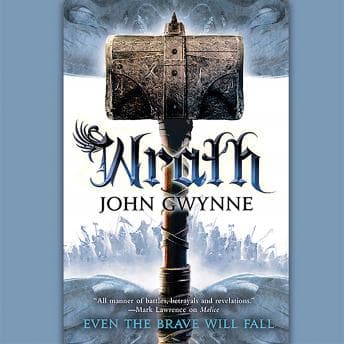

John Gwynne wrote a series finale that hits like a warhammer to the chest, and I mean that as the highest compliment.
I was three hours deep into Wrath during a late-night coding session — supposedly debugging a procedural terrain generator for my thesis, actually just staring at a terminal while the Banished Lands burned around me. My code didn't get written. Corban's story got finished. Dr. Patel would not approve. I regret nothing.
Giants Riding Bears Into Battle Is Peak D&D Energy
Let me just say: Corban getting captured by the Jotun — warrior giants who ride enormous bears — is the kind of setup that would make my old D&D group lose their minds. This isn't some throwaway monster encounter. Gwynne actually takes the time to build out the giant factions, their competing loyalties, and the political tension Corban has to navigate while literally being a prisoner. It's diplomacy at swordpoint, and it works because Gwynne earned those relationships over the previous three books. The progression is satisfying. You feel Corban's growth from uncertain young man to someone who can stand in a room full of hostile giants and command respect — not through power fantasy shortcuts, but through genuine character development.
And the war itself? This is Sanderson-level world-building in terms of scale. Nathair holding Drassil with three of the Seven Treasures, Calidus and Queen Rhin scheming alongside him, the threat of Asroth's demon-horde breaking through from the Otherworld — Gwynne is juggling maybe eight or nine POV threads and somehow keeps them all moving toward collision. The battle sequences are relentless, especially in the back half. If you don't like info-dumps, this isn't for you (but you're wrong). Some listeners have said the action overload toward the end gets overwhelming, and yeah, I can see that — there's a stretch where it's basically wall-to-wall carnage for hours. But honestly? For a series called The Faithful and the Fallen, where the whole arc has been building toward an apocalyptic confrontation between good and evil, I wanted that payoff. I wanted the chaos. It delivered.
Gwynne's clearly a David Gemmell disciple, and it shows in the best way. The honor-and-sacrifice ethos, the shield walls, the moments where a character makes a stand knowing they probably won't survive it. There's a rawness to the violence here that feels earned rather than gratuitous. This is dark fantasy with a moral backbone.
Damian Lynch Finally Owns This Series
Okay, so Damian Lynch. Here's the thing — by book four, he's clearly settled into these characters. One listener quote I saw nailed it: "Lynch has full control on the narration now." And that's accurate. His pacing is locked in. The energy stays high across 23+ hours, which is no small feat. His Corban feels distinct from his Nathair, and his emotional delivery during the big dramatic beats — deaths, betrayals, last stands — genuinely lands.
But. There are accent choices that are... puzzling. Some characters get voices that feel like they wandered in from a completely different world. It's not dealbreaking, but there were a couple of moments where I pulled off my headphones and went "wait, why does that character sound like that?" It's the kind of thing that'll bother you if accent consistency is your thing, and won't matter much if you're locked into the story. I was locked in, so I mostly let it slide.
The other knock: shouting scenes sometimes go flat. When a character is supposed to be roaring a battle cry or screaming in fury, Lynch occasionally delivers it in this controlled, almost monotone register. Steven Pacey walked so other narrators could run, and Pacey would've torn those moments apart. Lynch is good — genuinely good — but there's a ceiling on his intensity in those peak-emotion beats. The full-cast approach in Good Omens: A Full Cast Production reminds me how much a narrator's range matters when the material demands emotional extremes — different format, but the same lesson applies.
Who's Rolling Initiative on This One
If you've read the first three books in the Faithful and the Fallen, stop reading this review and go listen. The payoff is worth it. Yes, it's 23 hours. Yes, it's worth it.
If you haven't started the series — don't start here, obviously. Go back to Malice. But know that the series rewards patience. Gwynne builds slowly, plants seeds early, and harvests them across four books.
If you're coming from Sanderson, Gemmell, or GRRM and want something with that same scope but maybe a bit more straightforward good-vs-evil structure? This is your lane. My D&D group would love this — it's basically a campaign that went to level 20 and actually stuck the landing.
Skip if you can't handle extended battle sequences or if wonky character accents are going to pull you out. And definitely skip if you need a light listen — this is heavy, violent, and demands your attention.
The Thesis Can Wait Another Day
I listened to this instead of writing my thesis, and I'd do it again. Gwynne closed out this series with exactly the kind of epic, bloody, emotionally satisfying finale it deserved. Lynch's narration isn't flawless, but it's strong enough to carry you through 23 hours of war without losing the thread. The Banished Lands feel real. The stakes feel earned. And that ending — I sat in my apartment at 2 AM with my headphones on, staring at the ceiling, just processing. That's what a good series finale should do.