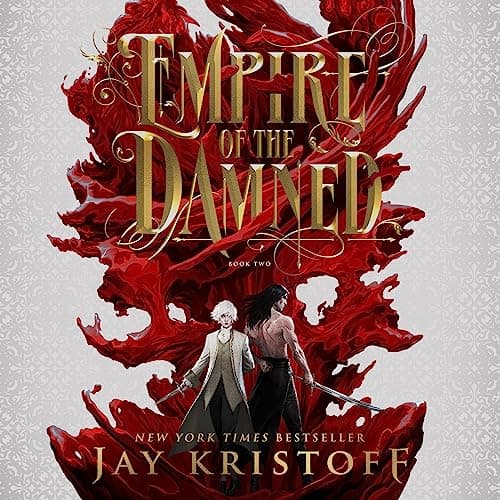
How long does a living thing hold on to what it is once the light's gone?
I asked myself that on the ridge above the cabin last January. I was lying on a foam pad well below zero with my headlamp off, waiting on an aurora forecast that turned out to be mostly wishful thinking. I got a pale green smear low on the northern horizon for maybe twenty minutes. Then nothing. Just dark, the creak of lodgepole in the cold, and Damian Lynch in my ears as Gabriel de León, sounding about as worn through as my fingers felt.
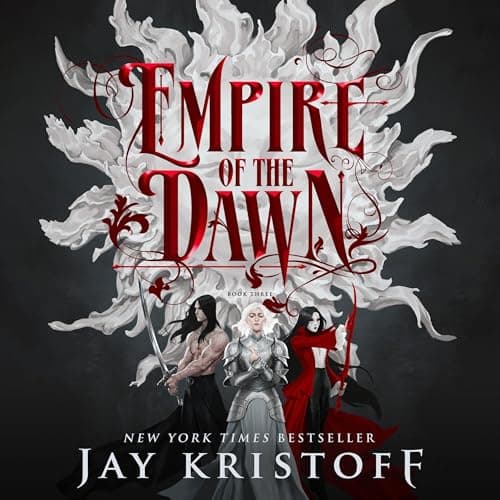
Fitting company. Empire of the Damned is set in a world where the sun quit, and it's the second leg of a very long walk. I've since kept walking the trail into Empire of the Dawn.
Kristoff cares more about blood than biomass
Here's my bias, up front. When a story kills the sun, my brain goes straight to the food web. No light means no photosynthesis, which means no forage and no prey base, and then everything downstream unravels. Fast. I want to feel that starving in the soil and the herds, not just in the people.
Kristoff isn't that writer. Not really. His endless night is a stage for vampire bloodlines: the Voss hunting Gabriel, the Dyvok at war with the duskdancers of the frozen Highlands, and the ancient Esani waiting at the end of the road with some truth about how Daysdeath might be undone. The cold reads as real cold. The ecology of a sunless continent just isn't the point.
And honestly? I made peace with that pretty early. What he does care about, he cares about ferociously. The engine here is Gabriel's own rising bloodlust, a man escorting something holy while the thing inside him gets hungrier. The Grail is a she, not a cup, and the whole book leans on the dread that whatever she learns about herself might be worse than anybody's ready for. That's a better hook than a lot of fantasy sequels manage. The uneasy alliance with Liathe gives the story friction, too. You never quite relax around her (I didn't, anyway).
Lynch sounds like the end of a long carry, and Shute holds the line
This is where the audio earns its keep. Lynch plays Gabriel with grit under the cadence and real exhaustion threaded through it, like a guy who's been hauling a heavy pack uphill for three days and has stopped pretending otherwise. The confessional passages, where Gabriel is telling his story rather than living it, carry a low, steady dread. That suited a black ridge at night almost too well. I heard that same worn-down, long-haul weight in Lynch's work on Wrath.
Shute takes Liathe's half of the confession, and she plays it low and controlled, with steel under the hush. You can hear the uncertainty haunting underneath it, which is exactly the right note for a narrator you're never sure you can trust.
One real snag. When perspectives overlap, a character voiced by one narrator can sound subtly different when the other picks them up. It's not a disaster. But a few times it jolted me out of the story, the way a trail marker you swear was on the left suddenly shows up on the right. Dual-narrator productions this long almost always pay that tax somewhere, and this one pays a little.
Thirty-one hours and thirty-four minutes in the middle of the trail
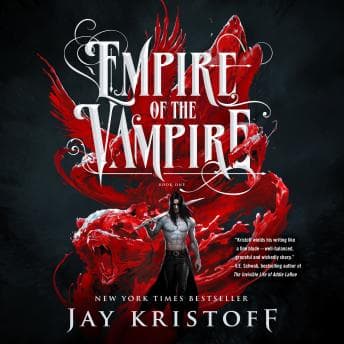
The runtime is 31h 34m, and I listened at 1.0x like I always do. That's a season of evenings, not a weekend. It's also a middle book. Bridge books carry the weight without handing you the summit view, and some listeners feel a real drop-off from Empire of the Vampire. I understand the complaint. A middle volume this size has to move pieces across the board (the Grail, the bloodlines, the Highland war) without closing much, and there are stretches where you feel the distance more than the destination.
But the action hits hard when it comes. Be warned: the violence is brutal, sometimes genuinely harrowing. Kristoff doesn't flinch, and neither does Lynch. If the first book's gore sat badly with you, this one won't go easier.
The bonus conversation between Kristoff and Joseph Morgan at the end works as a decent cooldown after that much blood. It's worth sticking around for if you like hearing how the sausage gets made. One thing audio can't give you: Bon Orthwick's illustrations, which are part of the print edition. If the art matters to you, the hardcover is worth a look alongside the audio.
Who should pack this one out
You'll get the most from this if you finished Empire of the Vampire hungry for more and you're willing to spend thirty-plus hours on a bridge volume that builds dread rather than resolving it. You'll also do well if a dual-narrator structure appeals and you don't mind the occasional wobble in character voices at the handoffs. If you came in hoping a sunless world would be treated as a real, collapsing ecosystem, you'll be disappointed, because the dark is a mood here, not a system. And if graphic violence wears you down, or you want each book to land on its own, I'd think twice before spending a credit.
Walking down in the dark
The aurora never really showed that night. I walked back down by feel, the snow squeaking, with Gabriel still muttering his confession in my ears, and I didn't turn him off until the stove was lit. A book doesn't have to get the ecology right to get the cold right. This one gets the cold right.