
"Social science affirms that woman's place in society marks the level of civilization."
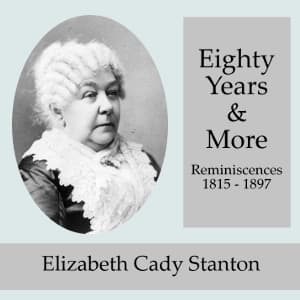
That's how Elizabeth Cady Stanton opens her memoirs. No preamble. No apology. Just a thesis statement that would get her canceled and celebrated in equal measure today. I was grading a stack of junior essays on The Scarlet Letter—ironic, given Stanton's thoughts on Puritan morality—when I started this, and by hour three I'd abandoned the red pen entirely.
This is why we still read the classics. Or rather, listen to them.
The Voice of a Revolution, Filtered Through Volunteers
Here's the thing about LibriVox recordings: they're labors of love, not professional productions. And that matters with a memoir this sprawling. Fourteen hours and forty-eight minutes of one woman's life, read by volunteers who donate their time because they believe these words deserve to be heard.
The narration is clear. Easy to follow. The reader (credited to Becky Miller in the summary, though LibriVox projects often involve multiple volunteers) approaches the text with the kind of earnest respect that suits Stanton's formal Victorian prose. But this isn't a performance in the theatrical sense—it's a reading. A faithful, careful reading. If you're expecting the kind of characterization where Susan B. Anthony sounds different from Lucretia Mott, adjust those expectations now.
What you get instead is something almost documentary. The words carry themselves. And Stanton's words? They're more than capable.
Eighty Years of Refusing to Sit Down
Stanton was born in 1815. Let that sink in. Napoleon had just been exiled. Madison was president. And here's this woman who would live to see the telephone, the automobile, and—though she died before it happened—would lay the groundwork for the Nineteenth Amendment.
The memoir spans her childhood in Johnstown, New York, her education (remarkable for a woman of her era), her marriage to abolitionist Henry Stanton, and decades of organizing, speaking, and frankly exhausting herself in service of rights she would never fully see realized. The dedication to Susan B. Anthony—"my steadfast friend for half a century"—isn't performative. Their partnership runs through every chapter like a second narrative thread.
But here's what surprised me, walking the lakefront with Denise on a Saturday morning while Stanton recounted her adventures in Europe: this isn't a dry political treatise. The woman is funny. Sharp. Occasionally petty in the most human way. She describes male politicians with the kind of precise, devastating observations my students would call "throwing shade." She talks about raising seven children while running a social movement like it was just... life. (It was just life. Her life.)
Victorian Prose That Rewards Patience
I listened at 1.0x. My students think I'm ancient for this, but Stanton wrote in the formal register of her time, and rushing through it strips the rhetoric of its power. These were speeches before they were pages. You can hear the cadence of a woman who knew how to hold a crowd.
The chapters on the Seneca Falls Convention alone are worth the time investment. Stanton doesn't just recount what happened—she recreates the arguments, the hesitations, the moment when Frederick Douglass stood up to support women's suffrage when others wavered. This is primary source material, delivered by someone who was there.
At fourteen-plus hours, this is a commitment. Some sections drag—the European travelogues, while historically interesting, don't carry the same urgency as the organizing years. But I found myself returning to it during faculty meetings (sorry, Principal Martinez, but Stanton's account of battling the New York legislature was more engaging than the budget discussion), during late-night grading sessions, during the kind of quiet moments where you want company but not distraction.
History Teachers, This One's Yours
If you teach American history, women's studies, or—like me—literature that engages with the question of who gets to speak and who gets silenced, this is essential listening. It's free on LibriVox and Archive.org, which means there's no financial barrier.
Skip it if you need polished production values, celebrity narration, or a tight three-hour listen. This is archival. Historical. A woman who died in 1902 speaking directly to you across more than a century. My students would probably struggle with the Victorian formality. But I'm assigning excerpts anyway.
Mr. Williams's Final Bell
Stanton ends her memoir still fighting. Still organizing. Still, at eighty-two, refusing to accept that the work was finished. She didn't live to vote. Neither did Susan B. Anthony. They knew they wouldn't. With the Old Breed captures that same quality—ordinary people doing extraordinary things knowing full well they might not live to see the outcome.
They did it anyway.
Hemingway said courage was grace under pressure. Stanton's version was louder, longer, and involved a lot more petitions. The narrator understands that pause is punctuation—the reading lets the weight of these moments land without rushing toward the next chapter.
For anyone who wants to understand how change actually happens—not in single dramatic moments, but in fifty years of committee meetings, speeches, and stubborn refusal to be quiet—this is the document. It's imperfect. It's long. It's occasionally self-congratulatory in the way memoirs tend to be.
It's also irreplaceable. Becoming gave me that same sense of witnessing history through the eyes of someone who shaped it—Michelle Obama's memoir has the polish Stanton's lacks, but both women understood that their stories belonged to something larger than themselves.





![Steve Jobs [unabridged audiobook] audiobook cover](/_next/image?url=https%3A%2F%2Fcovers.audiobooks.com%2Fimages%2Fcovers%2Ffull%2F9788499923406.jpg&w=1920&q=75)