
"The Return to Sender laser weapon." I actually paused the audiobook when that name dropped, took off my headphones, and stared at the lake for a solid thirty seconds. Denise asked if I was okay. I told her I was processing a fictional missile defense system named like an Elvis Presley song. She went back to her walk. I went back to listening.
Look — I came to this one sideways. A colleague in the social studies department recommended The End series because he knows I have a weakness for apocalyptic fiction (I teach Revelation alongside Yeats's "The Second Coming" every spring, much to my students' confusion). And Tim LaHaye's name carries weight whether you're a fan of the Left Behind books or not. So I figured: eleven hours, Stefan Rudnicki narrating, a 2011 Audies Finalist. Let's see what this is.
A Techno-Thriller Wearing Eschatological Clothes
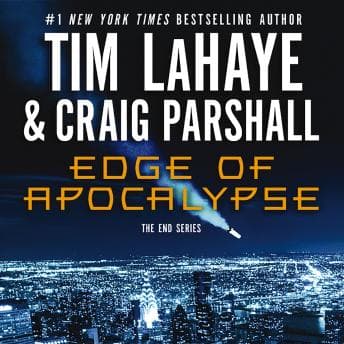
Here's what Edge of Apocalypse actually is: it's a Tom Clancy novel that went to Bible study. Joshua Jordan is your standard-issue military hero turned weapons genius — former spy-plane pilot, jaw like a granite shelf, the kind of guy who calls senators by their first names. The plot machinery involves his Return to Sender defense system, a corrupt White House trying to seize the technology, and a shadowy group of Christian power brokers called the Patriots who operate like a faith-based Illuminati. There's geopolitical chess involving North Korea, backroom Capitol Hill deals, and a family subplot where Jordan's marriage and his son's faith crisis are supposed to humanize all the military-industrial machinery.
The political conspiracy stuff actually works in stretches. Parshall — who's the DC insider of this writing duo — clearly knows how congressional hearings and media manipulation function, and those sections have a specificity that kept me engaged during my late-night grading sessions. But the theological layer sits on top of the thriller like a sermon stapled to a screenplay. Characters don't arrive at faith through doubt and struggle the way they do in, say, Dostoevsky or Graham Greene. They arrive at faith because the plot needs them to. This reminds me of what Hemingway said about prose — the dignity of an iceberg is that only one-eighth shows above water. I kept thinking about Redeeming Love, which leans into the same faith-first storytelling but earns its emotional moments because the characters actually bleed before they believe. Here, the iceberg is fully above the surface, labeled, and comes with a pamphlet.
My students would hate this. I... didn't hate it. But I had to adjust my expectations.
Rudnicki's Baritone Does Heavy Lifting (Sometimes Too Heavy)
Stefan Rudnicki has one of those voices that sounds like it was aged in a bourbon barrel. Deep, rich, authoritative. When he's handling the international espionage scenes — the North Korean missile launch sequence, the congressional testimony — his measured pace and slight accent lend the material a gravity it might not earn on the page. AudioFile wasn't wrong that the international element benefits from his delivery.
But here's the problem: that same deliberate pacing turns action sequences into slow-motion replays. There's a chase sequence mid-book where Jordan is evading surveillance, and Rudnicki narrates it with the same unhurried gravitas he brings to the Senate hearing scenes. The narrator understands that pause is punctuation — but not every sentence needs a period where a comma would do. And his character differentiation is minimal. Subtle tone shifts, sure, but when you've got Jordan, his wife, his rebellious son, a North Korean general, and various senators all sounding like variations of the same deep baritone, your brain has to work harder than it should to track who's talking.
That said — and this genuinely surprised me — the last hour pulls everything together. The emotional stakes finally catch up to the geopolitical ones, and Rudnicki's restraint pays off. He's been holding back for ten hours, and when the climax hits, the shift in his delivery is subtle but real. Like he was saving something. I finished the final chapter walking past Montrose Harbor at sunset, and I'll admit: the landing was better than I expected.
Who This Is Really For
If you loved Left Behind and want the same eschatological framework with a modern techno-thriller chassis, this delivers exactly that. If you're coming from the literary fiction side of things — if you want your apocalyptic fiction with the moral ambiguity of Cormac McCarthy or the psychological depth of Station Eleven — this isn't your book. It's not trying to be. It's a first installment in a four-book series, and it reads like one: setup-heavy, character-introducing, cliffhanger-ending. The prose deserves to be — well, the prose is functional. It moves you from scene to scene. It's not asking to be savored so much as consumed.
I'd also say this requires dedicated listening. Rudnicki's pace means you can't drift in and out — lose a paragraph during a faculty meeting and you've missed a plot turn. (Not that I would know anything about listening to audiobooks during faculty meetings, Principal Martinez.)
A speed bump to 1.25x wouldn't hurt here, and I don't say that lightly.
Worth Pausing the Faculty Meeting For? Almost.
This is a competent genre thriller with a specific audience and a narrator whose strengths don't always align with the material's demands. The conspiracy plotting kept me listening. The theology kept me skeptical. And Rudnicki's final hour kept me honest about the whole experience — because just when I was ready to write it off, the man reminded me he's a professional. First book in a series, so expect threads left dangling. Whether you pick up Thunder of Heaven depends on how much patience you've got left — and how much you trust LaHaye's roadmap to Revelation.