
I spend ten hours a day debugging distributed systems. So listening to a book about humanity destroying all computers because they got too smart? That's not science fiction; that's a fantasy I have every time PagerDuty goes off at 3 AM.
I listened to this entire 24-hour beast on the Caltrain—mostly during that dead zone between Redwood City and Menlo Park where the Wi-Fi drops and I can't refresh Jira anyway. And honestly? It hit the spot.
The Scott Brick Factor (A Warning)
Let's address the elephant in the room first. You either love Scott Brick or you think he sounds like a depressed robot reading a eulogy. (Though if you want to hear him narrate something with actual robots—and dinosaurs—Jurassic Park is a wild ride.) There is no middle ground.
(Kevin, my boyfriend, refuses to listen to anything Brick narrates. He says it sounds "too important." He's wrong, but whatever.)
Here's the thing—for a space opera this massive? You need that gravity. Brick treats every sentence like it's the last transmission from a dying planet. Yeah, sometimes it's a bit much when he's just describing a wall, but when the cymeks (giant cyborg killing machines) are tearing things up, his delivery lands. If you're used to full-cast productions, he might feel dry. Give it an hour. I cranked him up to 1.6x speed, and the pacing smoothed out perfectly. At 1.0x? You might fall asleep. At 1.6x? It's hypnotic.
Frank vs. Brian: The Vibe Shift
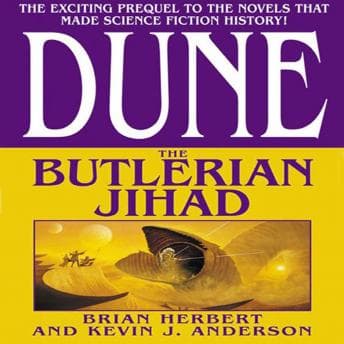
Let's be real. This is not Frank Herbert's writing.
Frank's original Dune is dense code. It's philosophy wrapped in sand. You have to pause it to think. Second Foundation lives in that same philosophical space—Brick narrates that one too, and it's equally brain-bending. Brian Herbert and Kevin J. Anderson? They wrote an action movie script.
And honestly? That's exactly what I needed for a commute.
I love the original series, but at 6 AM on a Tuesday, I don't always have the brainpower to deconstruct the geopolitical ramifications of the spice trade. Sometimes I just want to hear about Serena Butler starting a revolution because the machines killed her kid. It's plot-driven, fast (despite the runtime), and not trying to be smarter than it is. It fills in the gaps—like why the Atreides and Harkonnens actually hate each other—without requiring a PhD in fictional history.
The Ultimate Technical Debt
The whole premise—humanity rising up to smash their machine overlords (Omnius and Erasmus)—is basically the most aggressive bug fix in history.
As someone who works in tech, the "Butlerian Jihad" feels like what happens when you ignore legacy code for too long and the only solution is to burn the server room down. The story jumps between characters—Xavier Harkonnen (who is surprisingly heroic, which is a weird twist given the later books), Vorian Atreides, and the Sorceresses of Rossak.
Just a heads up on the timeline: The title is slightly misleading. This book is the start of the war. It's the inciting incident. If you're waiting for the final showdown (the Battle of Corrin), you're gonna have to wait for book three. This is the setup, the spark, and the initial chaos. It drags a little in the middle—classic trilogy setup issues—but seeing the origin of the feud kept me hooked.
Who's This For (And Who Should Skip)
If you want deep philosophy, go re-read the original. If you want a massive, sprawling space war that explains the backstory of the Bene Gesserit and Mentats while you sit in traffic? This is the one. Skip it if you can't handle Scott Brick or need your Dune dense and literary.
Just maybe don't listen to it near your Alexa. She might get ideas.