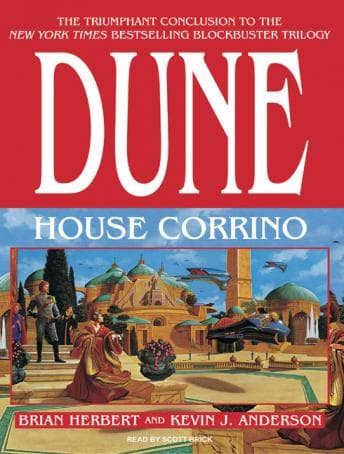

What happens when you give the keys to someone else's universe to two authors who clearly love the source material but can't quite match its DNA?
I've been sitting with this question for about six commutes now - 24 hours of Scott Brick in my ears, weaving through Shaddam's paranoia, Leto's grief, Jessica's quiet defiance. I finished the Prelude to Dune trilogy not with a bang but with a sort of... satisfied shrug? And honestly, that's both the best and worst thing I can say about House Corrino.
The Synthetic Spice Problem (Both In-Universe and Meta)
There's an almost too-perfect irony here. The central plot revolves around amal - synthetic melange manufactured in Ixian labs to replace the real thing from Dune. And that's kind of what this entire prequel trilogy is: a synthetic version of Frank Herbert's spice, competently manufactured, occasionally hitting those same neural pathways, but never quite producing the prescient visions of the original.
But look - I'm an engineer. I respect solid execution even when the architecture isn't revolutionary. Brian Herbert and Kevin J. Anderson do something genuinely useful here: they build out the political infrastructure of the Imperium in a way that makes Frank's original Dune land harder when you eventually (re)read it. Shaddam's desperation to consolidate power through amal, his willingness to literally destroy the only source of natural spice - it retroactively enriches why the Emperor is so threatened by Leto in the original novel. The ROI on this audiobook is better understood as "investment in the broader Dune experience" rather than standalone value.
The liberation of Ix storyline gives Leto something to do besides brood, and Rhombur's arc - a prince rebuilt with prosthetics leading a revolution to reclaim his homeworld - has this earnest pulp energy that I found weirdly charming at 6:15 AM somewhere around Millbrae. The Jessica pregnancy thread is the strongest emotional throughline, though. Knowing she's carrying Paul, knowing the Bene Gesserit wanted a girl, knowing what this boy will become - that dramatic irony does real work even when the prose itself reads more like expanded universe tie-in than literary fiction.
Scott Brick: The Emperor's Voice
Okay, so here's where it gets polarizing. Scott Brick narrates this the same way he narrated the first two Prelude books - animated, committed, consistent. His Shaddam has this clipped imperial impatience that works perfectly for a man who's terrified of irrelevance. His Baron Harkonnen leans into theatrical menace without going full cartoon villain (mostly). The political scenes - and there are SO many political scenes - benefit from his ability to shift register between Bene Gesserit cold calculation and Atreides nobility without losing the thread.
But I get why some people bounce off him. 24 hours is a LOT of single-narrator sci-fi, and Brick's style is... present. He's not invisible the way some narrators are. If his cadence doesn't click for you by hour two, you're in for a rough ride. I happen to like his energy for this material - he treats it seriously, which it needs, because the writing itself occasionally veers into soap opera territory and a less committed narrator would expose that.
(He's no Ray Porter. But then, who is.)
Where the Distributed System Has Race Conditions
The pacing issues are real. This book juggles maybe seven or eight POV threads, and not all of them earn their runtime. The Tleilaxu scheming scenes blur together after a while - how many times can we watch them be sinister in a lab? And there are moments where the plot requires characters to make decisions that feel driven by "we need to set up Frank's Dune" rather than by organic character logic. It's the prequel trap: you know where everyone ends up, so the tension has to come from the how, and sometimes the how feels like it's checking boxes.
There are also continuity quibbles that'll bug hardcore Dune fans. The book introduces elements that don't perfectly align with Frank Herbert's canon, and whether that bothers you depends entirely on how much you treat the original six books as sacred text. I'm somewhere in the middle - I noticed the seams but didn't lose sleep over them. (I lose sleep over production incidents, not fictional spice economics.)
At 1.5x speed, this clocks in around 16 hours. Manageable. But I'd say the middle third could've been tightened by about three hours without losing anything essential.
Perfect for: Dune completionists with patience. Skip for: anyone who hasn't read the originals.
If you've read Dune and want more universe-building while your brain is in autopilot mode on public transit, this delivers. If you're a Frank Herbert purist who gets angry about canon deviations, save yourself the frustration. And if you haven't read the original Dune yet - what are you doing here? Go listen to that first.
I finished this in 6 commutes, which means it saw me through one particularly brutal on-call week. It wasn't transcendent. It wasn't a waste. It was a solid piece of franchise fiction that does its job: it made me want to re-listen to the original Dune. That same "franchise fiction that earns its place" feeling hit me with Towers of Midnight too — another late-series installment carrying the weight of a much larger mythology, where the payoff is less about the book itself and more about what it sets up for the finale. And honestly? For a prequel, that might be the highest compliment.